Why Bat Length Is More Consequential Than Most Players Think
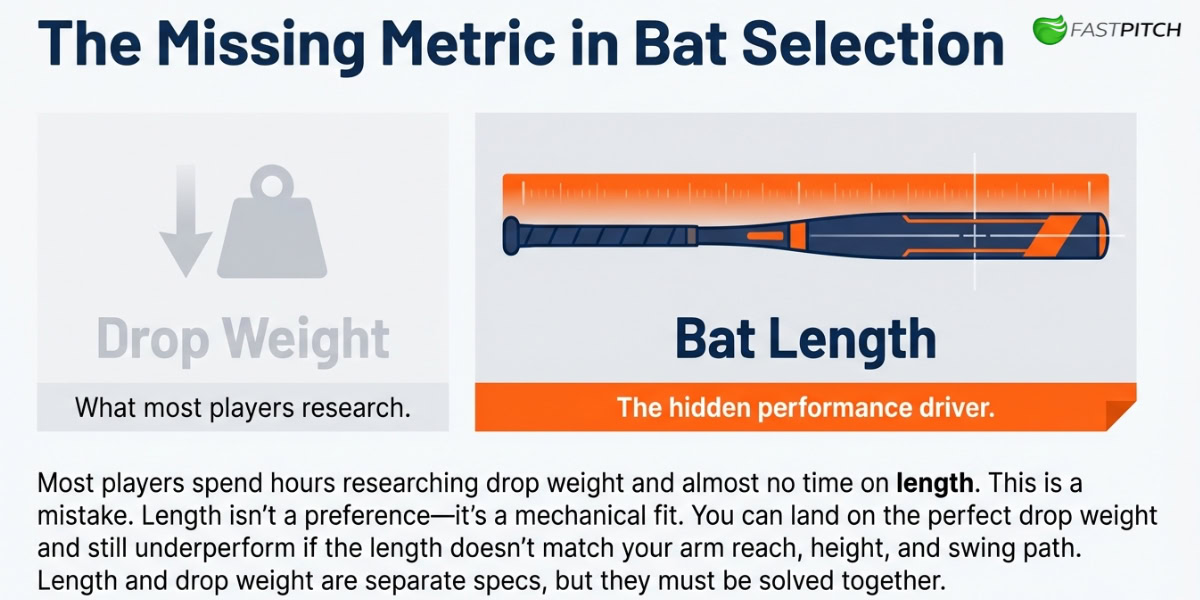
Most players spend a lot of time researching drop weight and almost no time thinking about length. That’s a mistake — and it shows up in games in ways that are hard to diagnose.
A bat that’s even an inch too long changes your relationship with inside pitches. The barrel arrives slightly later, you lose the ability to get your hands inside the ball, and pitchers who throw inside start owning you. A bat that’s too short leaves part of the plate uncovered. Pitches on the outer third get shorter, weaker contact, or misses; you shouldn’t be missing.
Length isn’t a preference. It’s a mechanical fit.
Here’s the other thing most buying guides skip: bat length and drop weight affect each other. You can land on the perfect drop and still underperform if the length doesn’t match your arm reach, height, and swing path. They’re separate specs, but they need to be solved together.
If you haven’t nailed down your drop weight yet, start with our fastpitch bat drop weight guide before coming back here — both decisions are easier when you make them in the right order.
How Bat Length Actually Affects Your Swing
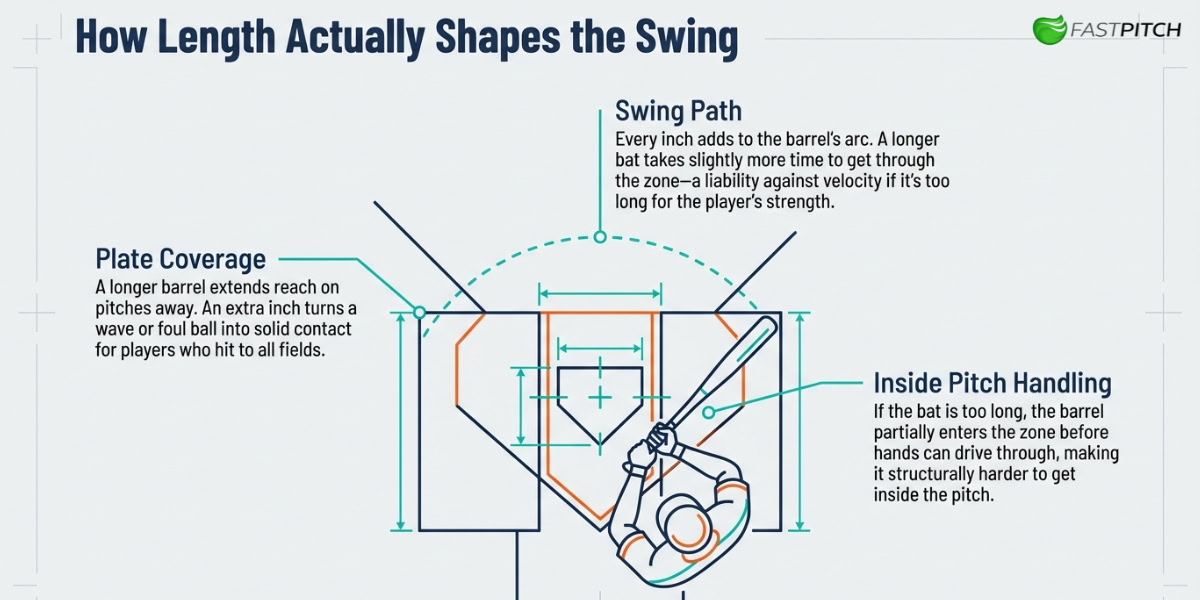
Before getting into numbers, it’s worth understanding the mechanics. Length isn’t just about reach. It shapes three things:
Plate coverage. A longer barrel extends your reach on pitches away. For players who hit to all fields and rely on covering the outer half, an extra inch of barrel makes a real difference on pitches they’d otherwise foul off or wave at.
Swing path. Every inch of length adds to the arc your barrel has to travel. A longer bat requires slightly more time to get through the zone. For most players, this is manageable — but if your bat is two inches too long for your strength level, that arc becomes a liability against velocity or late movement.
Inside pitch handling. This is where bat length causes the most visible problems. A bat that’s too long makes it structurally harder to get your hands inside a pitch thrown at the inner half. The barrel is already partially through the zone before your hands can drive through, and you end up rolling over or jamming yourself, even on pitches you should handle.
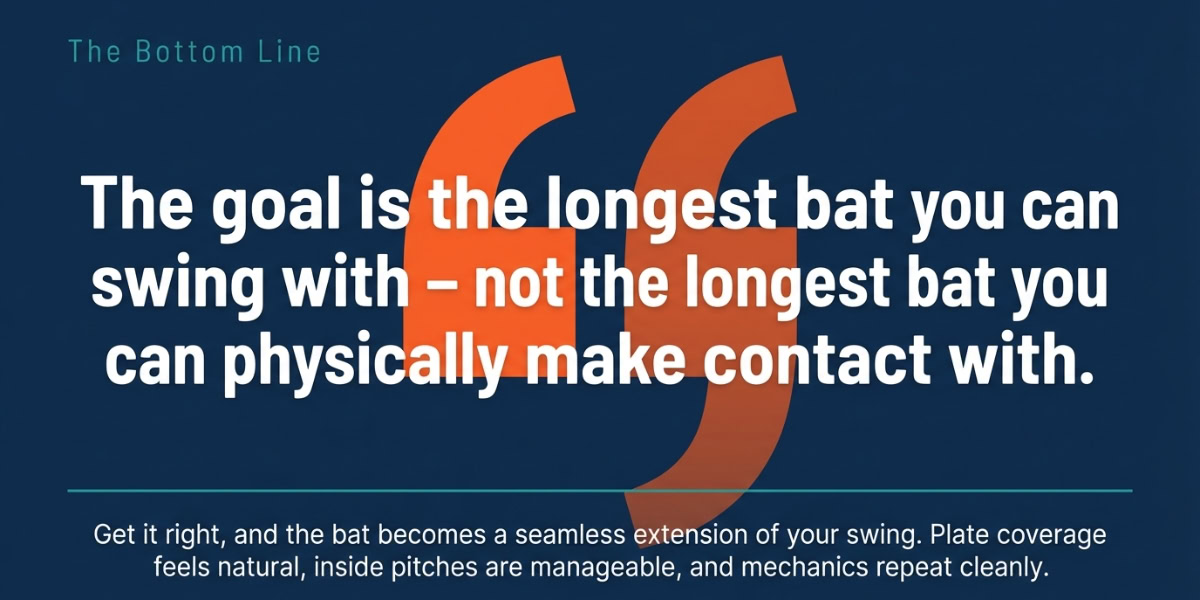
The goal is the longest bat you can swing with your best mechanics — not the longest bat you can physically make contact with.
Quick Takeaway
Fastpitch bat length is the measurement of the bat from knob to barrel end, expressed in inches. It directly affects plate coverage, swing arc, and inside pitch handling. The correct length is the longest bat a player can swing with clean, repeatable mechanics.
Fastpitch Bat Length by Age and Size: Reference Chart
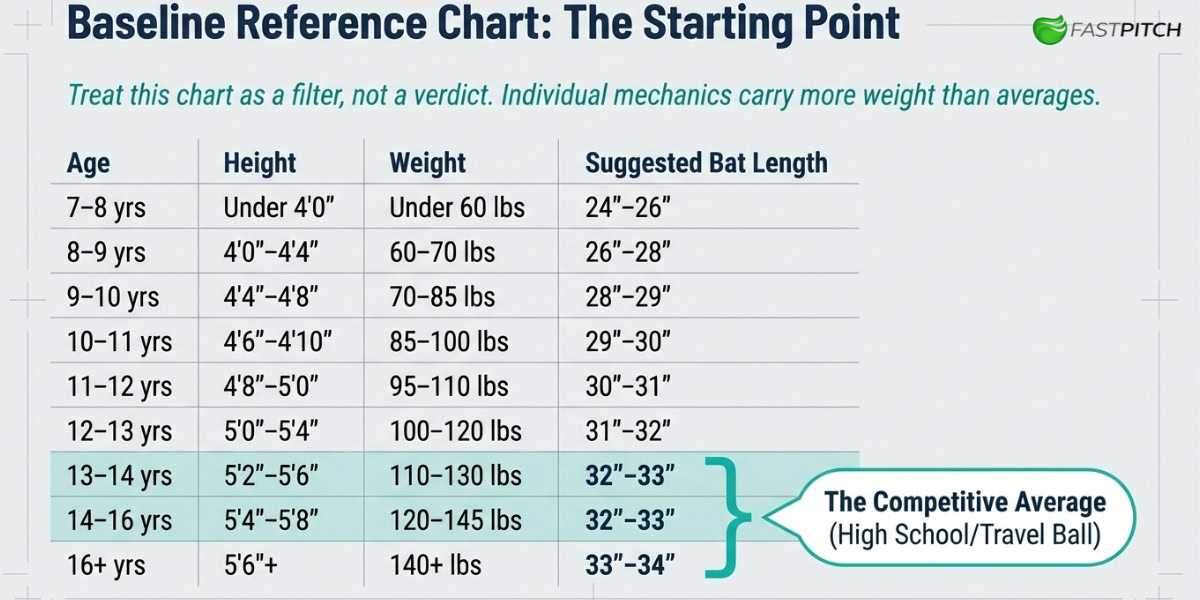
This chart gives recommended starting-point lengths based on age, height, and weight. Treat it as a filter, not a verdict — individual mechanics, arm length, and strength always carry more weight than any chart.
Fastpitch Bat Length · Sizing Chart
Starting points — mechanics always override age| Age | Height & Weight | Recommended Length |
|---|---|---|
| 7–8 | Under 4'0" · Under 60 lbs | 24"–26" |
| 8–9 | 4'0"–4'4" · 60–70 lbs | 26"–28" |
| 9–10 | 4'4"–4'8" · 70–85 lbs | 28"–29" |
| 10–11 | 4'6"–4'10" · 85–100 lbs | 29"–30" |
| 11–12 | 4'8"–5'0" · 95–110 lbs | 30"–31" |
| 12–13 | 5'0"–5'4" · 100–120 lbs | 31"–32" |
| 13–14 | 5'2"–5'6" · 110–130 lbs | 32"–33" |
| 14–16 | 5'4"–5'8" · 120–145 lbs | 32"–33" |
| 16+ | 5'6"+ · 140+ lbs | 33"–34" |
Bat Length Decision · Step-by-Step
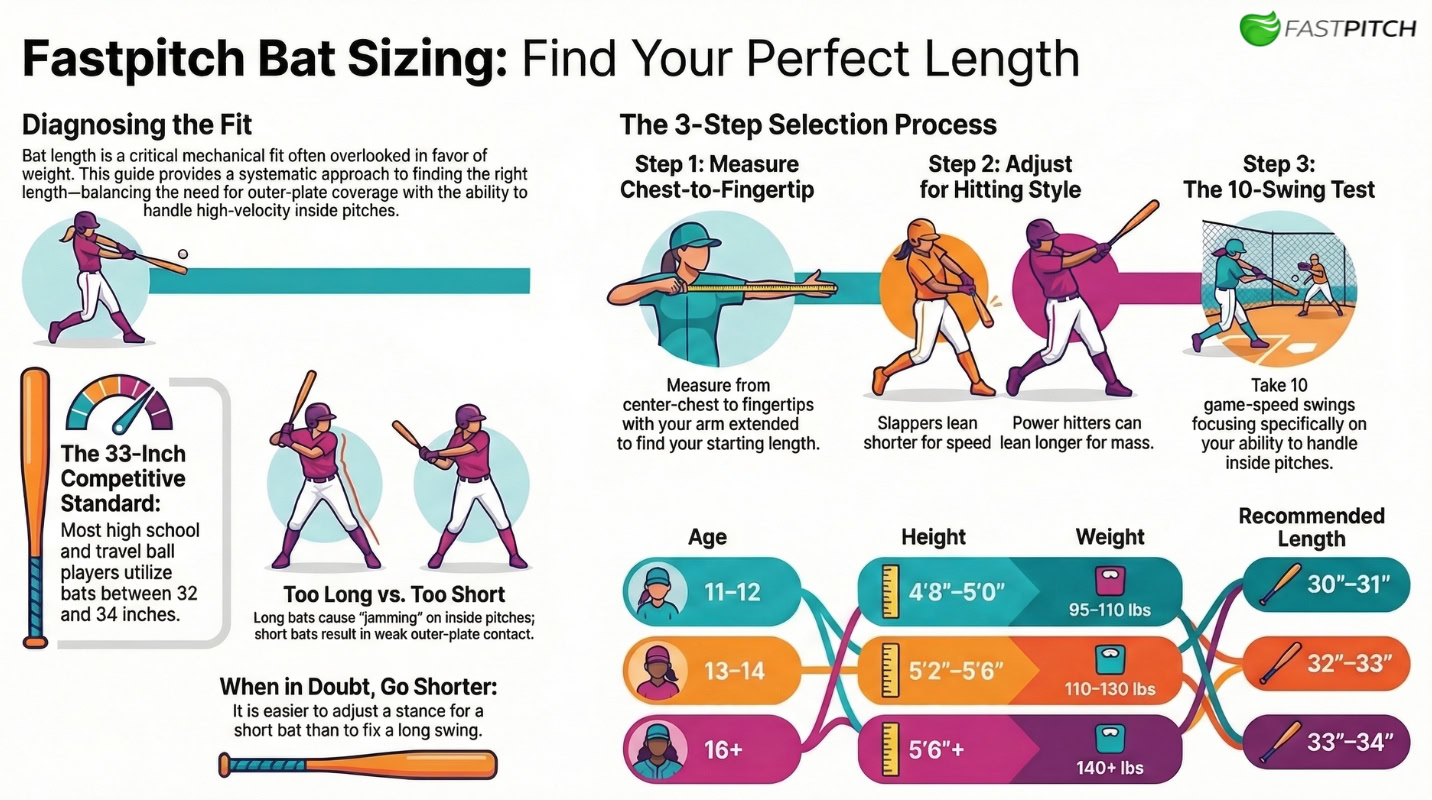
Identify your 1–2 inch range based on age, height, and weight. Most high school players fall between 32 and 34 inches.
Use the chest-to-fingertip method to find your baseline length in inches. This confirms where you sit inside your chart range.
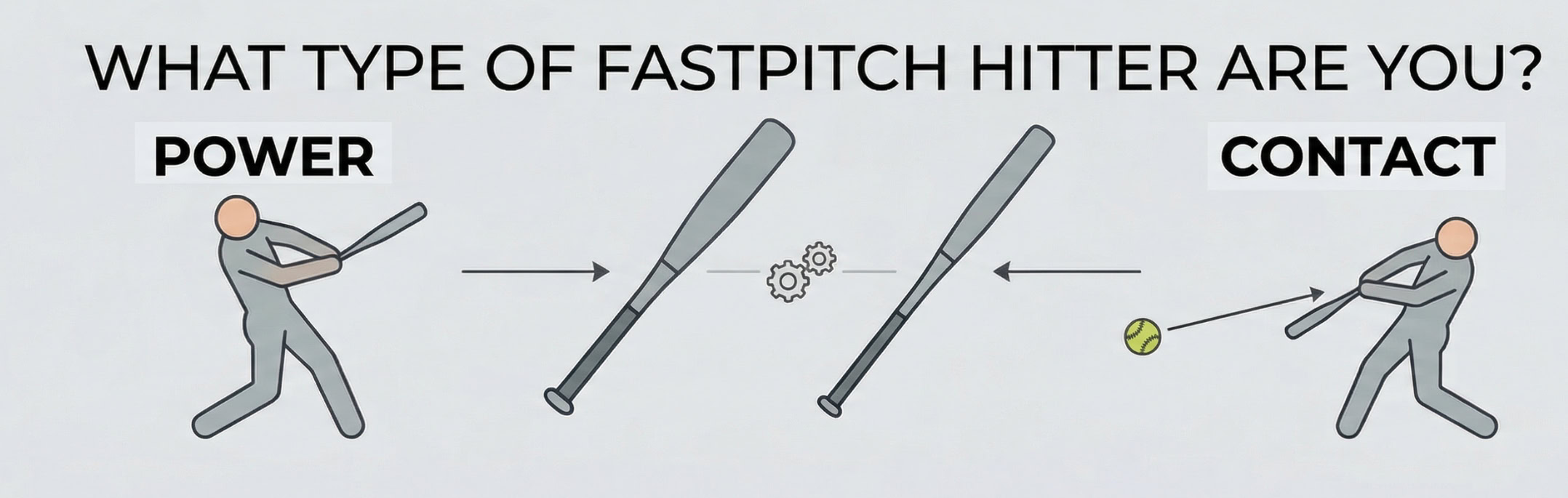
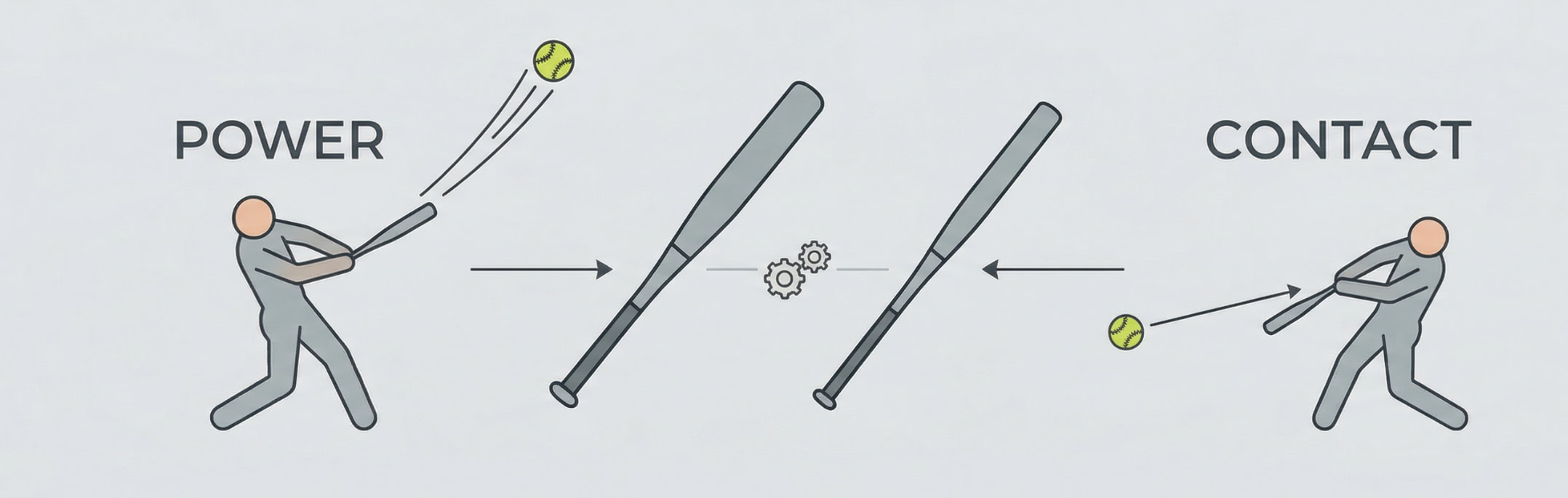
Contact hitters and slappers should choose the shorter end of their range. Power hitters with strong mechanics can test the upper end.
Take 10 full-speed swings focusing on inside pitches. If you consistently jam yourself, go shorter. Slightly short is safer than slightly long.
Quick Takeaway
To determine what length softball bat you need, start with a fastpitch bat size chart based on age and height, then confirm using the chest-to-fingertip method. Most high school players use 32–34 inches, with 33 inches being the most common competitive length.
Three Methods to Measure the Right Length for You
Charts give you a range. These three methods help you find your specific number within that range — and they can be done with the bat you’re considering before you buy.
Method 1: The Chest-to-Fingertip Method
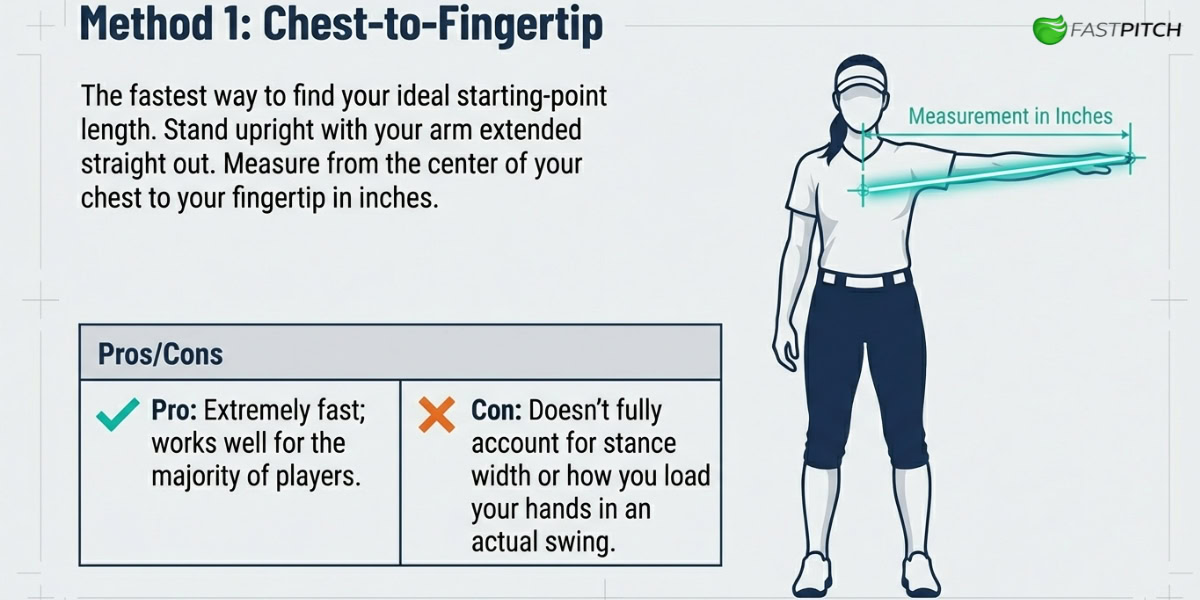
Stand upright with your arm extended straight out to your side, parallel to the ground. Measure from the center of your chest to your fingertip. The resulting measurement in inches is your ideal starting-point bat length.
This is the fastest method and works well for most players. Its weakness: it doesn’t fully account for stance width or how you load your hands in your actual swing.
Method 2: The Knob-to-Ground Method
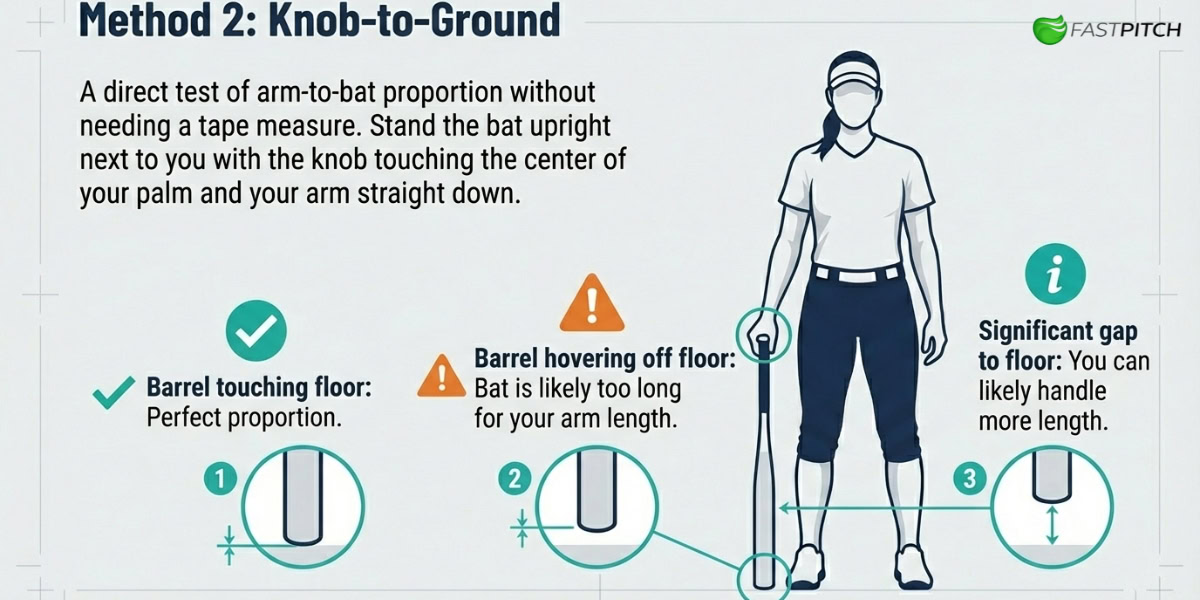
Stand the bat upright next to you with the knob touching the center of your palm. Hold your arm straight down at your side — the bat should rest with the barrel touching the floor. If the barrel comes off the floor, the bat is likely too long for your arm length. If there’s a significant gap between the barrel and the floor, you may be able to handle more length.
This method is particularly useful for younger players because it directly tests arm-to-bat proportion without any measuring.
Method 3: The Arm Extension Test
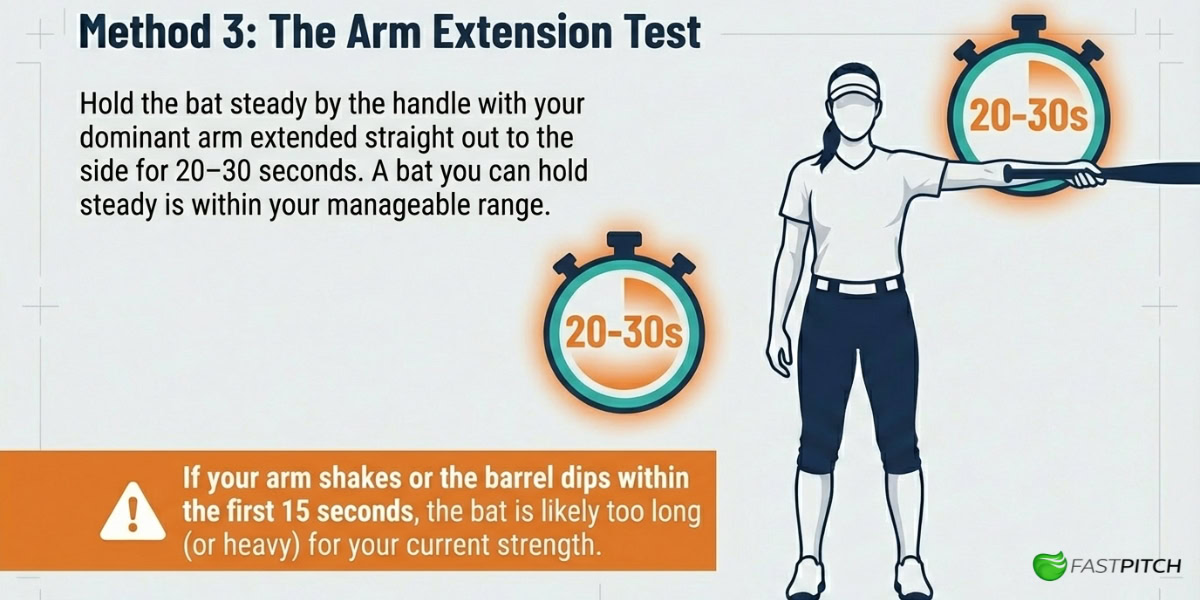
Hold the bat by the handle in your dominant hand. Extend your arm straight out to the side, pointing the barrel away from you, parallel to the ground. Hold it steady for 20–30 seconds. If your arm is shaking or the barrel is dipping within the first 15 seconds, the bat is likely too long for your current strength. A bat you can hold steady comfortably is within your manageable range.
Note that this method also tests weight, so it works better once you’ve already narrowed down your drop weight range.
Quick Takeaway
The fastest way to measure fastpitch bat length is the chest-to-fingertip method: measure from the center of your chest to your extended fingertip. The measurement in inches is your starting-point length before adjusting for strength and hitting style.
Bat Length by Position and Playing Style
Height and age get you to the right neighborhood. Playing style narrows it down to a specific number.
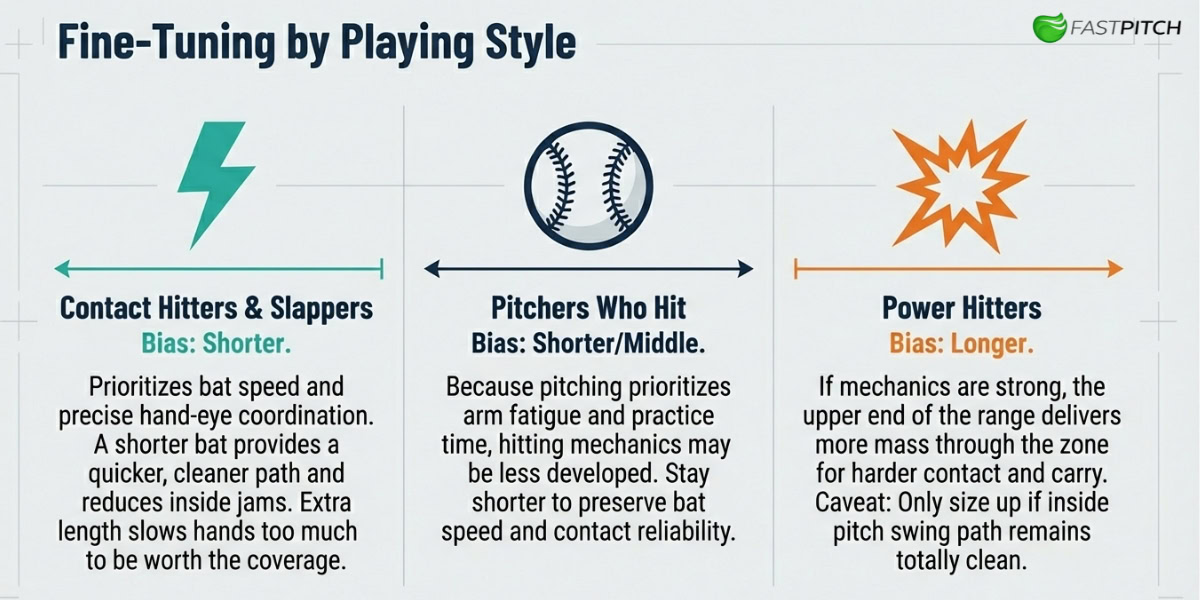
Contact Hitters and Slappers
Players who prioritize bat speed, plate coverage across the zone, and consistent contact tend to perform better on the shorter end of their range. A 5’5″ contact hitter who charts between 32″ and 33″ often finds that 32″ gives her a quicker, cleaner path to the ball — fewer jams on inside pitches and better late-count contact rates.
Slappers specifically benefit from the shorter end of their range. The entire slap game is built on bat speed and hand-eye precision. An extra inch of barrel that slows the hands through the zone costs more than it gains in plate coverage.
Power Hitters
Power hitters with strong mechanics and consistent barrel control can extract real benefits from the upper end of their range. More barrel length means more mass traveling through the hitting zone — and when a player with sound mechanics connects squarely, that translates to harder contact and more carry.
The caveat: power hitters who move to the longer end of their range need to be honest about whether their swing path remains clean on inside pitches and pitches up in the zone. If inside pitches become a weakness, the length is too much.
Pitchers Who Also Hit
Many pitchers are good athletes who develop late as hitters. Because pitching takes priority in terms of arm fatigue and practice time, pitchers who hit often have less developed swing mechanics than their position-player peers. When in doubt, pitchers who hit should stay at the middle or shorter end of their recommended range to preserve bat speed and contact reliability.
What Happens When Bat Length Is Wrong
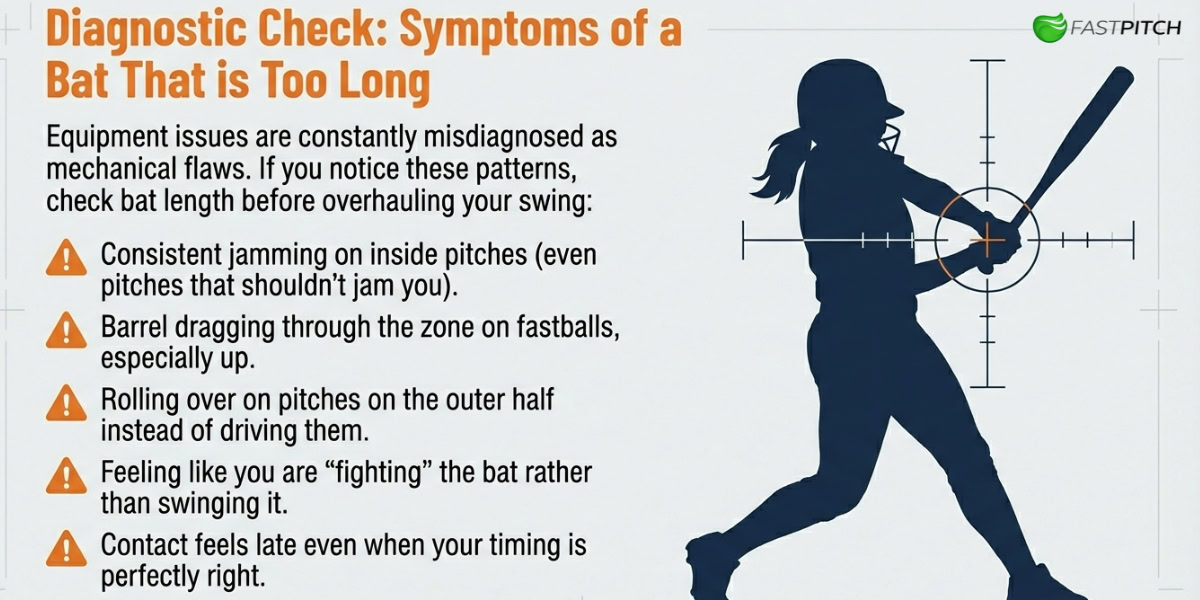
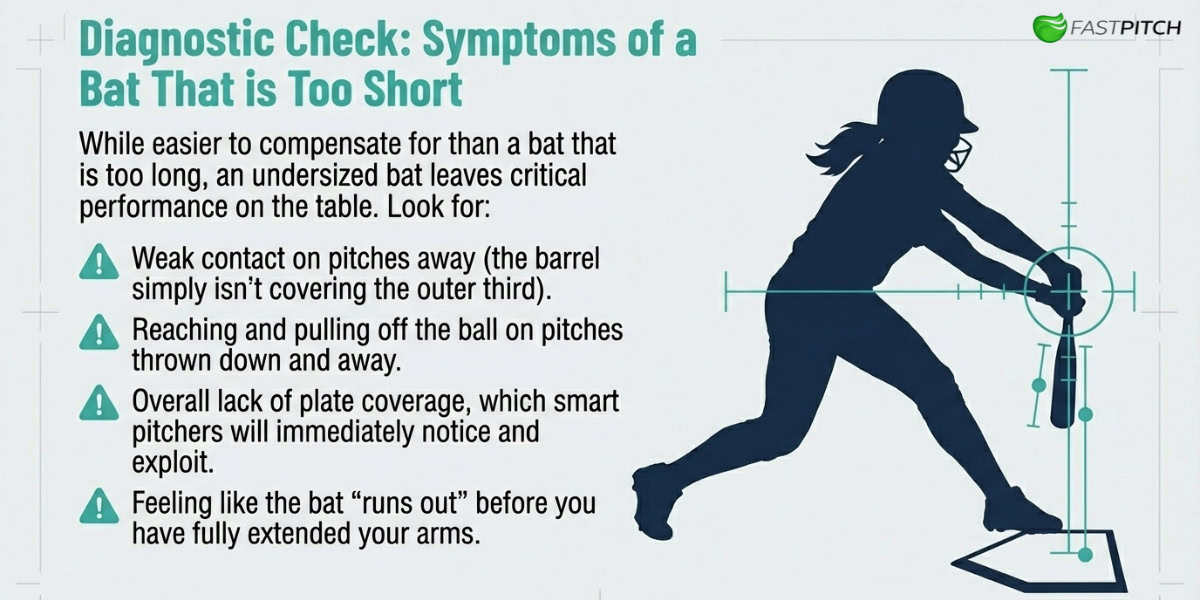
It’s worth spending a moment on what incorrect length actually looks like in practice — because the symptoms are often misdiagnosed as mechanical problems when the equipment is actually the cause.
Too long:
- Consistent jamming on inside pitches — even pitches that shouldn’t jam you
- Barrel dragging through the zone on fastballs, especially up
- Rolling over pitches on the outer half instead of driving them
- Feeling like you’re “fighting” the bat rather than swinging it
- Contact that feels late even when your timing is right
Too short:
- Weak contact on pitches away — the barrel isn’t covering the outer third
- Reaching and pulling off the ball on pitches down and away
- Less plate coverage overall, which pitchers will notice and exploit
- Feeling like the bat “runs out” before you’ve fully extended
If you’re diagnosing these patterns in your game and haven’t recently evaluated your bat length, that’s the first place to look — before adjusting your mechanics.
Quick Takeaway
A bat that is too long slows the swing arc and makes inside pitches harder to handle. A bat that is too short reduces plate coverage on outside pitches. Slightly shorter is generally safer than slightly longer when between sizes.
Bat Length and Drop Weight: Getting Both Right Together
Drop weight and bat length are the two foundational specs of any fastpitch bat. Neither decision lives in isolation.
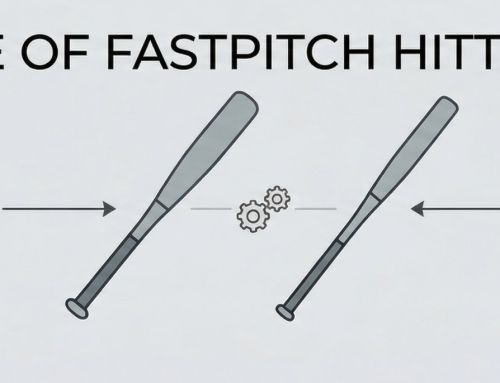
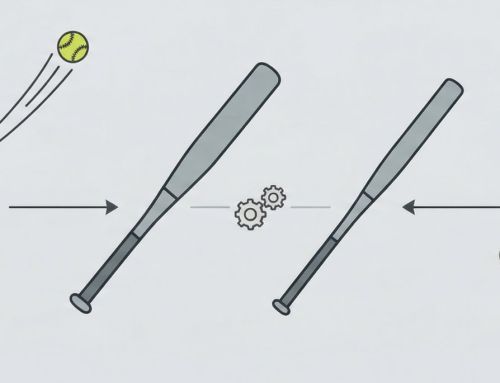
Here’s how they interact: a longer bat with a lighter drop can actually feel heavier in terms of swing momentum than a shorter bat with a heavier drop, depending on where the weight is distributed. A 33-inch, -10 bat and a 32-inch, -9 bat have different total weights but can feel surprisingly similar in the hands of the right player.
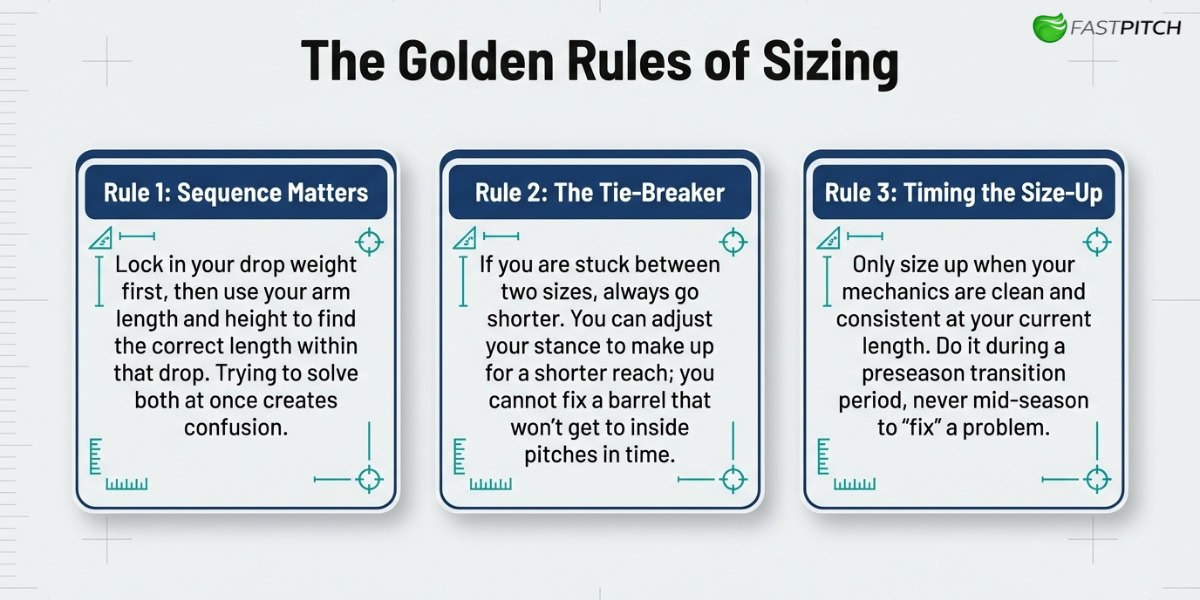
This is why the two decisions should be made in sequence — lock in your drop weight first (using your age, strength, and hitting profile), then use your arm length and height to find the right length within that drop. Trying to solve both at once creates confusion that’s easy to avoid.
Most high school players land between 32 and 34 inches, with 33 inches being the most common across competitive travel ball programs. If you’re in that range and unsure, start at 33″ with your confirmed drop weight and adjust based on how you handle inside pitches over the first few weeks.
The relationship between bat dimensions and swing speed has been studied directly. Research on bat weight and swing mechanics found that swinging a weighted bat has a more pronounced negative effect on bat speed than using a normal-weight or reduced-weight bat, and that this effect is strongest in adolescent athletes with shorter training backgrounds — due to underdeveloped muscle strength and suboptimal neuronal recruitment.
The same principle applies to length: a bat that exceeds a player’s current strength-to-length ratio doesn’t just feel heavier — it actively disrupts the kinetic chain. The research on bat swing intervention and bat speed provides the scientific basis for the sizing logic in this guide.
Quick Takeaway
Bat length and drop weight must be selected together. Lock in your correct drop weight first, then choose the appropriate length within that weight class. Solving both at once often leads to sizing mistakes.
FAQ: Bat Length Questions Answered
What bat length do most high school fastpitch players use?
The most common bat length at the high school and travel ball level is 33 inches. It sits in the middle of the competitive range and accommodates the majority of players between 5’3″ and 5’7″. Taller players and those with above-average arm length sometimes use 34 inches, while smaller-framed or shorter-reach players perform better at 32 inches.
Can a bat that’s too long hurt your performance?
Yes — and it’s one of the most underdiagnosed problems in fastpitch hitting. A bat that’s too long forces a longer arc through the zone, makes inside pitches structurally harder to handle, and can cause a player to roll over on pitches she should be driving. The symptoms are often mistaken for swing path problems when the bat itself is the issue.
Should I size up as I get stronger?
Generally, yes, but the timing matters. Moving up in length makes sense when your mechanics are clean and consistent at your current length — not as a means to fix problems. A player with a reliable swing at 32 inches can usually handle 33 inches after a preseason transition period. Moving up in length mid-season or before mechanics are set tends to create more problems than it solves.
Does bat length affect what certifications I need?
Bat length doesn’t affect which certification stamp your bat needs — that’s determined by performance standards, not dimensions. All USA Softball bats must be no more than 34 inches in length and no more than 2.25 inches in barrel diameter — but within those limits, your length decision is entirely about fit and mechanics, not legality. Confirm your program’s requirements in the USA Softball Official Rulebook before the season starts.
For high school players, bat legality at the varsity level is governed by the NFHS. For a bat to be legal for NFHS softball, it must bear the ASA 2000, ASA 2004, or USA Softball All-Games Certification Mark — and must not appear on the USA Softball Non-Approved Bats list. The NFHS bat certification resource walks through exactly how to verify compliance before you bring a bat to the plate.
For players with college aspirations, bat compliance operates under a separate set of standards from high school play. The NCAA maintains an approved softball bat list and conducts barrel compression testing at a minimum before every tournament — meaning a bat that passed inspection in October may fail in May if its compression has changed. College-bound players and their coaches should cross-reference the NCAA softball rules and approved bat list before committing to any bat purchase in the 16+ length range.
Is it better to go longer or shorter when I’m between two sizes?
Shorter. Every inch of length adds to the arc your barrel must travel and changes how you handle inside pitches. A bat that’s slightly short is a smaller problem than one that’s slightly long — you can make up for a shorter reach by adjusting your stance or plate positioning. You can’t make up for a barrel that won’t get to inside pitches in time.
Putting It Together: Your Bat Length Decision
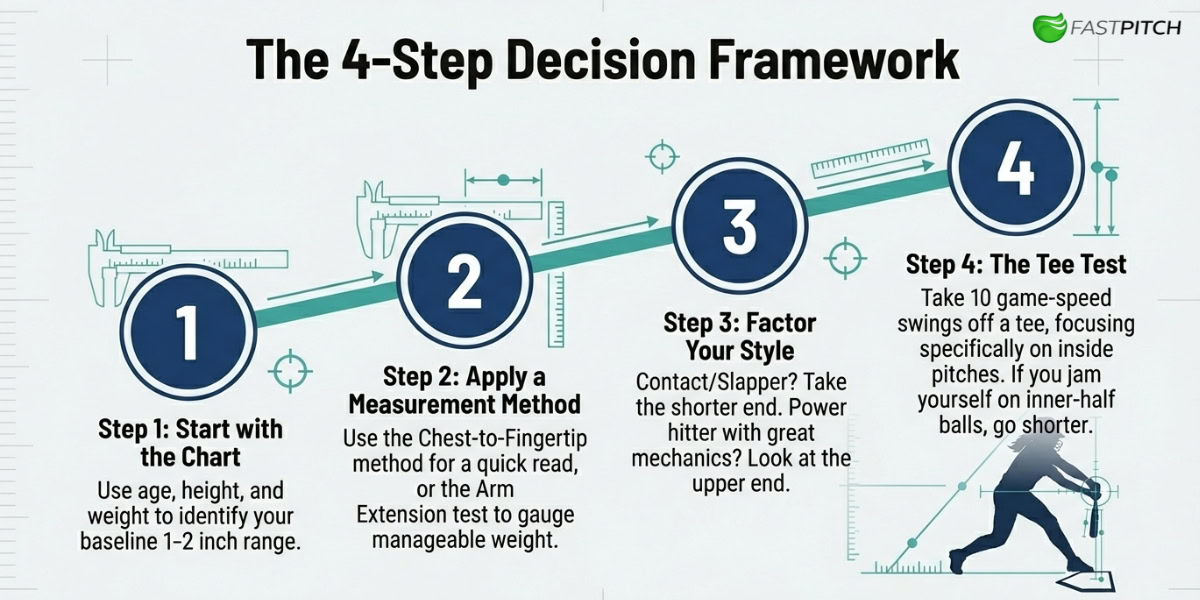
Here’s the cleanest way to land on the right length:
- Step 1 — Start with the chart. Use the age/height/weight table above to identify your 1–2 inch range.
- Step 2 — Apply a measuring method. Use the chest-to-fingertip method for a quick read, or the arm extension test if you already have a bat in your hands.
- Step 3 — Factor in your hitting style. Contact hitter or slapper? Take the shorter end of your range. Power hitter with strong mechanics? The upper end deserves a look.
- Step 4 — Test it before you commit. Ten swings off a tee at game speed, focusing specifically on inside pitches. If you’re jamming yourself on balls that should be on the inner half of the plate, go shorter.
Once you’ve confirmed the right length, the next step is finding the specific bat — at your drop, in your length, with the material and construction that matches your game. Our best fastpitch softball bats overview covers the top-performing options across every length and drop weight, with honest evaluations of what each bat actually delivers at the plate.
The Bottom Line
Bat length is the spec that gets the least attention and causes some of the most diagnosable problems in fastpitch hitting.
Get it right, and the bat becomes an extension of your swing — plate coverage feels natural, inside pitches are manageable, and your mechanics repeat cleanly. Get it wrong, and you’re fighting the equipment on every pitch, often without knowing why.
The right length is the one where your swing path stays clean, your inside pitch handling doesn’t suffer, and you can cover the strike zone the way your hitting style demands. Find that number, and the rest of the buying decision becomes easier.