Most hitters know the frustration: you’re doing the work, you’re getting reps, but the contact still isn’t consistent.
The ball finds the end cap when it should find the barrel.
You square one up, and the next pitch jams you. Contact hitting in fastpitch softball feels streaky when it should feel reliable — and that gap between effort and results is where this guide starts.
Becoming a better contact hitter in fastpitch isn’t about one swing change or one magic drill.
It’s about building a system — a consistent stance, a disciplined bat path, the right practice drills, a sound mental approach, and ultimately, equipment that works with your mechanics instead of against them.
This guide covers all of it, in the order that actually matters for player development.
Whether you’re a high school player trying to cut down on strikeouts, a travel ball athlete working on gap-to-gap production, or a coach building out a practice plan for your lineup, the principles here apply.
Build a Contact Hitter’s Stance: The Foundation Everything Else Depends On
Before any drill or mental technique is useful, your stance has to be right. A contact hitter’s stance isn’t about looking a certain way — it’s about creating the physical conditions for a fast, repeatable swing.
Foot Width and Weight Distribution
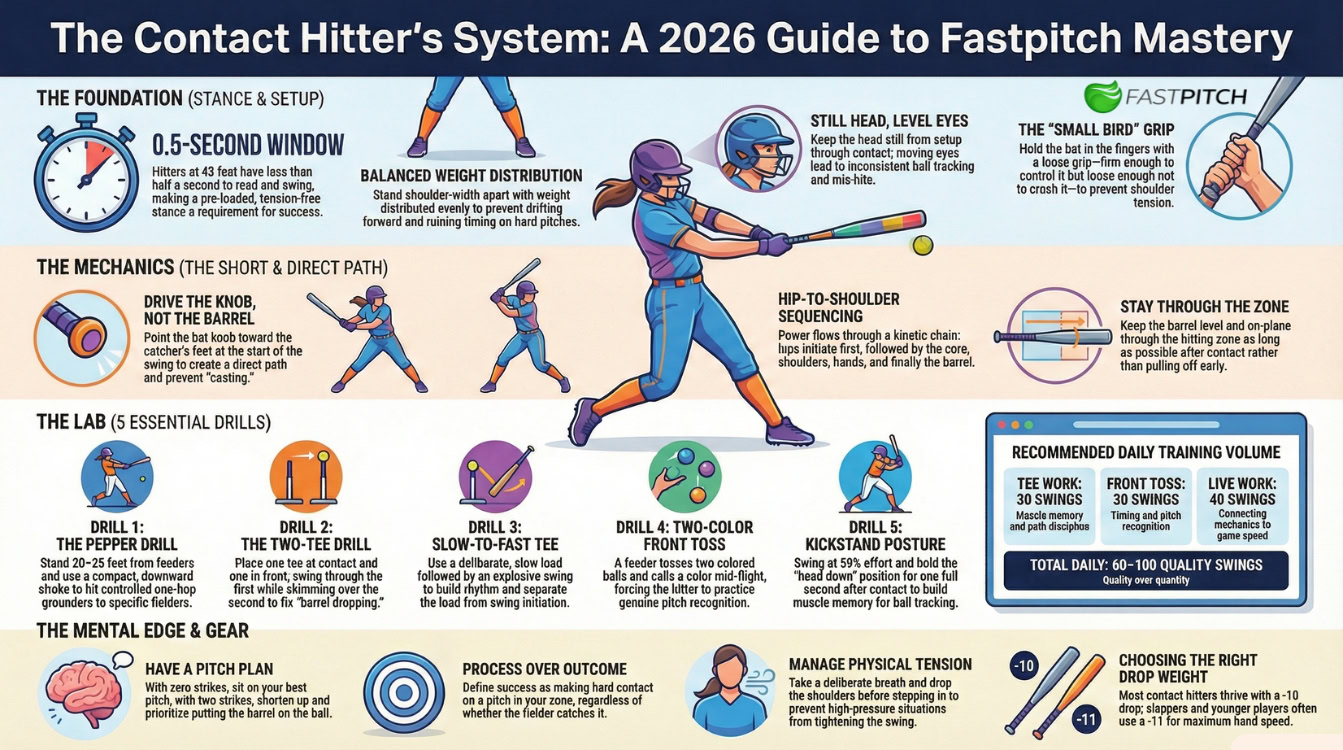
Stand with your feet roughly shoulder-width apart, knees slightly bent, and your weight distributed evenly — not loaded onto your back foot at setup, not tilted forward. Starting balanced means you can move in either direction without compensating. A player locked onto their back foot before the pitch starts will often drift forward at the wrong moment, shifting timing off and turning hard pitches into weak contact.
Grip Pressure: Loose Fingers, Engaged Forearms
Grip the bat in your fingers — not your palms — and keep that grip loose at setup. Tension in the hands travels up the forearms and into the shoulders, and tight shoulders slow bat speed. The goal is a relaxed grip that firms up at the point of contact, not one that’s squeezing from the moment you step in. A common coaching cue: hold the bat the way you’d hold a small bird — firm enough to control it, loose enough not to crush it.
Head Position and Load
Keep your head still and level from setup through contact. A moving head means moving eyes, and moving eyes mean inconsistent ball tracking. Load your hands and legs together — they should move as a synchronized unit, not in sequence. As the pitcher releases, your stride starts; your hands load slightly back to create tension in the swing. That coordinated load is where bat speed comes from, not from muscling through the swing.
- Contact hitting starts with your stance: balanced weight, quiet hands, and a relaxed grip are non-negotiable foundations.
- Bat path discipline matters more than bat speed for consistent contact — short, direct, and on-plane beats long and loopy every time.
- The Pepper Drill and Two-Tee Drill are the two highest-return drills for contact hitters at any level.
- Mental approach drives contact rate as much as mechanics — elite contact hitters have a plan before they step in the box.
- Your equipment amplifies your mechanics: a balanced bat in the right drop weight makes your contact work translate to results.
Master the Contact Hitter’s Bat Path: Short, Direct, and On-Plane
Bat path is where most contact problems actually live. A long, looping path to the ball — what coaches call “casting” — creates a narrow hitting window and makes any pitch that moves late nearly impossible to handle. A short, direct path to contact creates a wider window and more consistent barrel coverage across the strike zone.
Equipment fit matters here before any drill does. A bat that’s too long changes your relationship with inside pitches structurally — not mechanically. Before running these reps, make sure your length is matched to your arm reach and stance.
Drive the Knob, Not the Barrel
One of the most practical cues for fixing a casting swing: point the knob of the bat toward where the catcher’s feet would be as you begin your swing. From there, drive the knob toward the pitch location. This movement keeps the barrel behind the hands through the start of the swing and naturally creates a shorter, more direct path to contact. Hitters who lead with the barrel — pushing it toward the ball — create exactly the loop that kills bat speed and contact rate.
Stay Through the Zone
A common flaw even in experienced hitters is pulling off contact early — the barrel decelerates through the ball instead of staying on plane through the zone. The fix is in the finish: your barrel should stay level and through the zone as long as possible after contact before following through upward. Think of it as driving the ball rather than hitting it. That difference in intent produces a measurably different result at contact.
Hip-to-Shoulder Sequencing
Power and contact both start from the ground up. The kinetic chain in a softball swing moves from hips to core to shoulders to hands to barrel — in that order. Contact hitters who try to lead with their hands disrupt this sequence and lose the bat speed that their lower body generated.
Hips initiate first, reaching peak rotation before the torso follows, which then accelerates the hands, which accelerate the barrel. Understanding that sequence is the difference between a swing that looks strong and one that actually is.
Bat speed is part of the contact equation too. If you’re working on your swing efficiency, this guide on increasing bat speed covers the mechanical foundation.
🏏 The 5 Best Drills to Improve Contact Rate in Fastpitch Softball
Structured from tee work → front toss → live conditions. Run them in order for a complete hitting session.
The Pepper Drill
Stand 20 to 25 feet away from two or three infielders positioned side by side. Each feeder tosses the ball back immediately after fielding. Your job is to hit the ball sharply using a compact, downward stroke — the goal is controlled, one-hop ground balls, not hard drives.
Adjust your contact point based on pitch location: inside pitches go to the feeder on your pull side, pitches over the middle go back up the middle, outside pitches go to the opposite-field feeder. The speed of feedback is what makes Pepper uniquely valuable — dozens of reps in a short window, each one immediately revealing whether your swing path was compact or not.
The Two-Tee Drill
Set one tee at your normal contact point and a second tee slightly forward of your stride foot at the same height. Hit the ball on the back tee while making sure your barrel skims over the front tee on the follow-through. This is a barrel-dropper's drill — if your path dips under the front tee, your barrel is falling below the plane of the pitch before contact.
Work this drill across all pitch locations — inside, middle, and outside — and at different heights. Inside pitches contact further out front; outside pitches contact deeper in the zone. Running all three locations gives you a complete picture of your barrel path discipline across the full strike zone.
The Slow-to-Fast Tee Drill
Start in your normal stance. Load slowly against your back leg, pointing the knob of the bat toward the catcher's feet. Then drive off your back side toward contact explosively — slow load, fast swing. The deliberate contrast in pace builds rhythm and teaches the hitter to separate load from swing initiation, which is where most timing problems originate.
Many contact hitters rush their load when they feel pressure — in two-strike counts, against faster pitchers, late in close games. Ingraining a slow, deliberate load in practice means that rhythm stays accessible under game conditions. The swing can be as fast as your mechanics allow; the load does not need to be.
Front Toss — Two-Color Ball Variation
Standard front toss feeds the ball from a 45-degree angle toward the hitter's front hip — the slight angle replicates a more realistic ball flight than straight-on toss. For the two-color variation, the feeder tosses two balls simultaneously and calls a color. The hitter must identify and swing at the correct ball only.
The cognitive load this creates is significant. Hitters who can track a called color and swing correctly in front toss transfer that tracking discipline directly to reading spin and location from a live pitcher. Start with standard front toss to warm up the movement pattern, then introduce the color variation once the mechanics feel settled.
The Kickstand Posture Drill
Take swings at 50% effort — slow enough to feel every part of the movement. After each swing, do not look where the ball went. Instead, keep your head down and eyes focused on the empty tee or the spot where contact was made. Hold that position for one full second before looking up. This builds the habit of keeping your head still through contact, which directly widens your hitting window and reduces barrel drift.
A head that pulls off early — toward the pull-field for right-handed hitters — causes the barrel to leave the plane of the pitch too soon. The Kickstand drill addresses this at the source by building the finish-through-the-ball habit before the eye naturally chases the result.
The Mental Approach That Separates Consistent Contact Hitters
Technical mechanics and good drills can take a hitter a long way. But at the competitive high school and travel ball level, the gap between consistent contact hitters and inconsistent ones is often more mental than mechanical. The hitters who make contact at a high rate have a plan before they step in the box — and they execute it regardless of the count.
Have a Pitch Plan, Not a Reaction Strategy
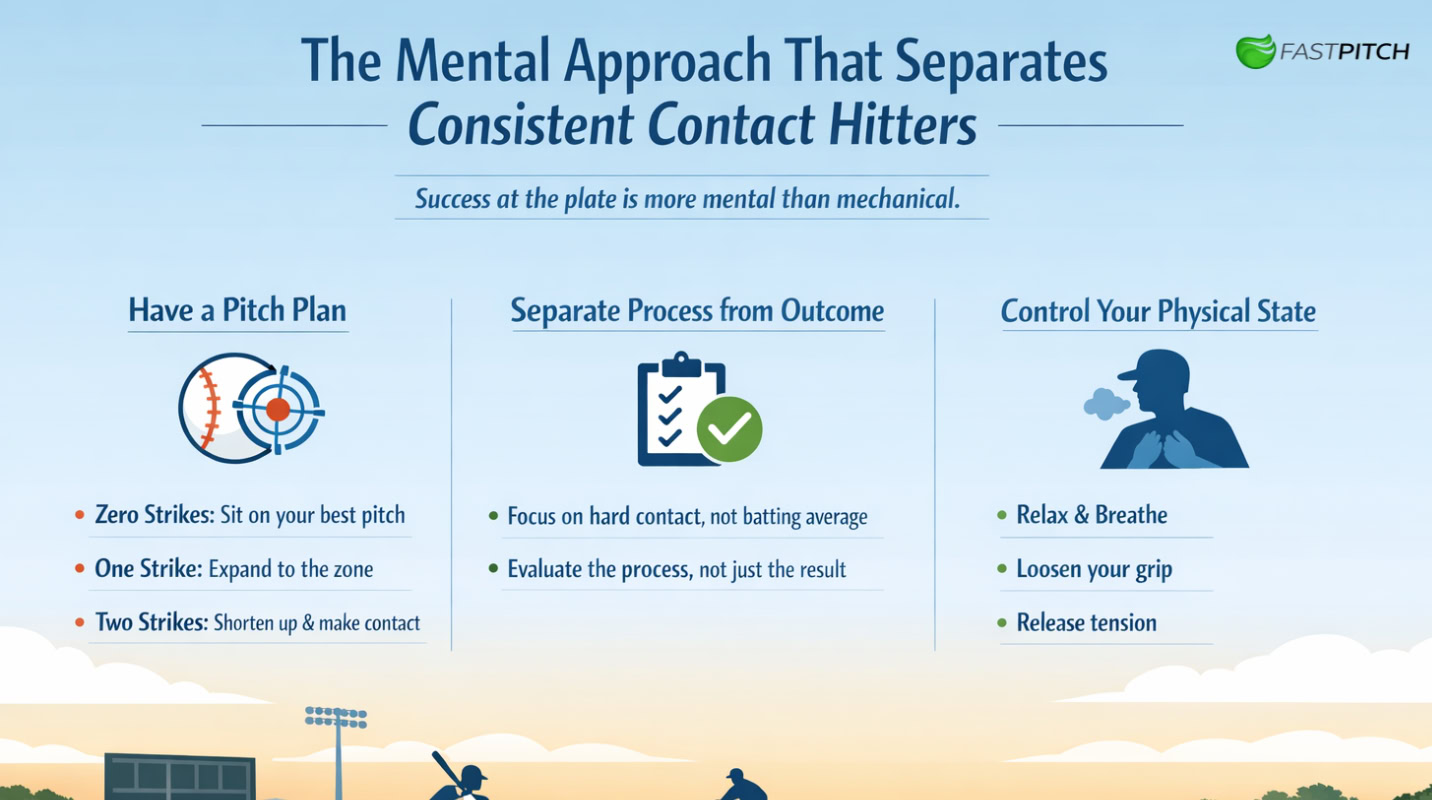
Elite contact hitters don’t wait to see what comes and then try to react. They decide before the pitch what zone and pitch type they’re sitting on, and they commit to that plan. With zero strikes, they sit on their best pitch location and let everything else take a called strike if it doesn’t match. With one strike, they expand the zone to a realistic strike zone and attack. With two strikes, they shorten up, put the barrel on the ball, and make contact, the only goal.
Separate Process from Outcome
A hard-hit ball that’s caught in the gap is not failure. A weak ground ball that finds a hole is not a success. Contact hitters who evaluate themselves on batting average alone will swing at pitches they shouldn’t chase and miss pitches they should drive. The goal in every at-bat is to make hard contact on a pitch in your zone. If you hit the ball hard, you win. Whatever the fielders do with it is separate from what you controlled.
Control Your Physical State Before the Pitch
Tension is the biggest mechanical disruptor at the plate, and it’s triggered by mental state more than physical fatigue. High-pressure at-bats — full count, runners on, close game — create tightness that shows up in the grip, the shoulders, and the load timing. The practical fix is physical and deliberate: take a breath before stepping in, let the shoulders drop, and consciously loosen your grip before the first pitch. These aren’t soft suggestions — they’re real pre-swing habits that contact hitters at every competitive level use to reset their physical state under pressure.
Once your mechanics and mental approach are dialed in, your bat becomes the final variable. We’ve tested the 2026 market to find the best balanced bats for contact hitters at every price point. See our full contact hitter bat guide here.
Frequently Asked Questions: Contact Hitting in Fastpitch Softball
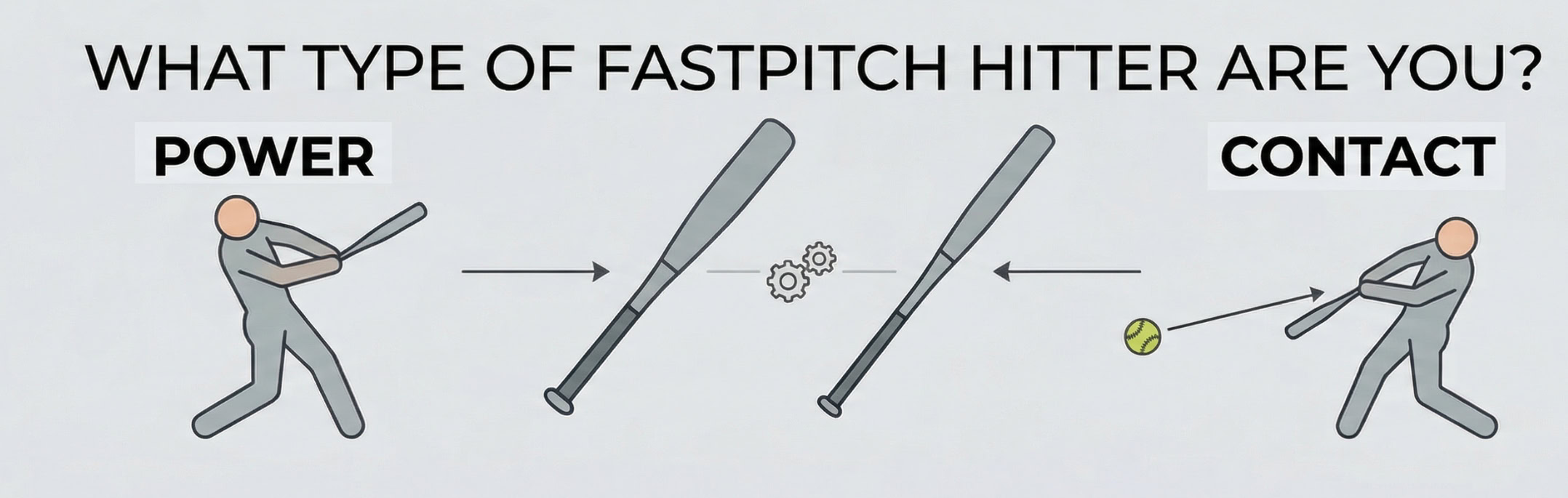
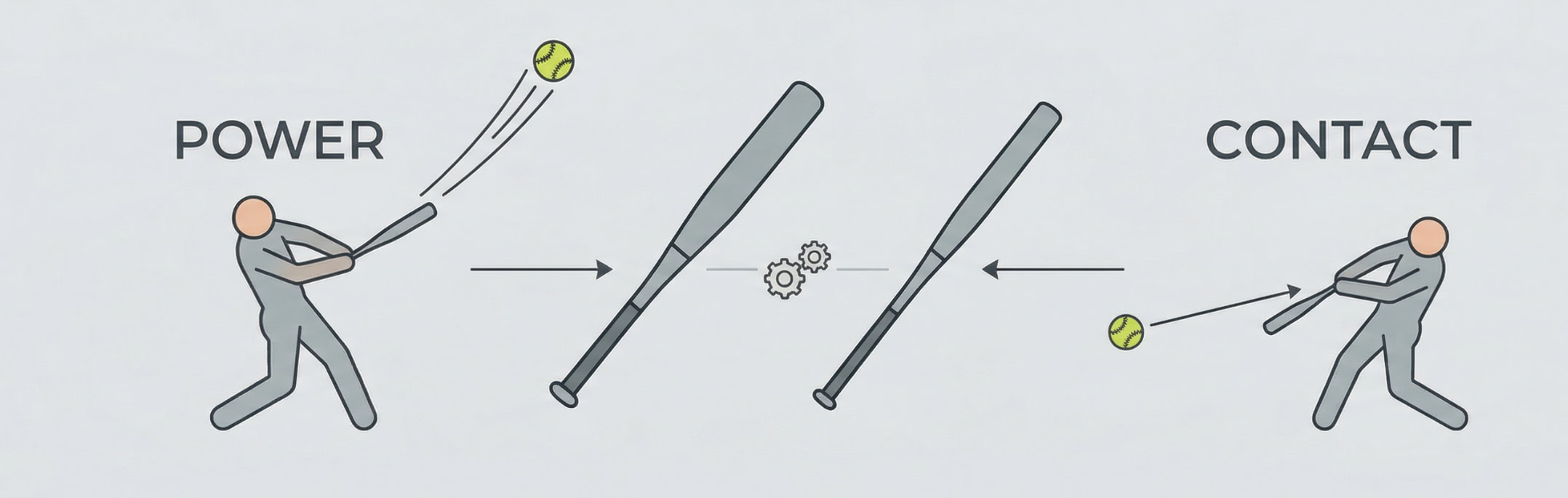
What is the difference between a contact hitter and a power hitter in fastpitch softball?
A contact hitter’s primary goal is consistent, hard contact — line drives, gap shots, and ground balls that find holes — rather than home run production. Contact hitters typically have a compact, balanced swing designed to cover the whole strike zone, and they tend to use balanced or ultra-balanced bats in lighter drop weights (-10, -11) to maximize bat speed and control. Power hitters prioritize driving the ball with maximum force and often use slightly end-loaded bats to add barrel mass to the swing.
The distinction matters because it changes every piece of equipment and training decision. A contact hitter using an end-loaded bat is working against her own swing. A power hitter using an ultra-light balanced bat may not be getting the most from her strength. Understanding which type of hitter you are is the starting point for building the right approach.
How many swings per day does it take to improve as a contact hitter?
Quality of swings matters significantly more than quantity. One hundred focused, mechanically correct swings — broken across tee work, front toss, and live pitching — will produce more measurable improvement than three hundred unfocused reps. Most hitting coaches at the high school and travel ball level recommend 60 to 100 quality swings per daily session, structured as roughly 30 off the tee, 30 in front toss, and the rest in live work when available.
The structured 60-swing approach used by many programs divides reps across focus areas: a set focused on smooth mechanics, a set with top-hand only, a set with bottom-hand only, then full swings from different pitch locations. That variety in a single session builds a more complete hitter than 100 straight full swings off the tee.
What drop-weight bat should a contact hitter use in fastpitch softball?
Most high school and travel ball contact hitters perform best in a -10 drop. It balances swing speed with enough barrel mass to drive the ball with authority through the infield and into the gaps. Slappers, younger players (14U and under), and hitters who are still developing bat speed often benefit from a -11, which swings lighter and allows quicker hand speed through the zone. A -8 or -9 is generally better suited to players with significant upper-body strength who can move the extra mass without sacrificing timing.
The right drop weight is ultimately the one you can swing fast without compensating in your mechanics. If a heavier bat causes you to get your hands through late, drift forward, or muscle the ball instead of driving it, you’re carrying more weight than your swing can effectively use.
Can you be a contact hitter and still hit for power in fastpitch?
Yes — and the best hitters at the high school and college level are both. A well-developed contact swing that stays on plane and drives through the ball naturally produces more exit velocity than a swing that compensates for poor mechanics with effort. Many players who think they’re “contact hitters only” are actually capable of driving the ball hard once their swing path is cleaned up and their lower-half sequencing is right. The label matters less than building the most complete swing your mechanics allow.
Putting It All Together
Becoming a better contact hitter in fastpitch softball is a system, not a single fix. It starts with a balanced, tension-free stance that creates the physical conditions for a fast, repeatable swing. It requires a bat path that’s short, direct, and stays on plane — built through deliberate, structured drill work like the Pepper Drill and Two-Tee Drill. It’s sustained by a mental approach that prioritizes process over outcome and maintains physical calm under pressure.
None of those elements works in isolation. Great stance mechanics with a looping bat path produce inconsistent contact. Good bat path with a rigid, tense setup never reaches its potential. And even a technically sound swing produces less than it should if the hitter’s mental approach chases bad pitches or collapses under pressure. The system works because all the parts reinforce each other.