What Is Drop Weight in Fastpitch Softball?
Most players learn what drop weight means about five minutes before they buy their first bat. That’s too late.
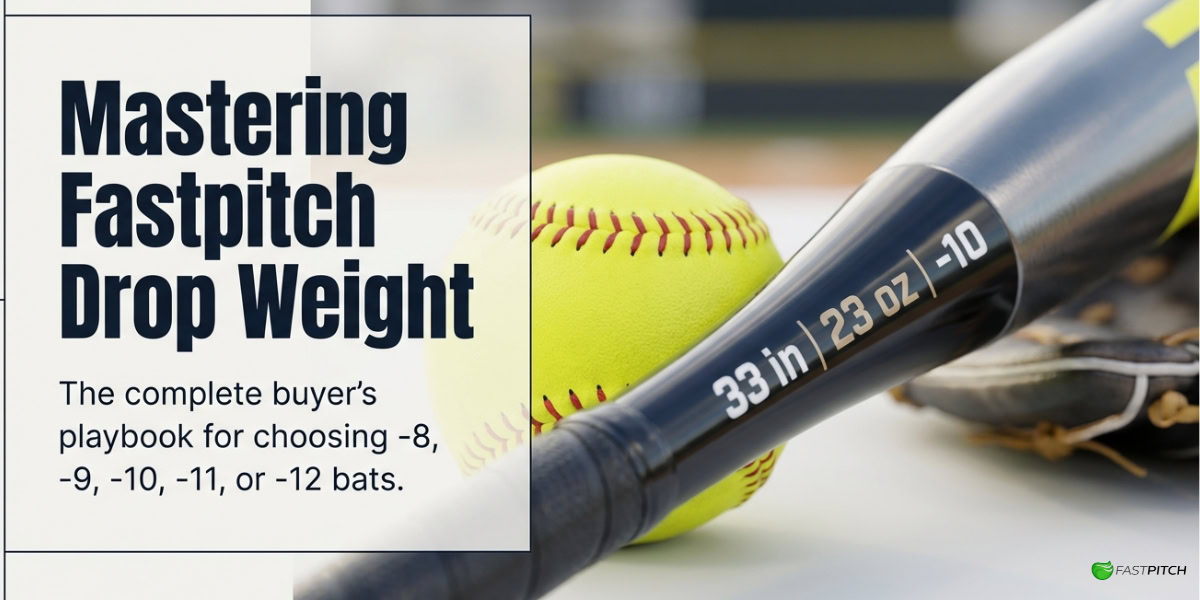
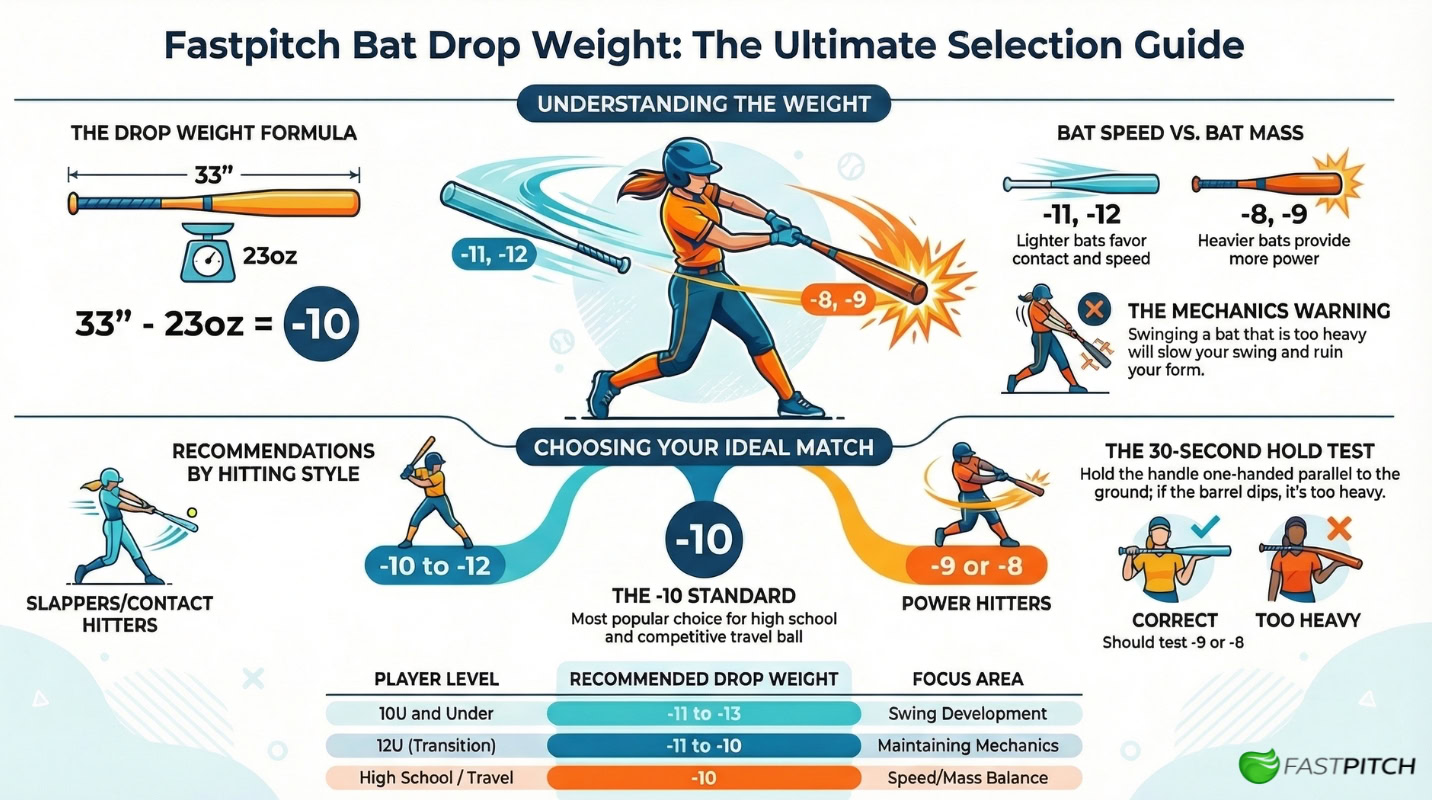
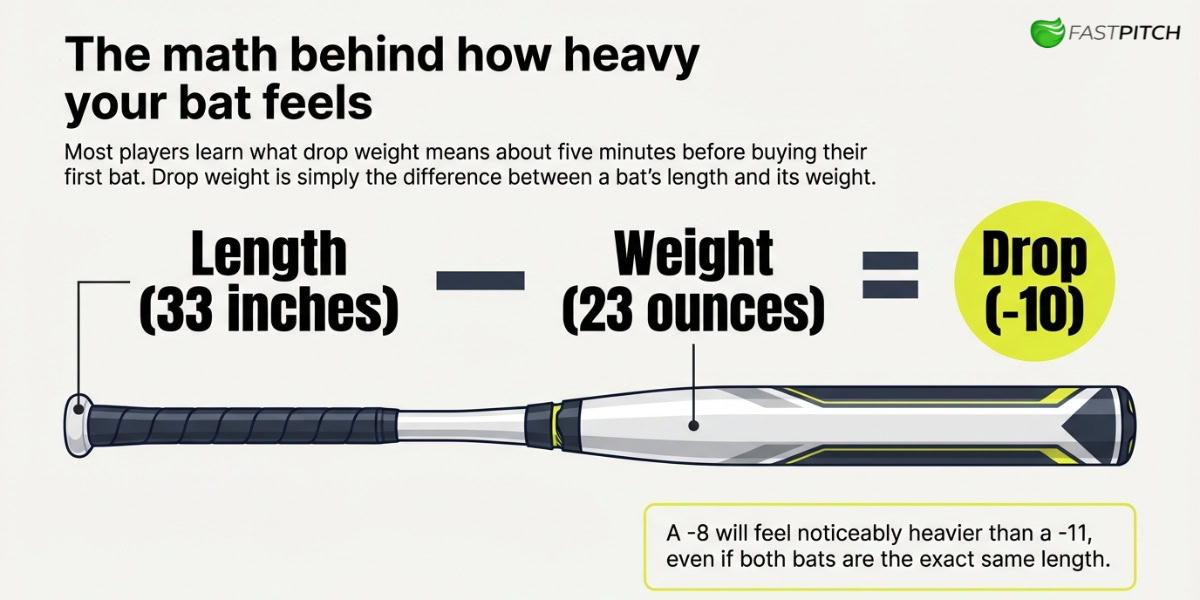
Drop weight is the number printed on every fastpitch bat, right next to the length. It looks like this: -10, -11, or -8. It is simply the difference between a bat’s length in inches and its weight in ounces.
Quick Takeaway
Bat drop is calculated using the formula: Drop = Length (inches) − Weight (ounces). The higher the drop number, the lighter the bat feels relative to its length. Players should choose a drop that allows full-speed mechanics without sacrificing control or power.
So a 33-inch bat that weighs 23 ounces is a -10 drop. A 32-inch bat that weighs 21 ounces is also a -11. The math is always the same.
What the number actually tells you is how heavy the bat feels in your hands. Drop weight is your first filter — but it’s one piece of a larger decision. If you’re starting from scratch, our how to choose a fastpitch softball bat guide walks through every variable before you buy.
Drop Weight at a Glance: What Each Number Means
Before getting into who should swing what, it helps to see the full range laid out clearly.
| Drop | Swing Feel | Best For |
|---|---|---|
| -12 / -13 |
|
10U and under, beginners building mechanics |
| -11 |
|
10U–12U, smaller players developing swing |
| -10 |
|
12U–high school, most travel ball players |
| -9 |
|
Advanced high school, college-bound power hitters |
| -8 |
|
Varsity / college hitters with strong mechanics |
Swing feel is relative. Two bats at the same drop can feel different depending on barrel balance and construction.
One thing the table above doesn’t cover: not every bat is legal in every league. USA Softball governs the majority of fastpitch programs across the country — from recreational leagues to high school varsity — and maintains an approved bat list that’s updated regularly. Before committing to any bat, it’s worth checking the USA Softball approved bat list directly to confirm the model you’re considering carries the right certification stamp for your league.
Travel ball programs operate under a separate set of rules. If your daughter plays USSSA-sanctioned tournaments, the certification requirements differ from USA Softball — and the two are not always interchangeable. Most current competitive bats carry dual stamps, but it’s worth verifying on the USSSA fastpitch bat requirements page before you buy, especially when purchasing a bat specifically for tournament play.
One important thing this table doesn’t capture: two bats with the same drop number can feel completely different depending on how the weight is distributed across the barrel. More on that in a moment.
How Drop Weight Affects Your Swing
This is where most buying guides typically stop and move on. Drop weight isn’t just about how heavy the bat feels standing in a store — it directly shapes what happens during your swing.
Bat Speed vs. Bat Mass
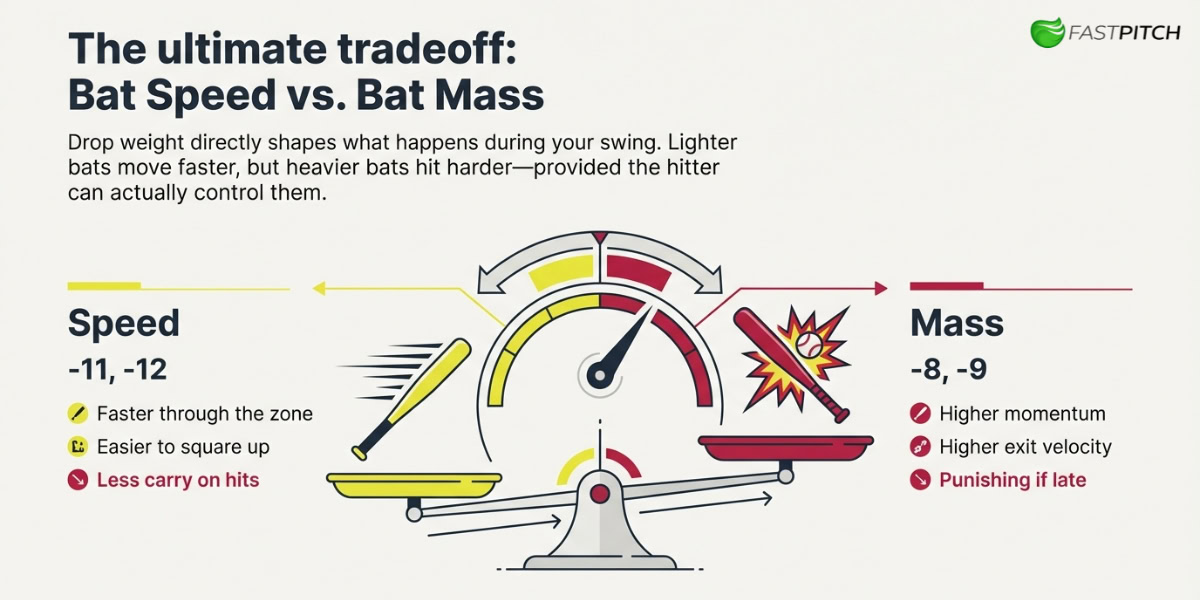
The core tradeoff with drop weight is this: lighter bats move faster, heavier bats hit harder — but only when the hitter can actually control the heavier bat.
A lighter bat (-11, -12) gets through the zone quicker. That’s an advantage for contact hitters who rely on bat speed to catch up to pitching, stay on time, and consistently square the ball up. The downside is less mass behind the ball at contact, which generally means less carry on well-hit balls.
A heavier bat (-8, -9) carries more momentum through the hitting zone. When a player with strong mechanics and bat speed connects cleanly, that extra mass transfers more energy into the ball — higher exit velocity, more distance. The tradeoff is that it’s harder to recover from being slightly late, and off-barrel hits feel more punishing.
The Mechanics Problem Nobody Talks About
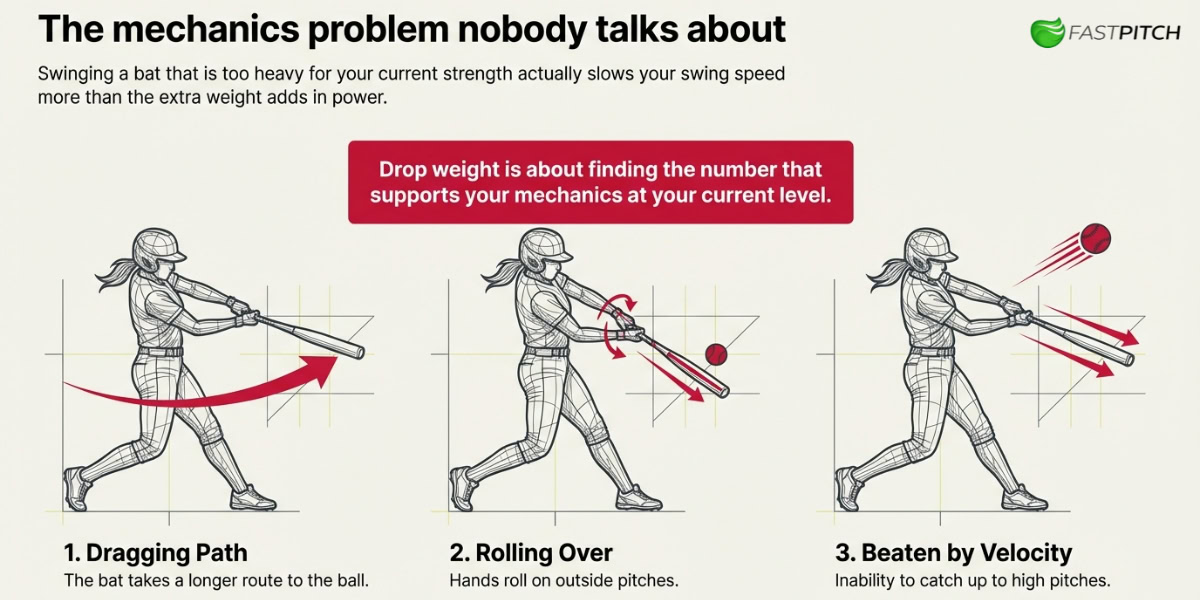
Here’s what most equipment guides skip: swinging a bat that’s too heavy for your current strength will actually slow your swing speed more than the extra weight adds in power.
A player fighting a -8 they’re not ready for will have a longer, dragging swing path. They’ll roll over on outside pitches, get beat by velocity up in the zone, and struggle to stay through the ball on off-speed. The bat isn’t the problem — the mismatch is.
This is why drop weight is less about picking the “best” number and more about finding the drop that supports your mechanics at your current level.
Drop Weight by Age and Level: A Practical Guide
The recommendations below are starting points, not rules. Player strength, mechanics, and hitting profile always matter more than a birthday.
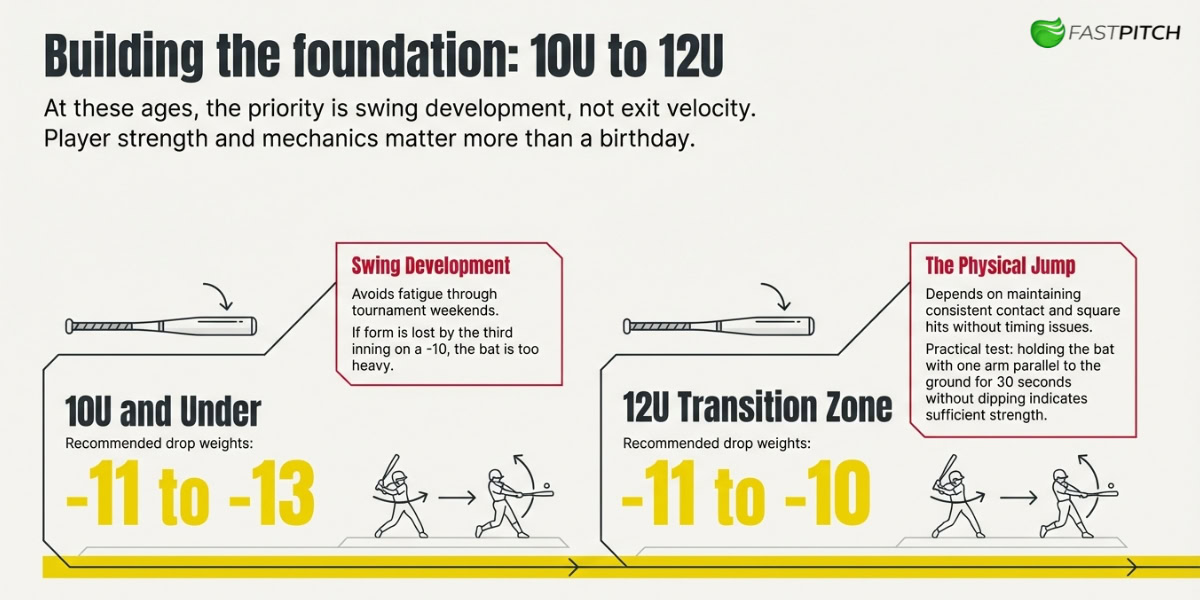
10U and Under: -11 to -13
At this age, the priority is swing development — not exit velocity. Lighter bats allow younger players to focus on mechanics without being hindered by weight. Most 10U players don’t yet have the bat path consistency to benefit from a heavier swing, and the added fatigue of a heavier bat through a full game or tournament weekend is real.
A -11 or -12 is appropriate for most players in this range. If your daughter is swinging a -10 at 9 years old and her form is breaking down by the third inning, that’s a signal the bat is too heavy.
12U: -11 to -10
This is the transition zone. Some 12U players are physically ready for a -10, others still benefit from -11. The right call depends less on age and more on whether the player can maintain her swing mechanics — consistent contact, square hits, no major timing issues — with the heavier option.
A practical test: if she can hold the bat handle straight out with one arm, parallel to the ground, for 30 seconds without the barrel dipping, she has the strength to handle the weight.
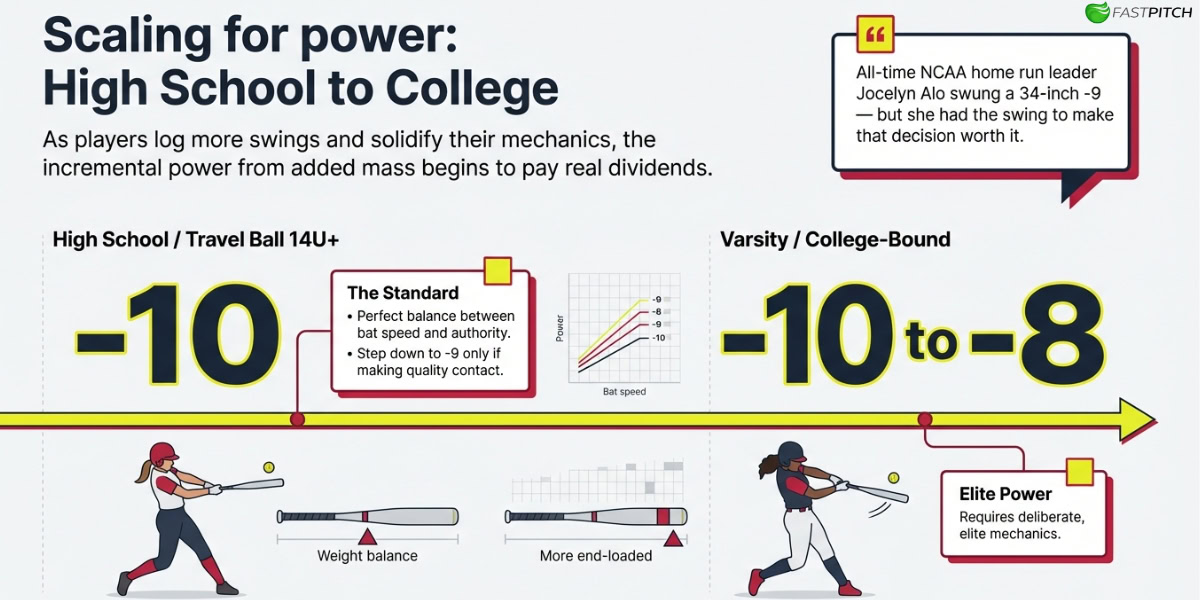
High School / Travel Ball (14U+): -10
The most popular drop weight at the high school and travel ball level is -10. It delivers a strong balance between bat speed and authority on contact — enough mass behind the ball to drive it into gaps, without being so heavy that swing speed suffers for most players at this level.
Players with naturally strong bat speed and consistent mechanics sometimes benefit from stepping down to a -9. But that move only makes sense if the player is already making quality contact on a -10 and wants more power, not if she’s struggling with timing on the current drop.
Varsity / College-Bound: -10 to -8
Elite-level hitters sometimes work down to a -9 or -8. At this stage, the player has logged enough swings to know her mechanics are sound, and the incremental power from added mass starts to pay real dividends. All-time NCAA home run leader Jocelyn Alo swung a 34-inch -9 — but she also had the swing to make that decision worth it.
For players with college aspirations, the standards tighten further. The NCAA maintains its own equipment regulations for fastpitch softball, and not every bat that’s legal at the high school or travel ball level meets collegiate standards. If you’re a college-bound player or a coach outfitting players who are being recruited, reviewing the NCAA softball equipment rules before selecting a bat is worth the five minutes — particularly for players considering a -8 or non-standard barrel length.
Worth noting: a -8 is an end-loaded, heavy-swing bat. Moving to it should be a deliberate decision with evidence that the player’s mechanics support it, not a guess based on wanting more power.
Drop Weight and Your Hitting Style
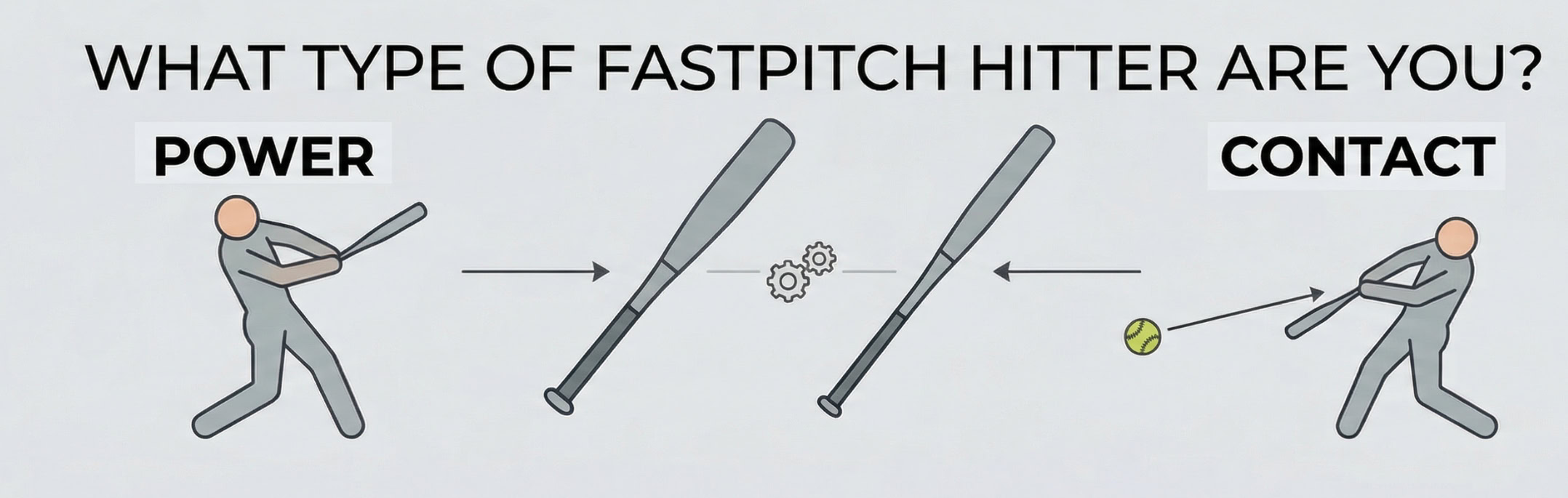
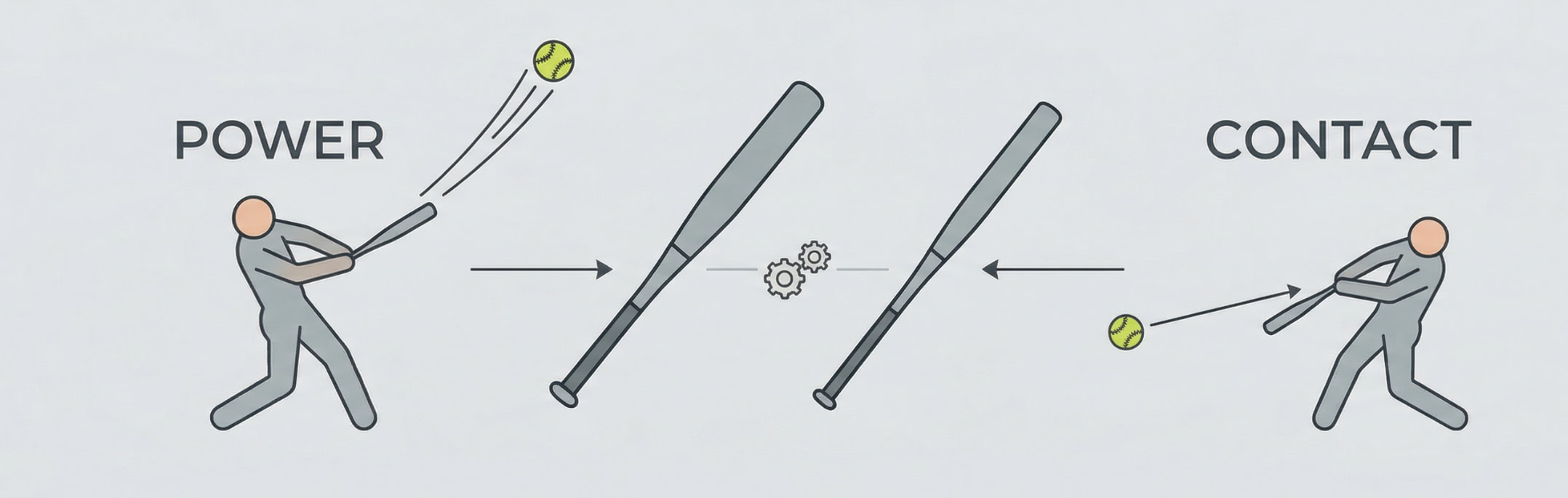
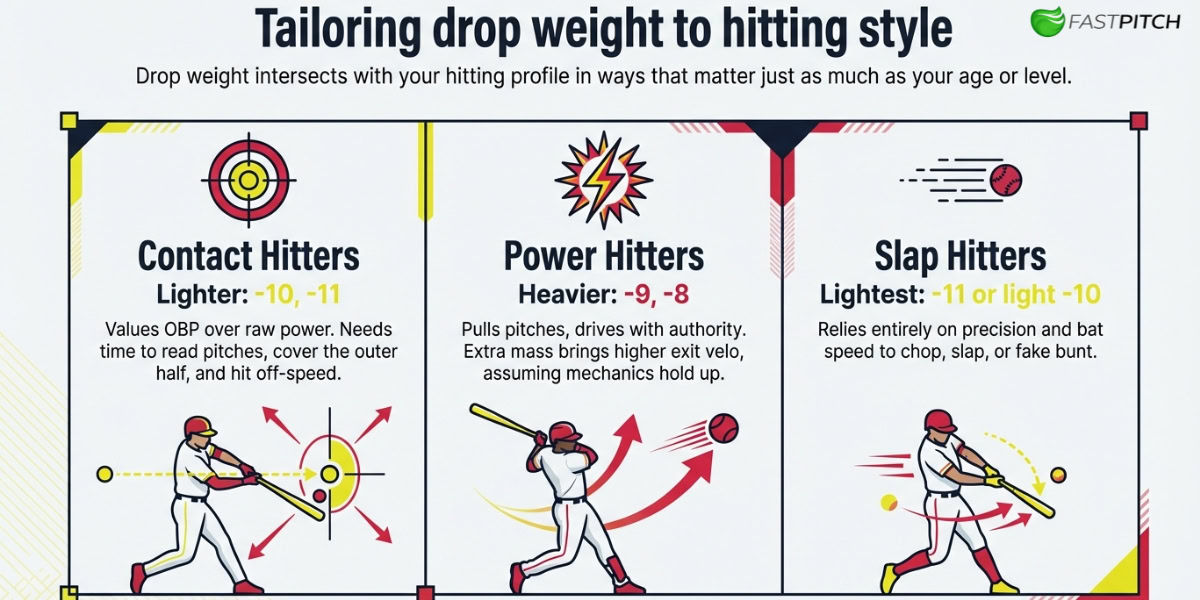
Drop weight intersects with hitting profile in ways that matter as much as age or level. Two players at the same school, same grade, same height — different hitting styles — might genuinely need different drops.
Contact Hitters
If your game is built on putting the ball in play, working gaps, and valuing on-base percentage over raw power, a lighter drop typically serves you better. The faster swing, a -10 or -11, provides more time to read the pitch, better coverage of the outer half, and more consistent contact on off-speed.
Contact hitters who move to a heavier bat ‘to get more power’ often find the opposite — they lose the bat speed that made them effective in the first place. The Louisville Slugger LXT is a good reference point here — a balanced -10 purpose-built for players whose game is built on consistent contact.
Power Hitters
Players who drive the ball with authority, pull pitches with regularity, and have the physical strength to accelerate a heavier bat through the zone can extract real gains from moving to a -9 or -8. The extra mass at contact translates into higher exit velocity and more carry — but only if the swing mechanics can support it.
The honest signal: if you’re a power hitter making consistent hard contact on a -10 but the ball isn’t carrying the way you’d expect, a -9 is worth testing. If you’re dropping your bat path and rolling over pitches, the problem isn’t the drop — it’s the mechanics.
What About Slap Hitters?
Slap hitters almost universally prefer lighter drops. The entire value of the slap game is bat speed and contact precision. A -11 or lighter -10 gives slappers the quickness through the zone they need to execute the play, whether chopping down, slapping through the left side, or running a fake slap into a bunt.
Balanced vs. End-Loaded: How It Changes the Drop Conversation
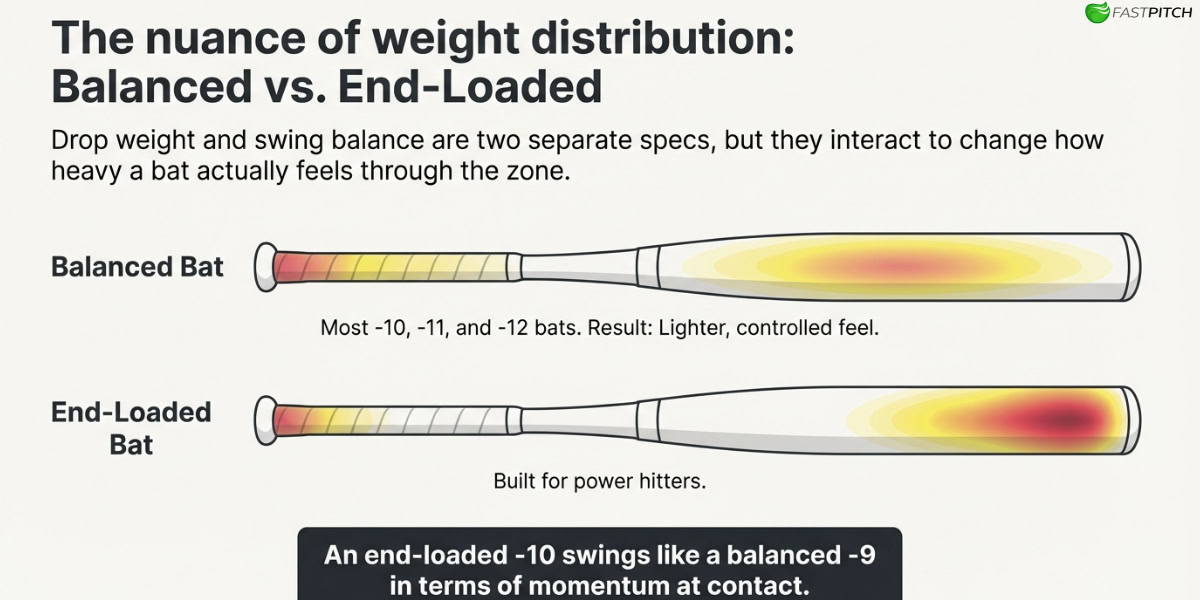
Drop weight and swing balance are two separate specs — but they interact in ways that affect how heavy a bat actually feels.
A balanced bat distributes weight evenly from the knob to the end cap. The result is a lighter, more controlled feel through the zone, even at a given drop weight. Most -10, -11, and -12 fastpitch bats are balanced by design.
An end-loaded bat shifts a percentage of the weight toward the barrel. This creates a heavier swing feel — effectively making a -10 end-loaded bat swing more like a -9 balanced model in terms of momentum at contact.
The practical takeaway: if you’re considering an end-loaded bat, hold the -10 end-loaded and a -9 balanced side by side. They may feel more similar than the numbers suggest. End-loaded designs are purpose-built for power hitters who can maintain bat speed with that extra weight out front. Contact hitters rarely benefit from end-load at any drop weight.
FAQ: Common Drop Weight Questions
What drop weight do most high school fastpitch players use?
The -10 is the standard at the high school and competitive travel ball level. It provides the most useful balance between bat speed and mass for the majority of players in that range. Players at the varsity level with strong mechanics occasionally move to -9, and college hitters sometimes work down to -8, but -10 is the most common starting point and the most common ending point for most high school careers.
Is a lighter drop always better for younger players?
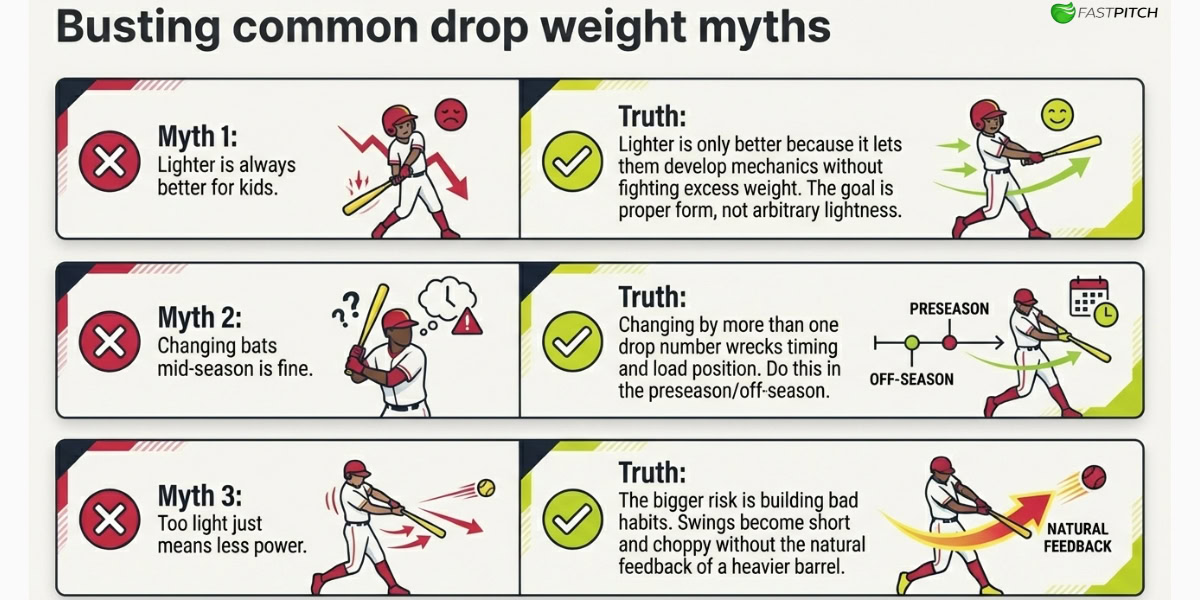
Generally, yes, but not because lighter automatically means “better.” Lighter drops at younger ages let players develop mechanics without fighting excess weight. A player whose swing is breaking down because the bat is too heavy is getting no benefit from the supposed “power” of the lower drop. The goal at 10U and 12U is consistent contact and proper form — that comes from a bat weight that supports the swing, not strains it.
Can switching drop weights mid-season hurt your swing?
It can, particularly if the change is more than one drop number. Moving from a -11 to a -8 mid-season will affect timing, load position, and swing path in ways that take time to adjust to. If you’re making a drop weight change, the preseason or off-season is the right time to do it — with adequate practice swings to reset muscle memory before live competition.
What happens if you swing a drop weight that’s too light?
A bat that’s too light will still make contact, but the lack of mass at contact means less energy transfer into the ball. Hitters who can handle a heavier bat but choose a lighter one for “bat speed” may find their well-hit balls carry less than expected. The bigger risk with a bat that’s too light is bad habits — the swing can become short and choppy without the weight providing natural feedback on follow-through.
How to Test If a Drop Weight Is Right for You
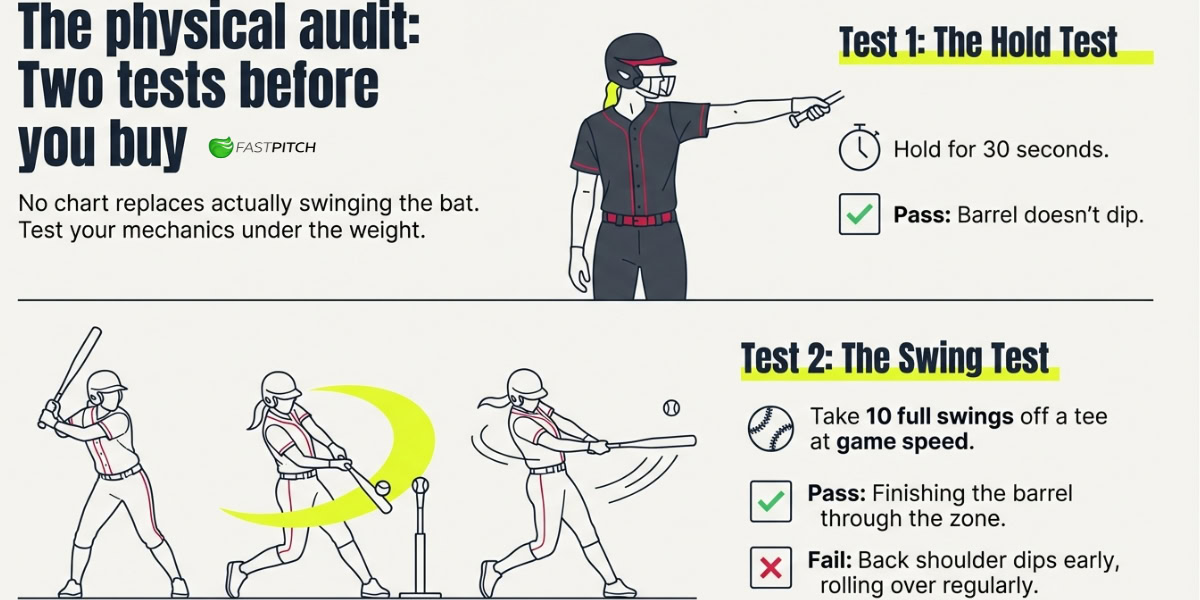
No chart replaces actually swinging the bat. Before you commit to a drop weight, try these two tests.
The hold test: Grip the handle with one hand and extend your arm straight out to the side, parallel to the ground. Hold it there for 30 seconds. If you can hold it steady without the barrel dipping, the weight is within your manageable range.
The swing test: Take 10 full swings off a tee — at game speed, not casual swings. Focus on whether you’re finishing the barrel through the zone consistently or if you feel the bat pulling you off-plane. If your back shoulder dips early or you’re rolling over regularly, the bat may be too heavy for your current mechanics.
The goal isn’t to find the heaviest bat you can manage. It’s to find the drop that lets you swing with your best mechanics — and execute that swing consistently, hit after hit, late in a tournament.
Putting It Together: Choosing Your Drop Weight
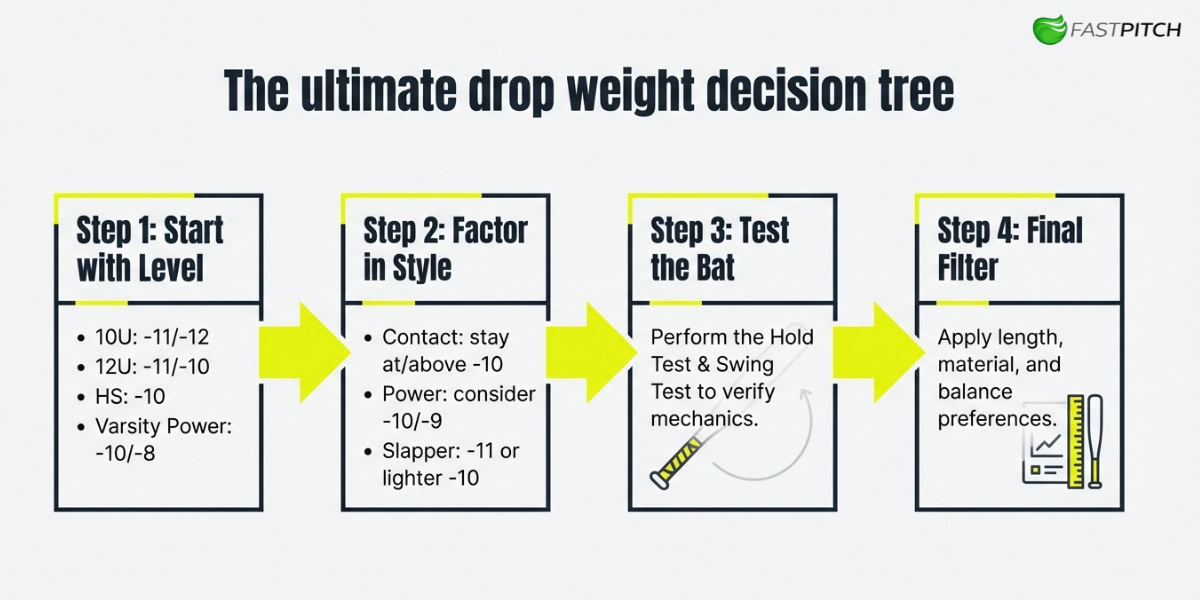
The decision doesn’t have to be complicated. Here’s a clean way to think through it:
Start with your level:
- 10U and under → -11 or -12
- 12U → -11 or -10, based on strength
- High school/travel ball → -10
- Varsity / college-bound power hitter → -10 to -8
Then factor in your hitting style:
- Contact hitter → stay at or above -10
- Gap/power hitter → consider -10 to -9
- Slapper → -11 or lighter -10
Finally, test the actual bat: No recommendation replaces how the bat feels in your hands through a full swing sequence.
One more thing worth keeping in mind: the drop weight is your first filter, not your whole decision. Length, material, swing balance, and construction all layer on top of it. Once you’ve identified the right drop, those specs help you narrow down to the bats that will actually perform for your game.
For a full breakdown of the top-performing fastpitch bats across every drop weight — tested and evaluated across all these criteria — check out our complete guide to the top-ranked fastpitch softball bats.
The Bottom Line
Drop weight is the first real decision in buying a fastpitch bat — and it’s the one most players either rush past or get wrong.
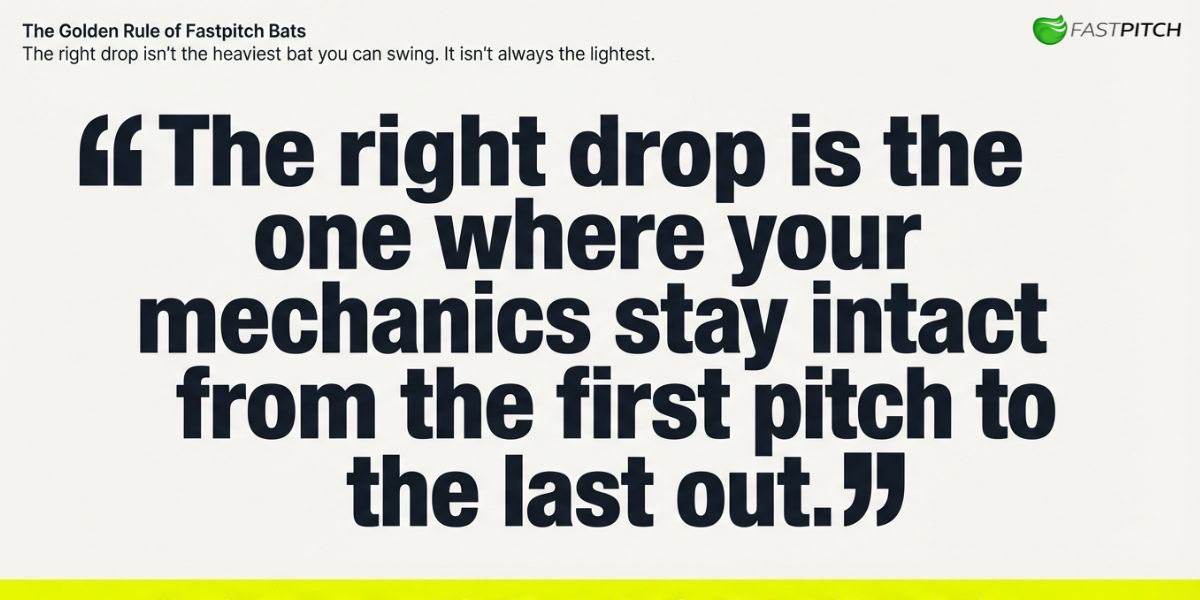
The right drop is the one that supports your swing mechanics, matches your hitting profile, and gives you the best chance to make quality contact consistently. That’s not always the heaviest bat you can swing. It’s not always the lightest. It’s the one where your mechanics stay intact from first pitch to last out.
When in doubt: start at -10 for high school, -11 for 12U, test with actual swings, and trust what your bat path tells you — not what the marketing says.