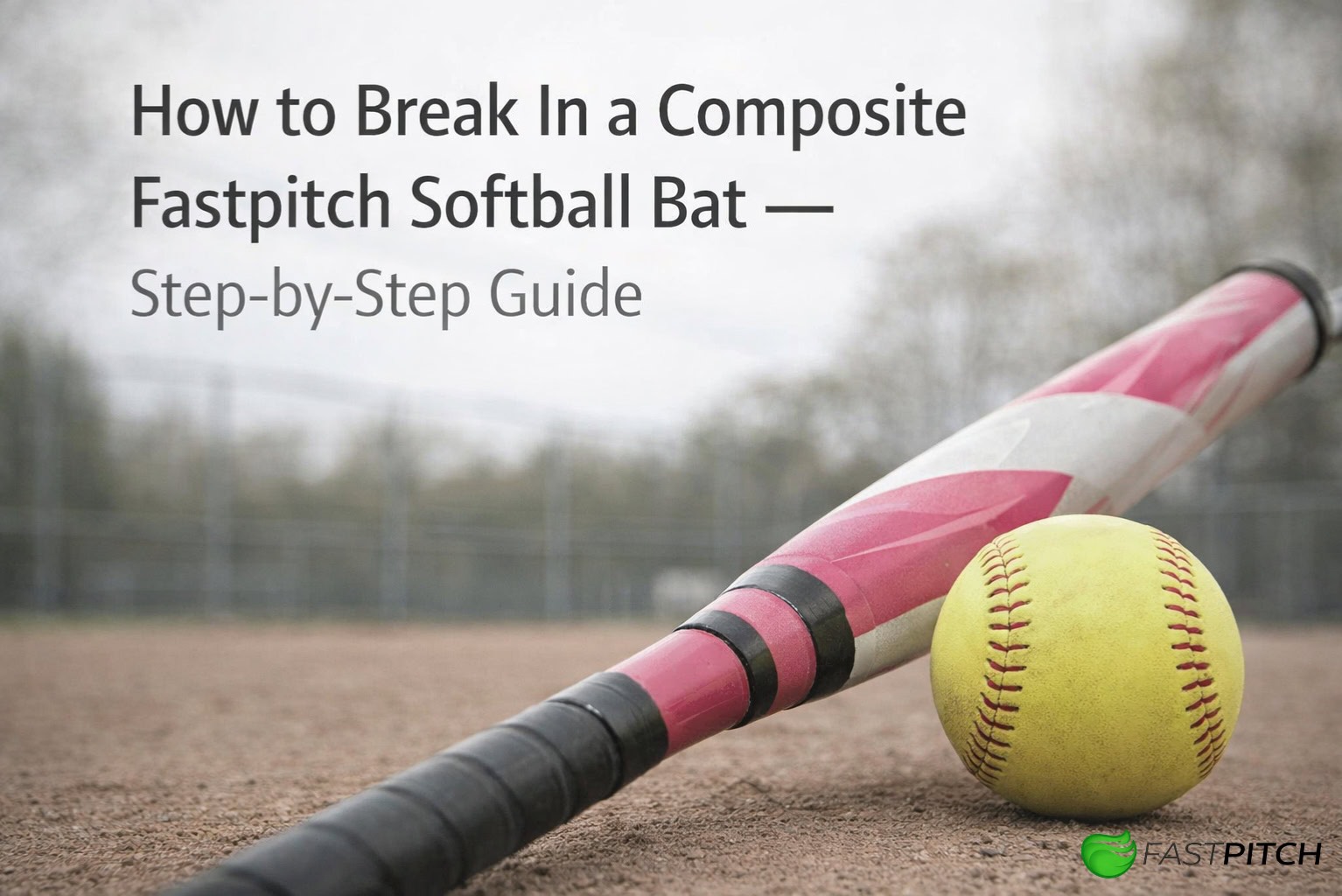
You just spent $400 on a new composite bat. It arrives, you pull it out of the wrapper, and head straight to the cage for full cuts.
That’s one of the most common — and expensive — mistakes in fastpitch softball.
A composite bat is not ready to perform on swing one. The barrel wall is stiff, the fibers are compressed, and swinging at full power before the bat is properly broken in can crack the barrel, kill its performance ceiling, and void the manufacturer’s warranty all at once.
This guide walks you through exactly how to break in a composite fastpitch softball bat the right way — what to do, what to avoid, and how to protect a serious investment from preventable damage.
If you’re still deciding which composite bat to buy before worrying about break-in, start with our best composite fastpitch softball bats guide first, and if you haven’t confirmed your length yet, either, our fastpitch bat length guide is worth reading before you start the break-in process — breaking in the wrong size bat is an expensive mistake.
⚡ Quick Takeaways
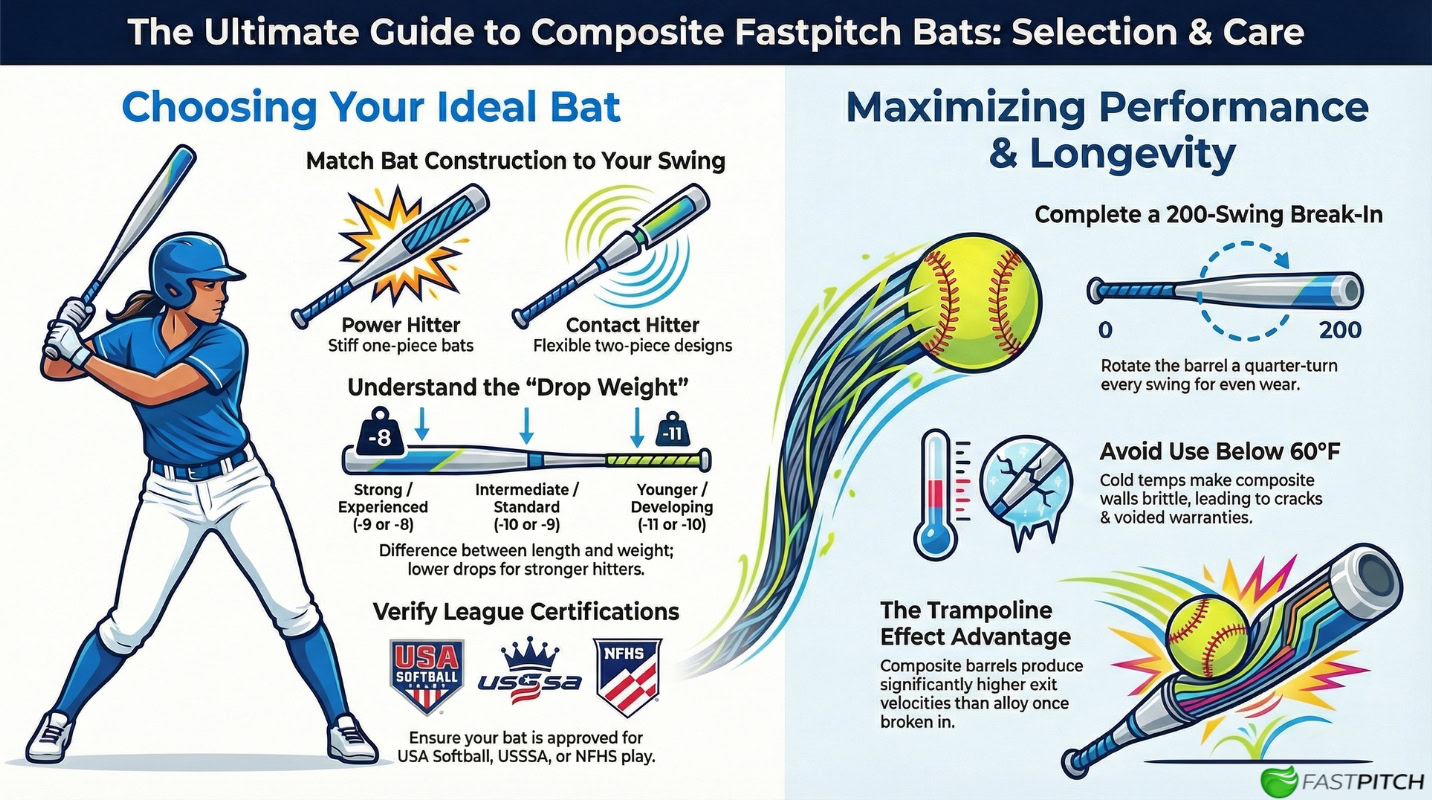
- Composite bats need 150–200 hits before the barrel reaches peak performance — skipping this costs you pop and risks cracking
- Always rotate the bat a quarter turn between swings to ensure the entire barrel wall breaks in evenly
- Never use dimpled batting cage balls during break-in — they're denser than game balls and can damage the barrel wall
- Don't swing a composite bat below 60°F — cold temperatures make the barrel brittle, and most manufacturers won't honor warranty claims from cold-weather damage
- Once fully broken in, limit daily cage use — every hit counts toward the bat's lifespan
Why Composite Bats Need a Break-In Period
What’s Actually Happening Inside the Barrel
Composite bats are built from layers of carbon fiber material bonded under pressure. Unlike alloy bats — which are essentially a single-material tube ready to perform the moment you pick them up — composite barrels have a structural flexibility that takes time and deliberate use to develop.
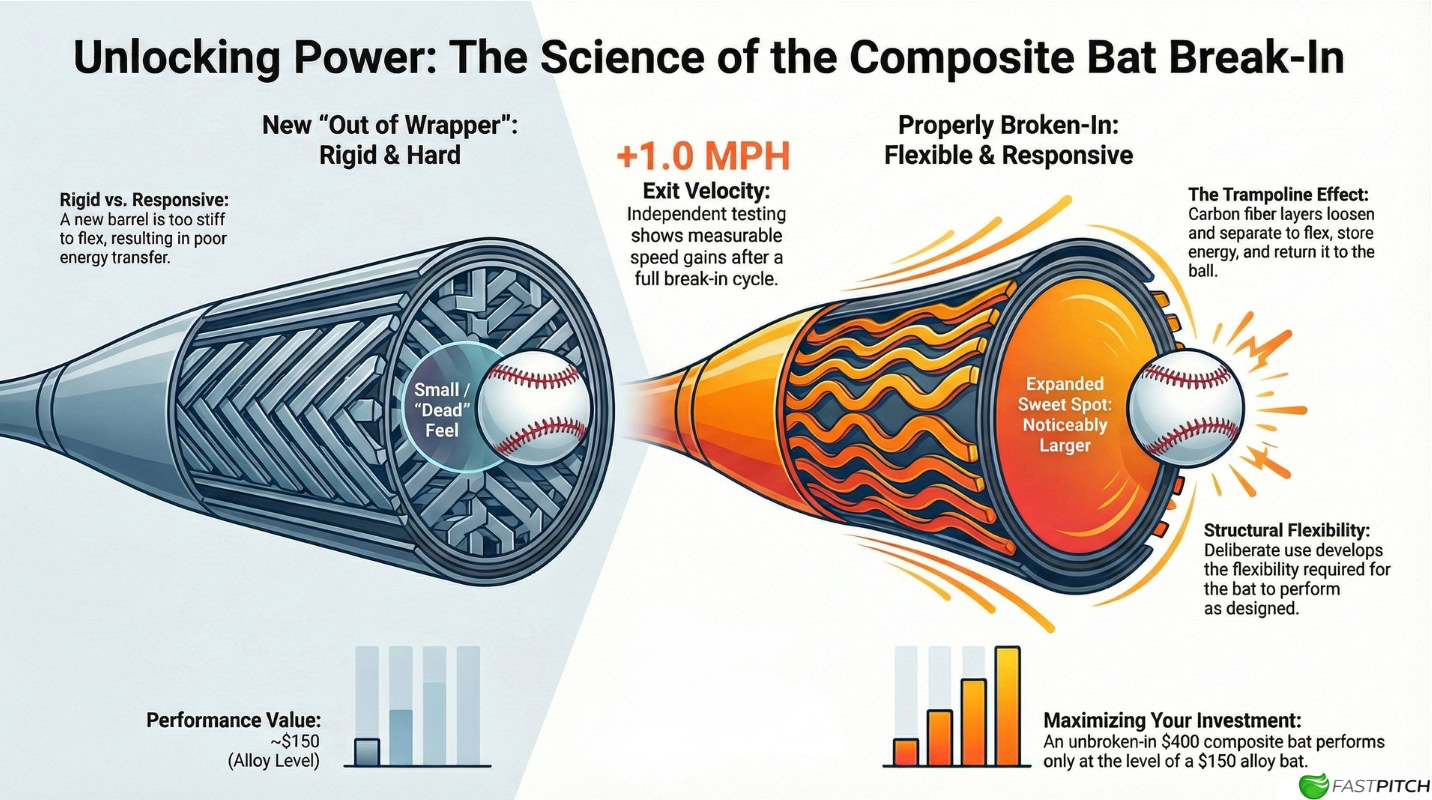
During the break-in process, those carbon fiber layers gradually loosen and separate in a controlled way. The result is a barrel that flexes slightly on contact, stores energy, and returns it to the ball — the trampoline effect that makes composite bats worth their price tag.
A barrel that hasn’t gone through this process is rigid. It doesn’t flex the way it’s designed to, which means less energy transfer, a smaller effective sweet spot, and a harder feel on contact. You’re essentially using a $400 bat at the performance level of a $150 alloy.
How Break-In Affects Performance
The difference between a broken-in composite barrel and a brand-new one is measurable. Independent bat testing data consistently shows exit velocity gains of around 1.0 mph or more after a full break-in cycle — modest on paper, but meaningful in a game where the difference between a line drive and a fly ball is measured in fractions.
More practically, a properly broken-in barrel gives you a noticeably larger sweet spot. Off-center hits that would feel dead on a new barrel start carrying. The bat begins to perform the way the manufacturer designed it to perform.
Skipping this process doesn’t just delay that payoff — it can prevent it permanently.
What You Need Before You Start
Use Regulation Leather Softballs Only
This is the single most important rule of the break-in process: use real, regulation leather softballs. Not rubber practice balls. Not the yellow dimpled balls sold for batting cage machines.
Dimpled cage balls are denser and harder than regulation softballs. When you make contact with one, the force on the barrel wall is greater than it’s designed to absorb — especially during break-in when the barrel is still stiff. Repeated contact with cage balls during break-in is one of the most reliable ways to crack a composite barrel, and virtually every manufacturer excludes cage ball damage from warranty coverage.
Use the same ball you’d use in a game. That’s what the bat is built for.
Temperature Check Before Every Session
Composite barrels become significantly less flexible in cold weather. Below 60°F, the carbon fiber material stiffens, and the energy it would normally store on contact gets transferred directly into the barrel wall instead. The result is stress fractures — often invisible at first — that shorten the bat’s lifespan or cause sudden cracking.
This isn’t a minor manufacturer’s caution. It’s a structural reality of how composite materials behave at low temperatures.
Check the temperature before every session during break-in. If it’s below 60°F, put the composite away and use an alloy bat. The same rule applies after break-in — a composite bat swung in cold conditions is a composite bat at risk.
Step-by-Step Break-In Process
The full break-in cycle covers 150–200 swings across three phases. Take 2–4 sessions to complete it, depending on how long you practice. Rushing through all 200 swings in a single session at full power is not break-in — it’s stress-testing.
The Quarter-Turn Rotation
Before getting into the phases, understand the rotation rule. After every swing — or every few swings — rotate the bat a quarter turn (90 degrees) in your hands before the next contact.
The barrel is cylindrical, and a flat surface hitting a round barrel will only compress the same narrow strip of the barrel wall if you don’t rotate. The goal is to break in the entire circumference of the barrel evenly. Uneven break-in creates inconsistent barrel response and can lead to weak spots.
Rotation is easy to forget. Make it a habit from swing one.
Break-In Progression Table
Break-In Progression
| Phase | Swing Count | Power Level | Method |
|---|---|---|---|
| 1 | 50 swings | 50% | Off a tee — regulation softball |
| 2 | 50 swings | 75% | Soft toss — regulation softball |
| 3 | 50–100 swings | 100% | Front toss or live — regulation softball |
Phase 1 — Off the Tee at 50% Power (50 Swings)
Start at a tee with controlled, half-speed swings. The goal here is not to hit hard — it’s to begin the process of loosening the barrel wall through consistent, evenly distributed contact.
Fifty swings sounds like a short session. Resist the urge to swing harder. You’re not warming up; you’re treating the barrel like a structured conditioning process. The power comes later.
Rotate the bat a quarter turn every few swings throughout.
Phase 2 — Soft Toss at 75% Power (50 Swings)
Move to soft toss with a partner at around three-quarter effort. The slight increase in movement and timing introduces more variation in contact location across the barrel, which helps develop a consistent sweet spot rather than a single break-in point.
Keep the rotation habit going. By the end of this phase, you should be around 100 total break-in swings.
Phase 3 — Front Toss or Live at Full Power (50–100 Swings)
Now you can open it up. Front toss or live pitching at full effort for the final 50–100 swings completes the break-in cycle. The barrel has enough flexibility at this point to absorb and return energy the way it was designed to.
By the end of Phase 3 — 150 to 200 total swings — your composite bat is fully broken in and performing at its intended level.
Common Break-In Mistakes That Void Your Warranty
Using Cage Balls
Already covered above — but worth repeating because it’s the most frequent cause of composite bat damage during break-in. Dimpled cage machine balls are designed for durability, not for replicating game-ball contact. If your local cage only has machine balls available, wait until you have access to regulation softballs for break-in sessions.
Swinging Full Power From Swing One
A stiff, unbroken-in barrel under maximum force is under maximum stress. Composite barrels are designed to flex — before they’re conditioned to do that, a full-power swing concentrates stress in a way the fiber layers aren’t ready to distribute. Starting heavy and fast is exactly how barrel cracks start.
Cold Weather Use
Explained in detail above. Cold damage is structural, often invisible early, and almost universally excluded from manufacturer warranties. One cold-weather session can undo the investment before break-in is even complete.
Rolling or Shaving the Barrel
Bat rolling — using a machine to compress the barrel mechanically — and bat shaving — thinning the interior barrel wall — both attempt to replicate break-in artificially. Beyond the fact that both practices are illegal under USA Softball, USSSA, and most other governing associations, they compromise the structural integrity of the bat.
A rolled or shaved bat is more likely to fail suddenly, and it will perform inconsistently because the compression isn’t distributed the way a proper break-in creates.
These are illegal modifications, not shortcuts. Avoid them entirely.
How to Care for Your Composite Bat After Break-In
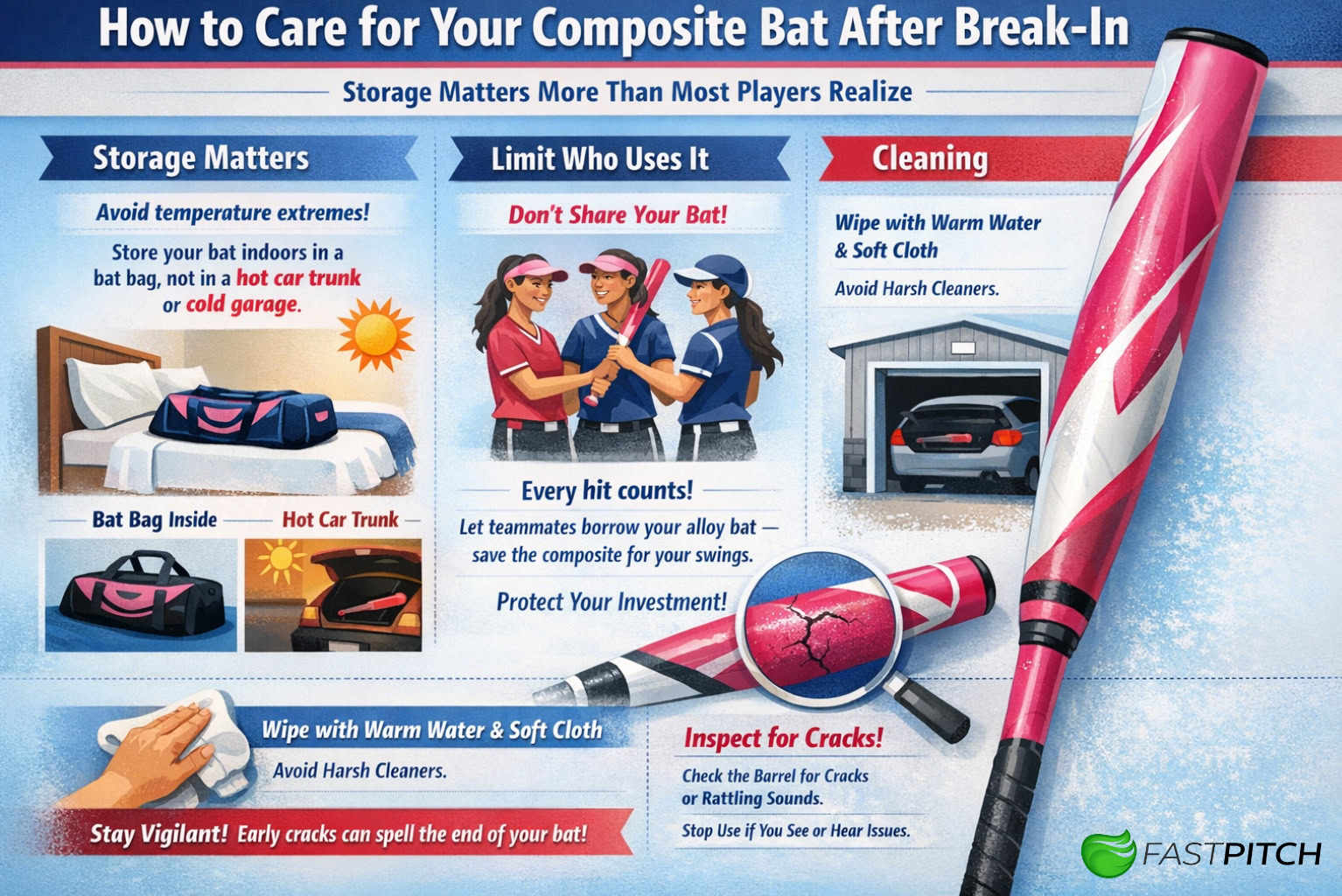
Storage Matters More Than Most Players Realize
A composite bat left in a hot car trunk in July or a cold garage in January is being exposed to temperature extremes it isn’t built for. High heat can soften the adhesive bonds between composite layers; extreme cold creates the brittleness issues already discussed.
Store your bat indoors, away from direct sunlight and temperature extremes. A bat bag in your bedroom or equipment closet is the right approach — not the trunk of the car between Saturday tournaments.
Limit Who Uses It
Every hit on a composite bat is part of its lifespan. A bat that gets borrowed by three teammates during batting practice is a bat that ages three times faster than it should.
This isn’t overprotection — it’s basic investment sense for a bat that costs $400. Let teammates use your alloy bat if you bring a spare. Keep the composite for your swings.
Cleaning
Wipe the barrel down with warm water and a soft cloth after use. Avoid solvents, alcohol-based cleaners, or anything abrasive. The exterior finish of a composite bat isn’t just cosmetic — it protects the underlying material from moisture penetration.
Inspect the barrel periodically for hairline cracks, especially around the sweet spot and the end cap junction. Early-stage cracking often sounds slightly different on contact — a dull or rattling sound where there used to be a clean ring. If you notice that, stop using the bat and contact the manufacturer.
FAQ: Composite Bat Break-In Questions
Can you break in a composite bat in a batting cage?
Yes — but only if the cage provides regulation leather softballs. If the cage uses dimpled rubber or plastic machine balls, don’t use your composite for break-in there. The harder surface of those balls puts disproportionate stress on a stiff, unbroken-in barrel and can cause cracking that voids your warranty.
How do you know when a composite bat is fully broken in?
Two reliable indicators. First, the sound changes — a properly broken-in composite produces a fuller, more resonant ring on solid contact compared to the flat, sharp sound of a new barrel. Second, the feel on mishits improves noticeably. Off-center contact that previously felt dead or stiff begins to carry better. If you’re 150–200 swings in and both of those things are true, your bat is ready.
Does a composite bat need to be re-broken in after being stored for a season?
Not typically. If the bat was properly broken in and stored correctly — indoors, away from temperature extremes — the barrel should return to its conditioned state within a dozen or so normal-use swings at the start of a new season. However, if the bat was stored in a vehicle or an unheated space through winter, inspect it carefully before use and ease back into full-power contact over the first few sessions.
What’s the difference between break-in for a one-piece vs. two-piece composite bat?
The break-in process and timeline are essentially the same. The main practical difference is what you’re conditioning. In a one-piece composite, the entire bat — barrel and handle — is a single continuous structure. In a two-piece design like the DeMarini Prism+ or Louisville Slugger LXT, the barrel and handle are separate components connected at a joint. The barrel breaks in the same way; the joint doesn’t require conditioning. Both follow the same 150–200 swing, three-phase process.
Final Word
Breaking in a composite bat correctly is a straightforward process — but it requires patience that a lot of players skip in their first session with a new bat. The phases aren’t complicated: start controlled, build gradually, use game balls, rotate the barrel, stay warm.
What you get on the other side of 150–200 swings is a bat performing at its actual ceiling — the level it was engineered to reach — rather than a stiff, underperforming version of itself.