The Debate That Comes Up Every Season
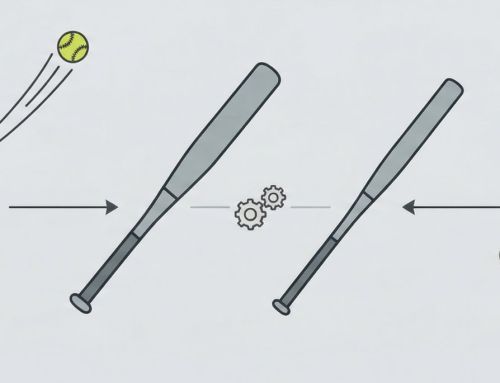
Walk into any dugout during a travel ball tournament, and you’ll hear it: composite or alloy?
Players swear by one or the other, parents ask which is worth the extra $150, and coaches have opinions that don’t always agree. The problem is that most of the answers online are vague, promotional, or quietly tied to which bat someone is trying to sell.
Here’s the reality: both materials are legitimate. Both have real strengths and real limitations. The one that’s right for you depends on how you train, where you play, and what you’re willing to invest in both money and time.
Fastpitch bat technology has changed more in the last 20 years than in the previous century combined — a point we cover in our softball facts guide for anyone who wants to understand how the equipment evolved before choosing between materials.
This breakdown will give you a clear, honest look at both options so you can stop guessing.
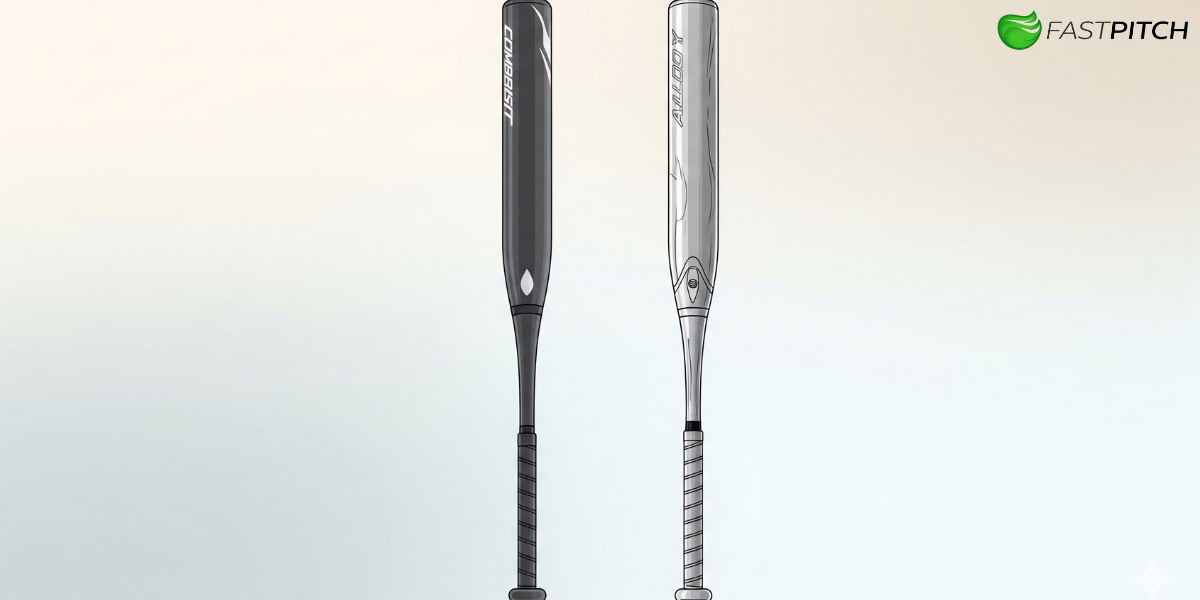
How Each Material Actually Works
Understanding the difference isn’t just about knowing which one sounds more advanced — it’s about understanding what happens to the ball on contact.
How composite barrels perform
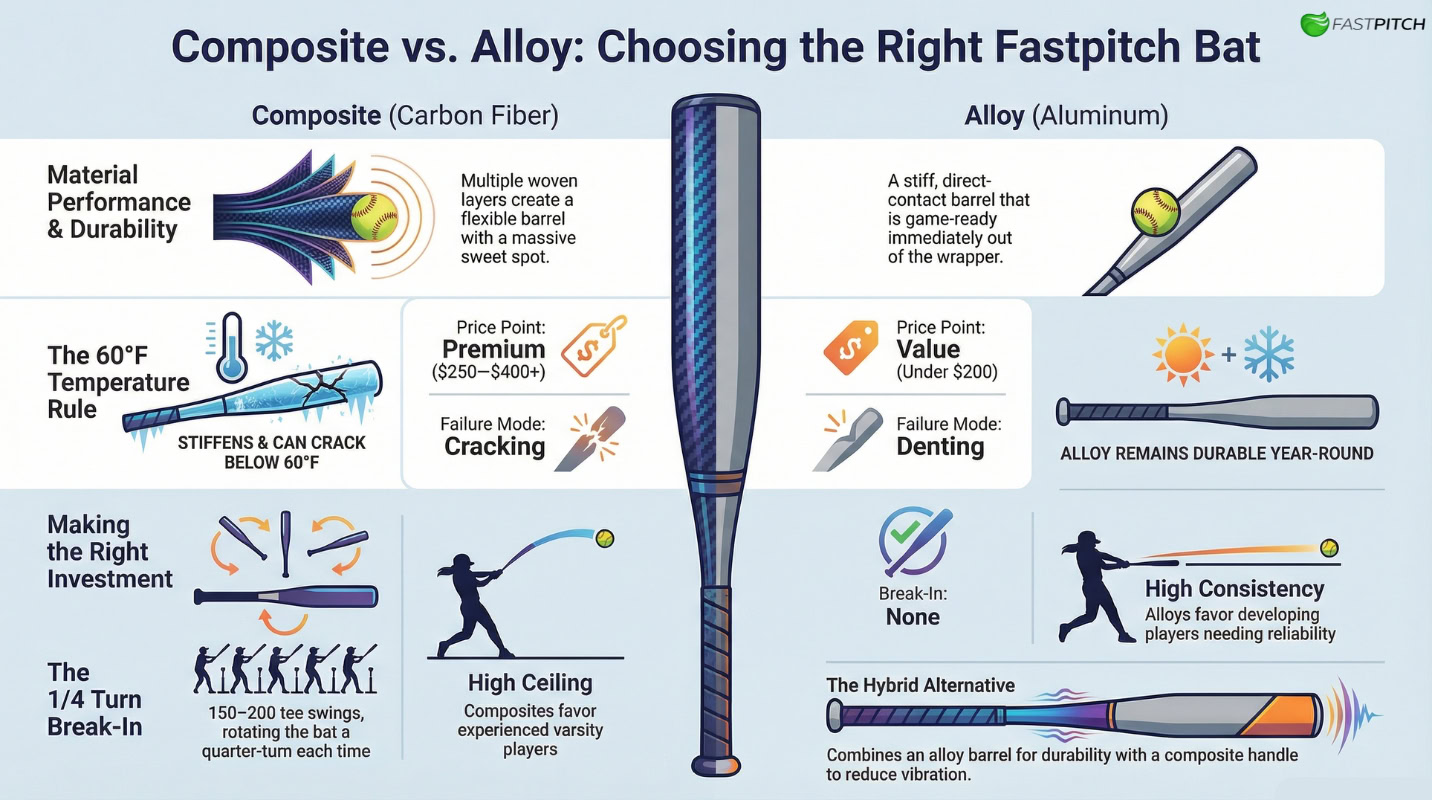
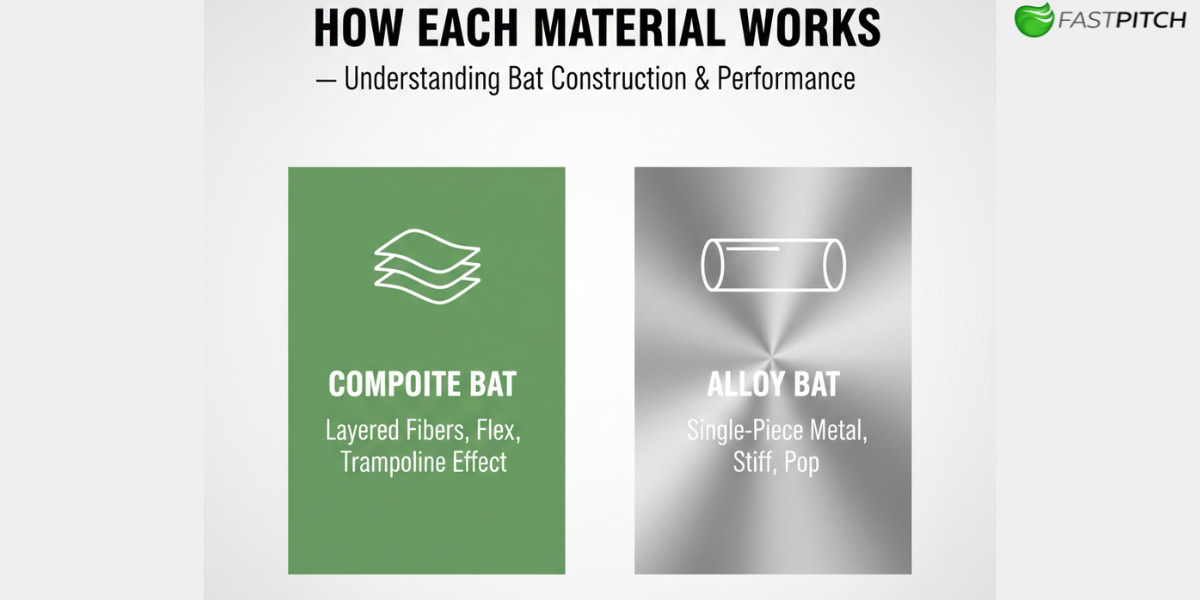
Composite bats are constructed from multiple layers of carbon fiber, woven and compressed into a barrel structure. That layered design gives engineers precise control over how the barrel flexes at the point of contact — a property called the trampoline effect, or more accurately, energy transfer.
When the ball compresses against a composite barrel, the barrel flexes inward slightly and then rebounds, pushing energy back into the ball. A well-broken-in composite barrel does this consistently across a wider sweet spot than most alloy bats can match.
The key phrase there is “well-broken-in.” The layered fibers need repeated use to loosen and reach their optimal flex level. Out of the wrapper, a composite bat performs at roughly 70–80% of its eventual ceiling. A proper break-in procedure — rotating the bat evenly and hitting off a tee through roughly 150–200 quality swings — is what unlocks the performance the bat is actually capable of.
How alloy barrels perform
Alloy bats are constructed from aluminum, sometimes blended with other metals, and formed into a single-wall or double-wall barrel. There are no fibers to loosen, and no trampoline effect to develop — what you feel on swing one is what you get on swing 500.
The performance profile of an alloy bat is consistent and immediate. The contact feel is stiffer and more direct, and the feedback on mishits — while occasionally more unpleasant — gives experienced hitters useful information about where they’re making contact.
At comparable price points, alloy bats typically offer a tighter sweet spot than composite, but the gap has narrowed considerably in recent years as alloy barrel engineering has improved.
Break-In — The Step That Changes Everything for Composite
The break-in process for composite bats is not optional. Skipping it, or doing it incorrectly, leaves performance on the table — and can actually reduce the bat’s lifespan if you go straight into game use before the fibers are ready.
The correct break-in method
The recommended process is straightforward but requires patience:
- Use a batting tee and hit real softballs (not rubber or cage balls)
- After each swing, rotate the bat roughly a quarter turn
- Aim for 150–200 total swings, evenly distributed around the barrel
- Start at 50–60% of your normal swing intensity and work up gradually over the first 75–100 swings
The goal is to compress and loosen the composite fibers uniformly around the entire barrel. Uneven break-in leads to uneven performance — and in worst cases, premature cracking on the section that absorbed disproportionate contact.
Cold weather and composite performance
This is where alloy holds a clear, practical advantage.
Composite barrels rely on fiber flexibility to generate their trampoline effect. Below approximately 60°F, those fibers stiffen — and a stiff composite barrel behaves more like an alloy bat without the benefits of alloy construction. Players in colder climates who use composite bats in early spring conditions often notice a real difference in performance during outdoor warmup games.
More critically, hitting with a composite bat in cold temperatures before the break-in is complete increases the risk of micro-fractures in the barrel — damage that typically voids manufacturer warranties.
If your season starts in cold weather, an alloy bat is a more practical choice for the early weeks, regardless of which material you prefer long-term.
Durability — Which One Lasts Longer?
Composite durability
A well-cared-for composite bat from a reputable brand will typically last 1–3 competitive seasons under normal use. The main failure mode is barrel cracking, which usually develops from one of three causes: cold-weather use before proper break-in, repeated mishits on the handle, or manufacturing defects.
Most major brands offer at least a one-year warranty on composite bats, covering defects but not misuse.
Alloy durability
Alloy bats don’t crack — they dent. A dented alloy barrel loses structural integrity and should be retired, but the durability window before denting occurs is generally longer than the composite cracking under comparable use. Alloy bats also don’t have cold-weather restrictions, making them usable year-round without condition management.
For players who train year-round, use multiple bats, or play in climates with dramatic temperature swings, alloy often provides a better overall cost-per-use ratio.
Performance Ceiling — Where the Materials Separate
Here’s the honest comparison most guides avoid.
A fully broken-in, high-end composite bat from a brand like DeMarini, Easton, or Louisville Slugger will outperform an alloy bat at an equivalent price point — in ideal conditions, with a mature swing, making consistent square contact.
But the conditions matter. If you’re still developing your mechanics, frequently making off-center contact, or playing in variable weather, the composite’s higher ceiling may be inaccessible to you — and an alloy bat will deliver more consistent, predictable results.
The composite advantage is real. It just requires the right player, the right conditions, and a properly executed break-in to access.
FAQ: Is composite worth the extra money for high school players?
For most high school players in travel or varsity programs — yes, if the budget allows and the player commits to the break-in process. A quality composite in the $250–$350 range will perform meaningfully better than an alloy at the same price once broken in. But a $400 composite swung by a player still working on mechanics won’t outperform a $200 alloy in the hands of someone with a more consistent swing. Prioritize fit and fundamentals first.
Price Comparison — What Each Material Costs
| Material | Entry Level | Mid Tier | High Performance |
|---|---|---|---|
| Alloy | $60–$130 | $130–$220 | $220–$320 |
| Composite | $130–$200 | $200–$300 | $300–$500+ |
| Hybrid (alloy/composite) | $180–$280 | — | — |
Hybrid bats occupy an interesting middle ground — they combine an alloy barrel (game-ready, no break-in) with a composite handle (reduced vibration, two-piece flex). They’re a reasonable option for players who want immediate performance without the break-in commitment, at a price point below premium composite.
Price Comparison — What Each Material Costs
Hybrid bats occupy an interesting middle ground — they combine an alloy barrel (game-ready, no break-in) with a composite handle (reduced vibration, two-piece flex). They’re a reasonable option for players who want immediate performance without the break-in commitment, at a price point below premium composite.

Which Players Should Choose Each Material?
Choose composite if:
- You’re in a serious travel ball or varsity high school program
- You can commit to a proper break-in routine before the season
- Your climate allows spring and fall games above 60°F
- Your budget allows $250 or more
- Your swing mechanics are consistent enough to benefit from a wider sweet spot
Choose alloy if:
- You’re a younger or developing player building fundamental mechanics
- Your season starts in cold weather (early March outdoor play, for instance)
- You need a reliable, game-ready bat immediately
- Your budget is under $200
- You prefer a stiffer, more direct feel on contact
FAQ: Can I use one bat for both practice and games?
You can, but dedicated practice bats extend the life of your game bat. Composite bats — particularly before full break-in — benefit from controlled tee work. Using a separate alloy bat for cage sessions and saving your composite for competitive games is a common and sensible approach for players who’ve invested in premium equipment.
The Bottom Line
Composite and alloy are not competing materials — they’re different tools for different situations. Composite offers a higher ceiling for experienced players in favorable conditions. Alloy offers consistent, reliable performance for a wider range of players, weather conditions, and budgets.
Neither choice is wrong. Choosing the right one requires an honest look at your game, your climate, and your commitment to the break-in process.
Once you know which material fits your needs, the next step is finding the specific bat that performs best within that category. Our complete breakdown of the best fastpitch softball bats covers the top-performing options in both composite and alloy — with honest evaluations of what each bat actually delivers.