You squared it up perfectly. You felt the connection. But the ball died in the outfield instead of flying over the head of the outfielder.
That’s not a timing problem. That’s a bat speed problem — and it’s fixable.
Bat speed is one of the most trainable skills in fastpitch softball. Players at every level — from travel ball freshmen to college starters — can add measurable mph to their swing with the right approach.
The challenge is that most training advice out there is either incomplete, too generic, or skips the most important step entirely.
This guide covers the whole picture: mechanics first, then drills, then strength training, then equipment. In that order.
Because without the right sequence, faster swings just reinforce bad habits.
What Is Bat Speed — and Why Does It Matter So Much?
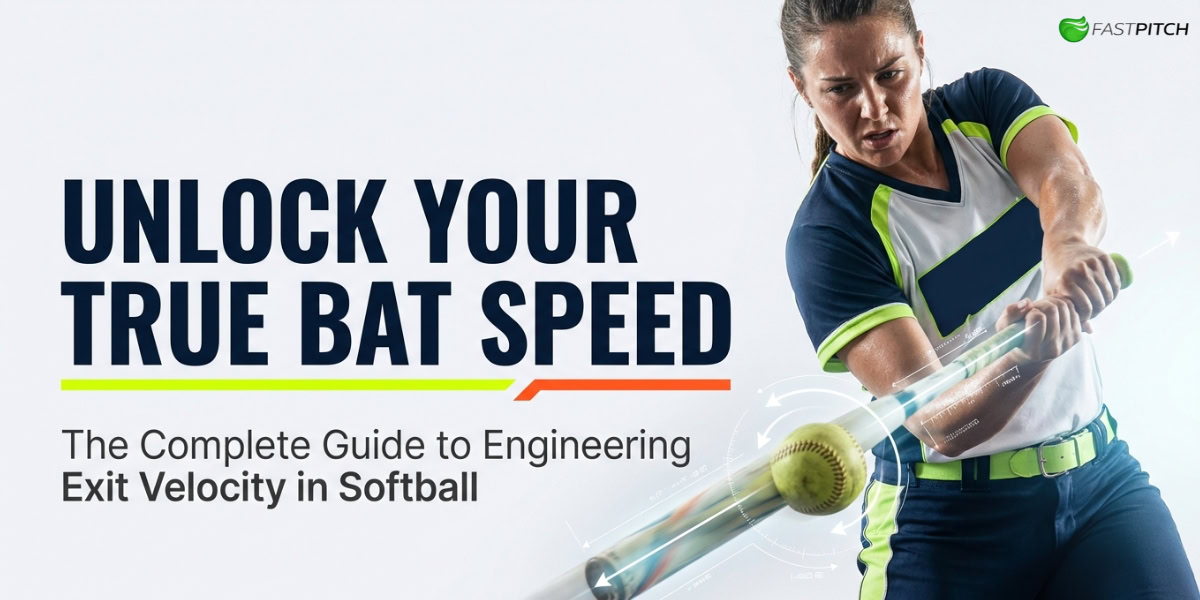
Bat speed is exactly what it sounds like: how fast the barrel moves through the hitting zone, typically measured at the point of contact. It’s usually tracked in miles per hour using a bat sensor or swing analyzer.
Here’s why it changes everything.
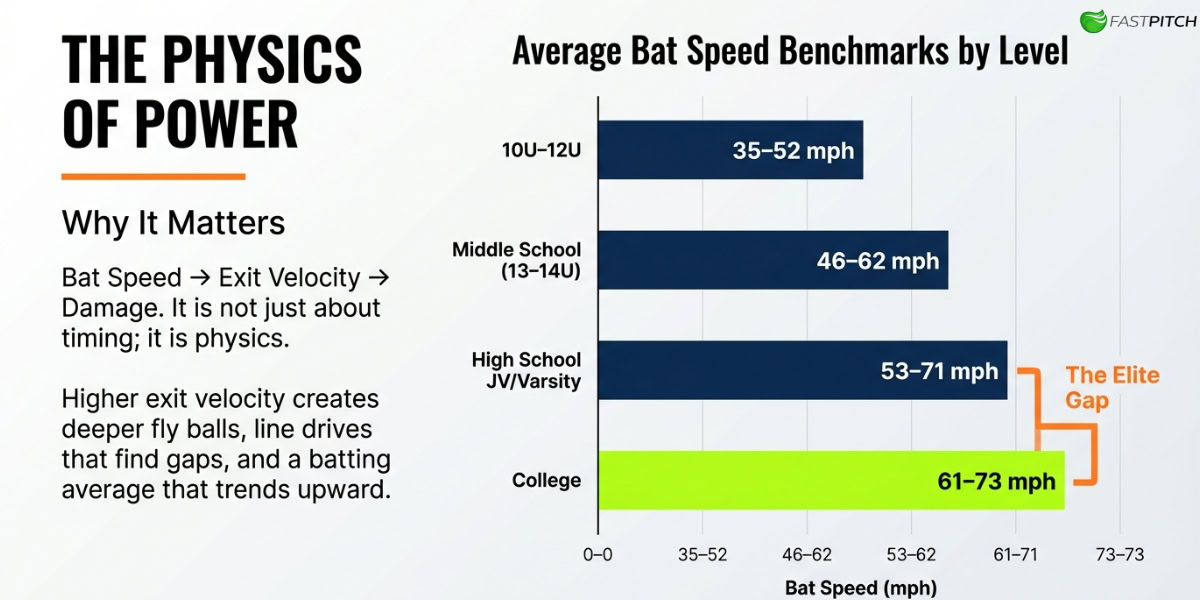
Bat speed directly drives exit velocity — the speed at which the ball leaves the bat. Higher exit velocity means harder hits, deeper fly balls, more line drives that find gaps, and a batting average that trends upward over a full season. High bat speed creates greater potential for higher exit velocity, which increases the distance the ball travels and the hitter’s ability to do damage at the plate.
Average bat speed benchmarks by level:
- 10U–12U: 35–52 mph
- Middle School (13–14U): 46–62 mph
- High School JV/Varsity: 53–71 mph
- College: 61–73 mph
If you’re below the benchmark for your level, bat speed training is one of the highest-leverage things you can work on right now.
“The fastest recorded softball pitch is now 79.4 mph — thrown by Karlyn Pickens at the 2025 NCAA Super Regional. At 43 feet, that gives batters a reaction window comparable to a 100 mph MLB fastball. For more context on what elite fastpitch demands from hitters, our softball facts guide puts those numbers into perspective.”
Quick Takeaway
Bat speed is the velocity of the barrel at contact. It directly determines exit velocity, ball distance, and overall hitting performance. Increasing bat speed increases offensive production.
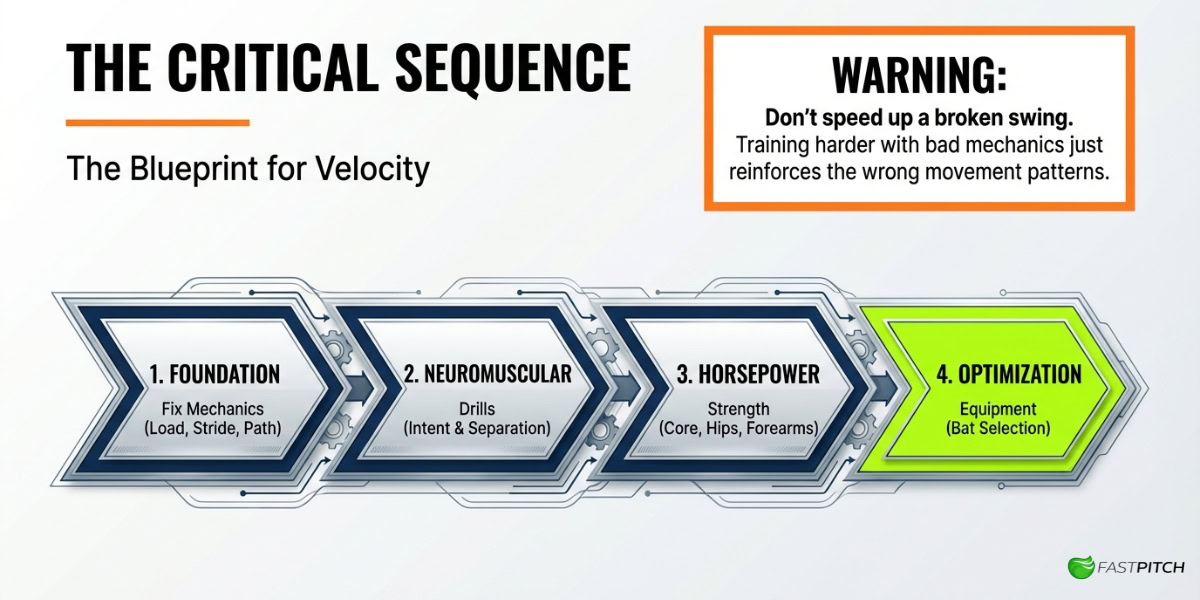
Step 1: Fix Your Mechanics First (Or Speed Training Backfires)
Here’s what most bat speed articles skip: if your swing mechanics are off, training harder just makes the wrong movement pattern faster. You end up swinging a broken swing at higher mph — which is worse, not better.
Before adding velocity, build the right foundation.
Load and Stride
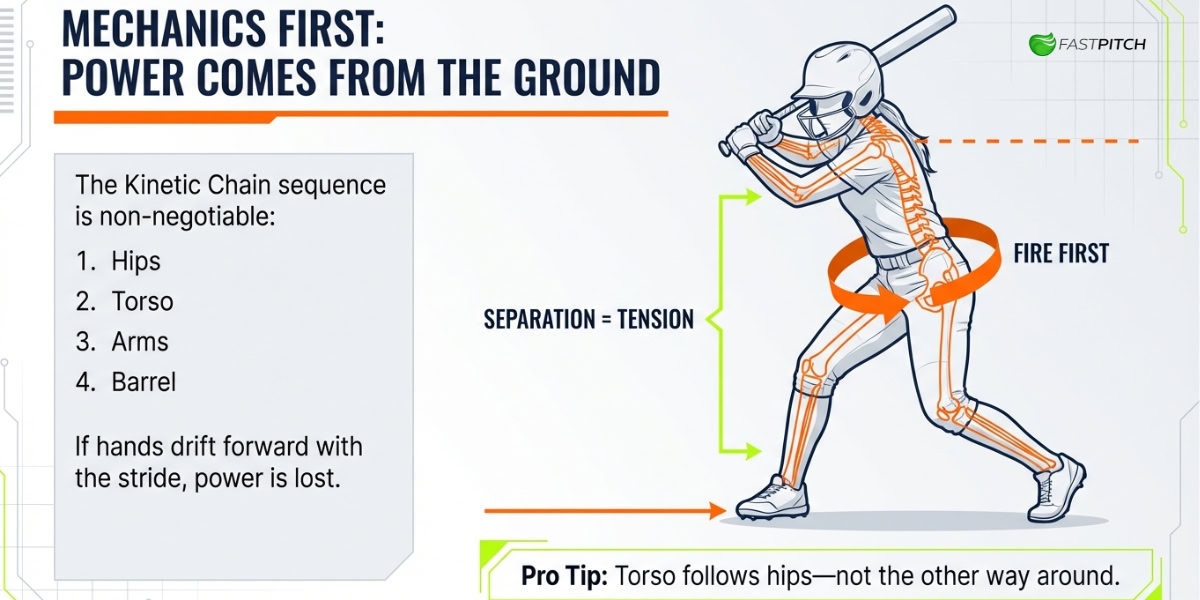
A proper load creates tension in the hips and hands. When you stride toward the pitcher, your weight shifts forward — but your hands and hips stay back. This separation is what generates the whip effect through the zone.
What to watch for:
- Hands drifting forward during the stride? You’ve lost your load — and your power with it.
- Striding too wide? You lock your hips and kill rotation before it starts.
Hip Rotation Leads the Swing
The hips fire first. Always. The hands follow. The bat follows the hands.
That sequence — hips → torso → arms → barrel — is the kinetic chain of a fast, powerful swing. Disrupting that order, even slightly, costs you mph. Most players who feel “weak” at contact are actually just reversing steps two and three — they’re pulling with their arms before their hips have opened.
Drill to build the habit: Hold a bat or a towel at waist height with both hands. Without moving your arms, rotate your hips as hard and fast as you can. Feel the torso follow the hips — not the other way around.
Keep the Barrel Path Short and Direct
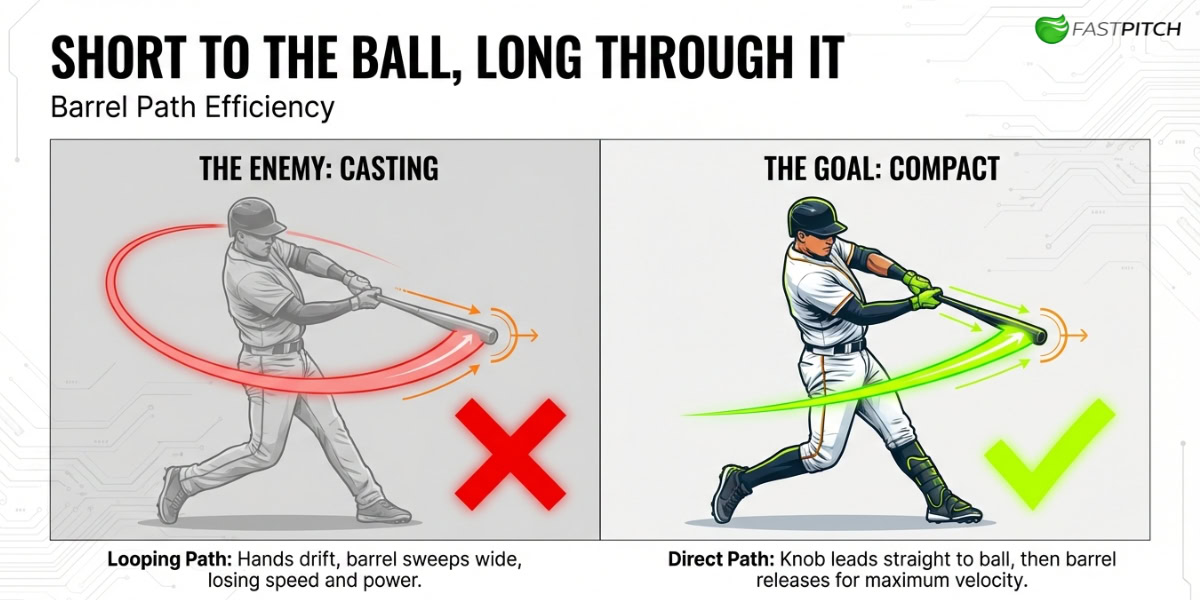
A long, looping swing path is the enemy of bat speed. The longer the route to contact, the more time the barrel spends traveling unnecessary distance — and the slower it arrives.
The goal is a compact, direct path: the knob of the bat leads toward the ball, then the barrel unleashes at contact. Think short to the ball, long through it.
Quick Takeaway
Proper swing mechanics are the foundation of bat speed. Without correct load, hip rotation, and barrel path, speed training reinforces inefficient movement patterns and limits results.
Step 2: Bat Speed Drills That Actually Work
These are the drills that produce measurable results. They’re built around the mechanical principles above — not just repetition for its own sake.
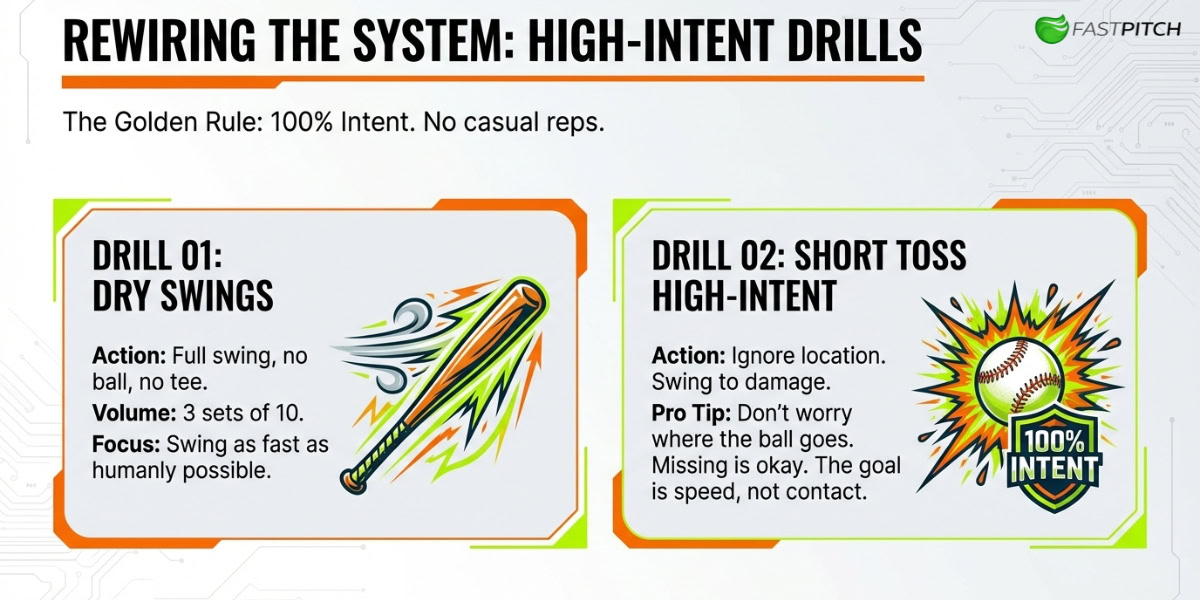
1. Dry Swing with Maximum Intent
Simple. Effective. Underused.
Stand in your hitting stance. Load. And then take a full swing with 100% intent — no ball, no tee, no distraction. The only goal is to swing the bat as fast as humanly possible.
Most players unconsciously hold back during normal practice because they’re focused on where the ball goes. Dry swings with max intent train your nervous system to fire at full speed. Do 3 sets of 10, 2–3 times per week during your off-season training block.
2. The Hip Separation Drill
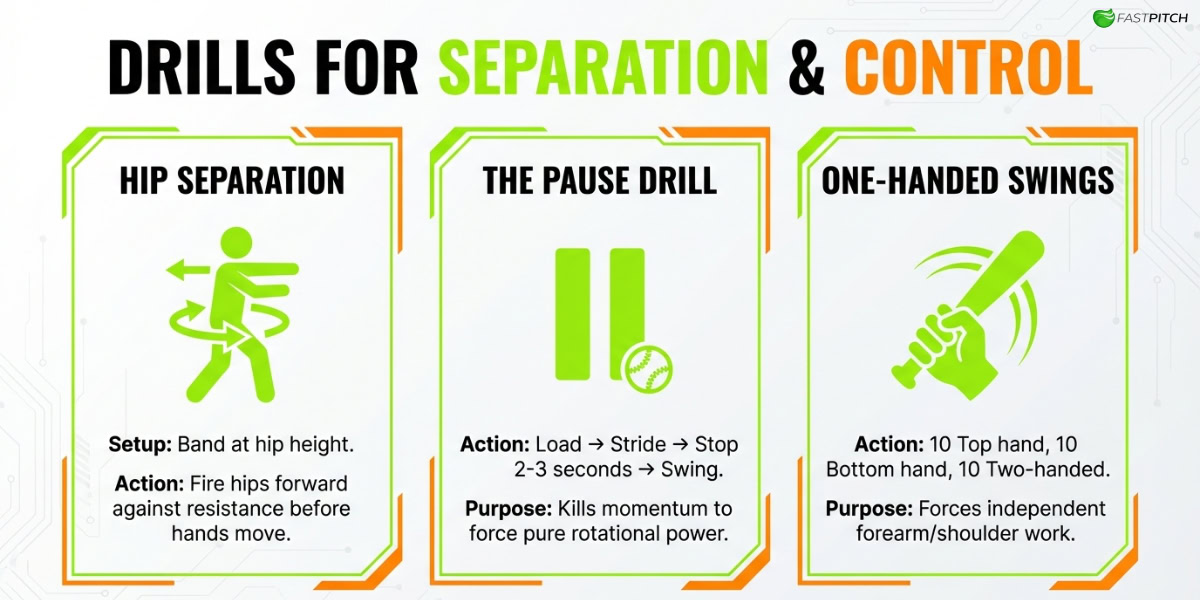
Use a resistance band or a light cable machine anchored at hip height behind you. Stand in your stance and loop the band around your waist. Load and stride — then fire your hips forward against the resistance before your hands move at all.
This drill teaches the feel of hip-first rotation in a way that’s hard to replicate otherwise. It’s uncomfortable at first. That’s the point.
3. One-Handed Bat Drills
This is one of the best swing-speed builders available — and you need nothing but a bat and a tee.
Choke up with your top hand only. Load, rotate, and swing through contact on the tee. The single-hand forces your forearm, wrist, and shoulder to do independent work. It exposes any weaknesses in your arm path and strengthens the exact muscles responsible for accelerating the barrel through the zone.
Do 10 swings with the top hand. Then 10 with the bottom hand. Then 10 two-handed swings immediately after. Notice how your two-handed swing feels faster.
4. Short Toss High-Intent Rounds
Have a partner toss from 15–20 feet. Your only job: swing as hard as you possibly can on every pitch.
Don’t worry about where the ball goes in these rounds. Don’t adjust for location. Don’t slow down on tough pitches. Max-effort swings only, every rep. This trains your nervous system to operate at full output — and when you return to normal hitting, controlled speed feels easier.
Do 3–4 rounds of 10 swings, twice a week.
5. The Pause Drill
Take your load and stride — then pause completely for 2–3 seconds before swinging.
That brief pause eliminates any momentum you’ve built and forces you to generate all your swing speed from a dead stop, using pure rotation and muscular power. It’s harder than it sounds, and it directly targets the hip-fire sequence described in Step 1.
Quick Takeaway
The best bat speed drills include maximum-effort dry swings, hip separation drills, one-handed swings, and high-intent short toss. These drills improve neuromuscular firing speed and barrel acceleration.
Step 3: Strength Training for Bat Speed
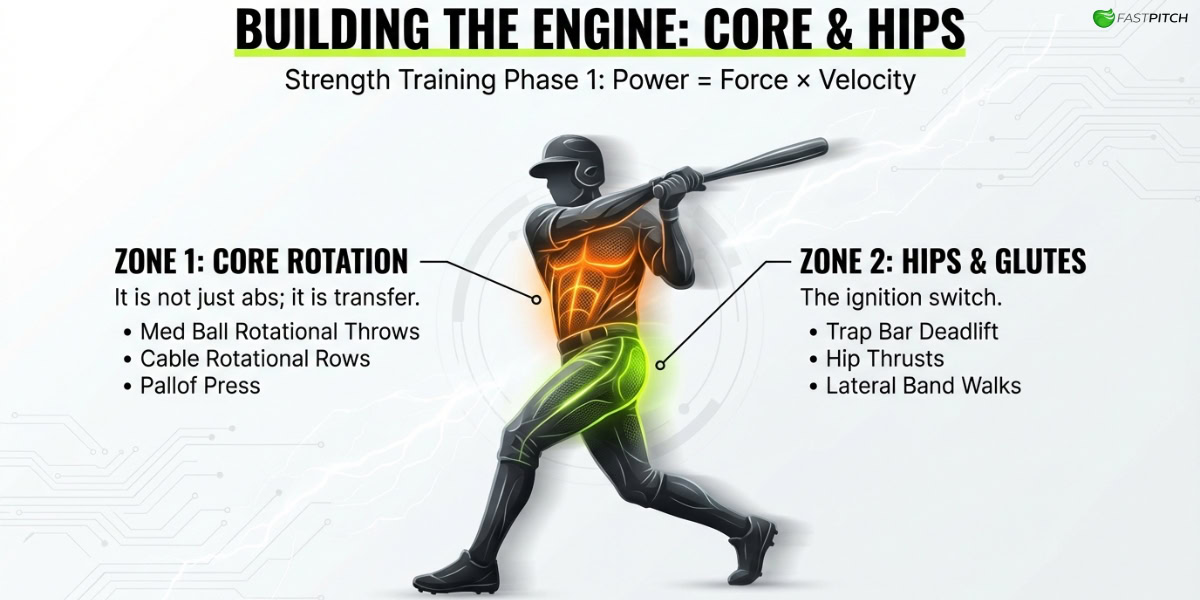
You don’t need to be big to swing fast. But you do need to be strong — specifically in the right places. Power equals force times velocity: you need a great foundation of strength, and you need to be fast. You can’t focus only on one aspect of power without focusing on the other.
Here are the key muscle groups to prioritize — and the exercises that build them efficiently.
Core Rotation (The Engine)
The core isn’t just your abs. It’s everything from your hips to your chest — all the muscles responsible for transferring power from your lower body into your arms and hands.
Best exercises:
- Medicine ball rotational throw: Stand sideways to a wall. Load, rotate hard, and throw the medicine ball into the wall as explosively as possible. Catch and repeat. Start with a 6–8 lb ball, 3 sets of 10 per side.
- Cable or band rotational row: Anchor a resistance band at chest height. Stand sideways, pull across your body in one explosive rotation. This mimics the swing sequence exactly.
- Pallof press: Anti-rotation exercise that builds the stability needed to transfer force without energy leaking through your core.
Hips and Glutes (The Ignition)
Your hips are the first thing that moves in a fast swing — and the glutes are what power them. Most fastpitch players underestimate how much lower-body drives bat speed.
Best exercises:
- Trap bar deadlift: A full-body strength builder that develops the posterior chain — glutes, hamstrings, lower back — that drives hip rotation. Start with 3 sets of 5.
- Hip thrust: Loaded hip extension. Sit with your upper back on a bench, bar across your hips, and drive straight up. This is the most direct glute-builder available.
- Lateral band walks: Light, but critically important for hip abductor strength. These muscles stabilize your hip during the stride and allow your rotation to be explosive rather than shaky.
Forearms and Grip (The Accelerator)
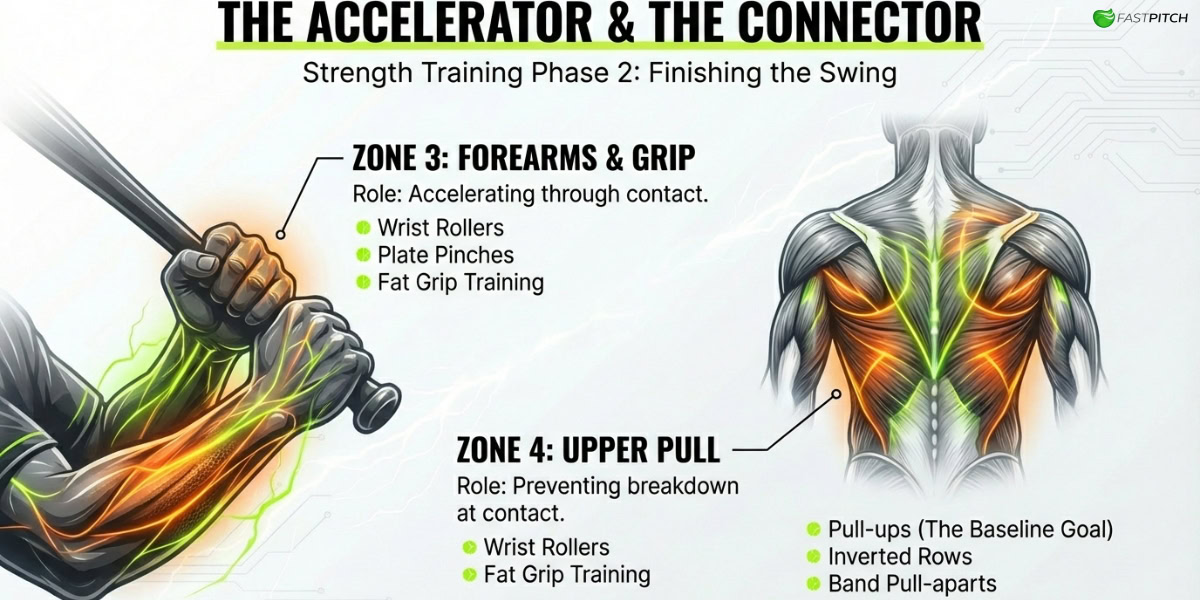
The forearms don’t start the swing — but they finish it. Strong forearms let you accelerate the barrel through the zone and keep it on path through contact.
Best exercises:
- Wrist roller: A dowel rod with a rope and a small weight. Roll the weight up and back down using only your forearms. 3 sets, 2–3 times per week.
- Plate pinches: Pinch two plates together between your fingers and hold for a time. Simple, brutal, effective.
- Fat grip training: Add thick grip attachments to any pulling movement — rows, pull-downs, or pull-ups. This builds the entire forearm far faster than isolation work alone.
Upper Body Pull Strength (The Connector)
Strong back and rear shoulders allow your arms to accelerate and pull through without breaking down at contact. Most softball players need far more upper body strength — the pull-up and chin-up are among the best exercises available, and most female athletes, including college athletes, cannot yet perform one full repetition. That’s your baseline goal.
Best exercises:
- Inverted rows
- Cable rows
- Band pull-aparts
- Progressed chin-up work
Quick Takeaway
Bat speed increases through rotational core strength, explosive hip power, and strong forearms. Lower-body force generation is the primary driver of swing velocity.
Step 4: Overload and Underload Training
This is one of the most research-supported methods for increasing bat speed — and one of the most misunderstood.
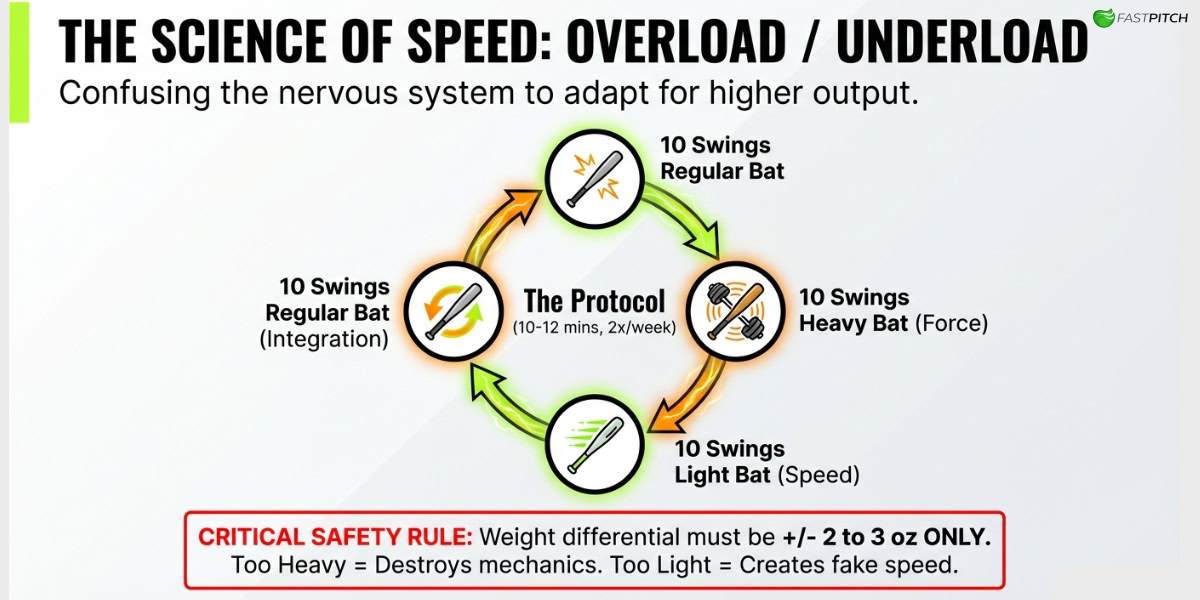
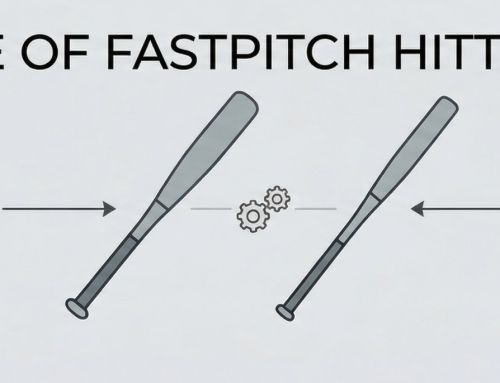
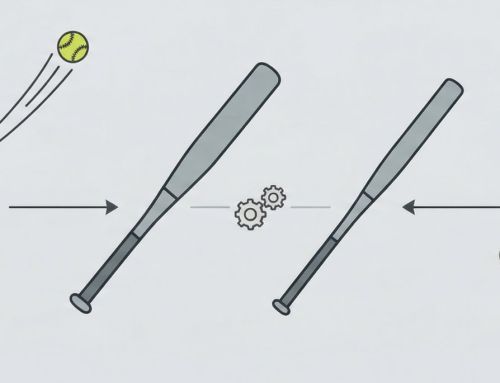
The concept is simple. You alternate between swinging a heavier-than-normal bat (overload) and a lighter-than-normal bat (underload), combined with your regular game bat.
Why it works: Your nervous system adapts to the resistance it encounters. Overload training builds force production. Underload training teaches your muscles to move faster than they’re used to. Alternating between the two, and finishing with your regular bat, trains your body to produce both force and velocity simultaneously.
The protocol: One overload/underload session should take about 10–12 minutes. Do it twice a week.
- 10 full swings with your regular bat
- 10 full swings with the heavier bat (2–3 oz heavier than your game bat)
- 10 full swings with the lighter bat (2–3 oz lighter than your game bat)
- 10 full swings with your regular bat again
Repeat for 3 cycles. Take a 2-minute rest between cycles.
Critical rule: Every single swing is a maximum-effort swing. Slow, casual reps in this protocol are wasted reps. The adaptation only happens when your nervous system is pushed to its limit.
Important: Research consistently shows the weight differential should stay within 2–3 ounces in either direction. Going too heavy throws off your mechanics; going too light creates swing patterns that don’t transfer to your game bat.
Quick Takeaway
Overload and underload training alternates bats that are 2–3 ounces heavier and lighter than a game bat. This method improves force production and swing speed when performed at maximum intent.
Step 5: Choose a Bat That Lets You Swing Faster
Equipment won’t replace technique or training. But the wrong bat actively limits the bat speed you’ve already built.
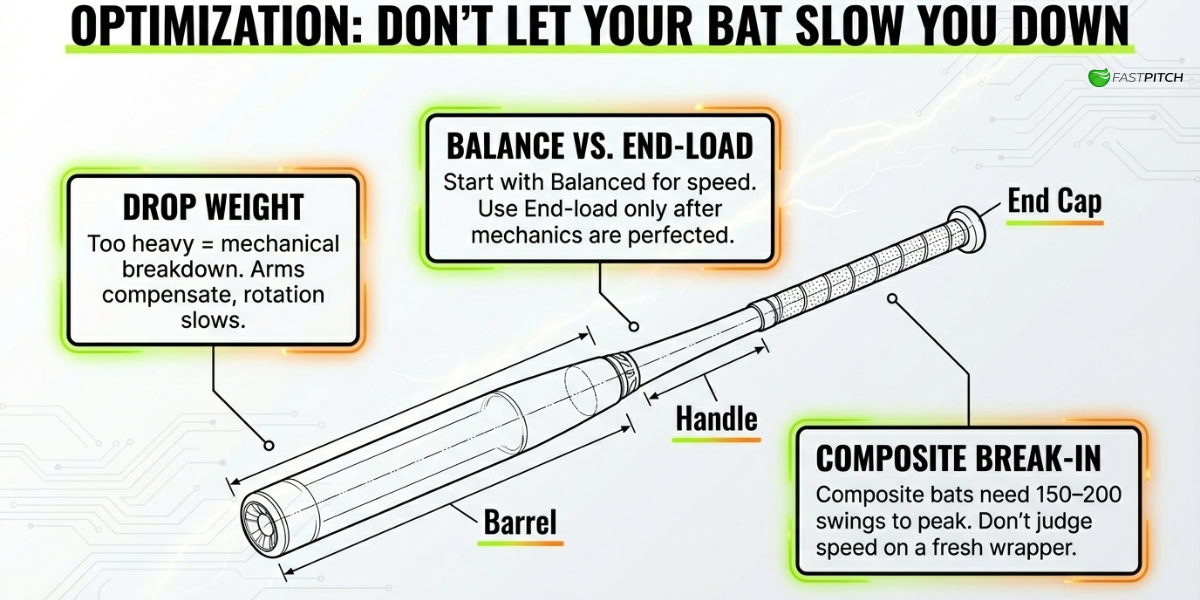
Drop weight matters more than most players realize. A bat that’s too heavy for your current strength level will cause your swing mechanics to break down under load — your arms compensate, your hip rotation slows down, and your bat speed drops. A bat that’s properly matched to your strength lets your mechanics stay clean at full speed.
Balance vs. end-loaded: Balanced bats allow faster swing speeds for most hitters. End-loaded bats add power but require more strength to maintain bat speed through contact. If you’re still developing your swing speed, start with a balanced bat.
Barrel and material: Composite bats generally produce a larger sweet spot and more efficient energy transfer than alloy once they’re properly broken in. If you’re training for bat speed, a high-quality composite bat lets you feel the results of your work more immediately.
The same principle applies to length — a bat that’s even an inch too long structurally delays the barrel through the zone on inside pitches. Our fastpitch bat length guide covers how to match both specs to your swing before you buy.
If you’re not sure which bat gives you the best combination of swing speed and performance, our complete guide to the best fastpitch softball bats breaks down every top model by swing type, level, and budget — with real testing behind every pick.
Quick Takeaway
Bat choice affects swing efficiency. A balanced bat matched to the player’s strength allows full-speed mechanics, while a bat that is too heavy reduces bat speed and control.
How to Track Your Progress
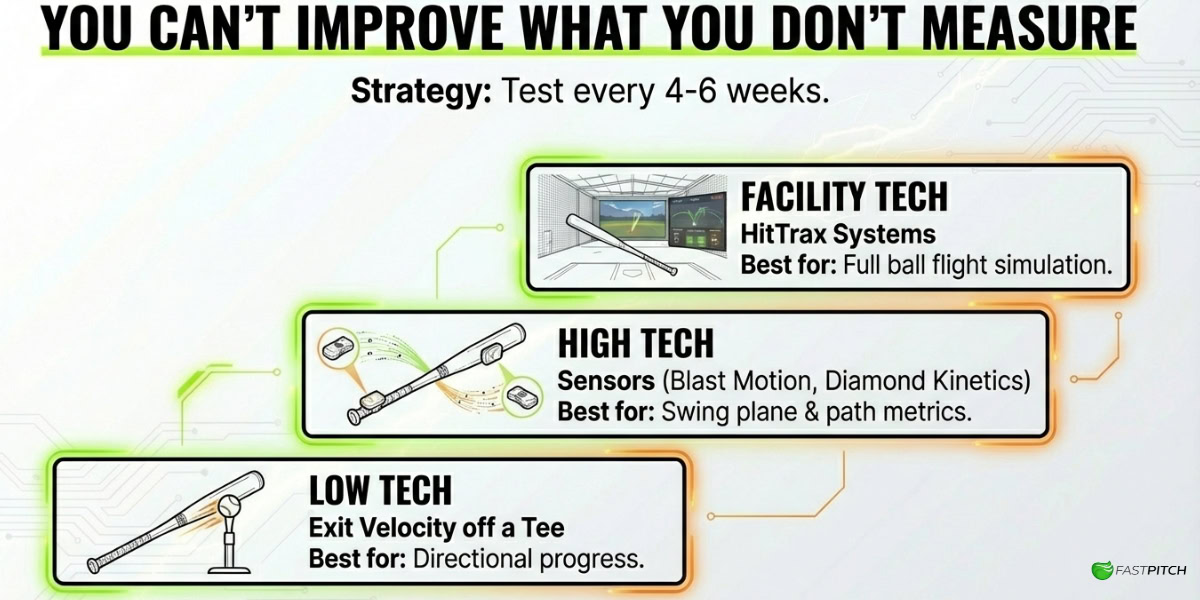
You can’t improve what you don’t measure. If you’re serious about increasing bat speed, track it every 4–6 weeks so you can see what’s working.
Tools worth using:
- Blast Motion sensor — attaches to the knob, connects to an app, tracks bat speed per swing
- Diamond Kinetics SwingTracker — similar functionality, detailed swing analytics
- HitTrax systems — available at many training facilities, tracks exit velocity alongside bat speed
Even without a sensor, you can track directional progress through exit velocity measurements off a tee. A consistent increase in exit velocity is a reliable proxy for improving bat speed.
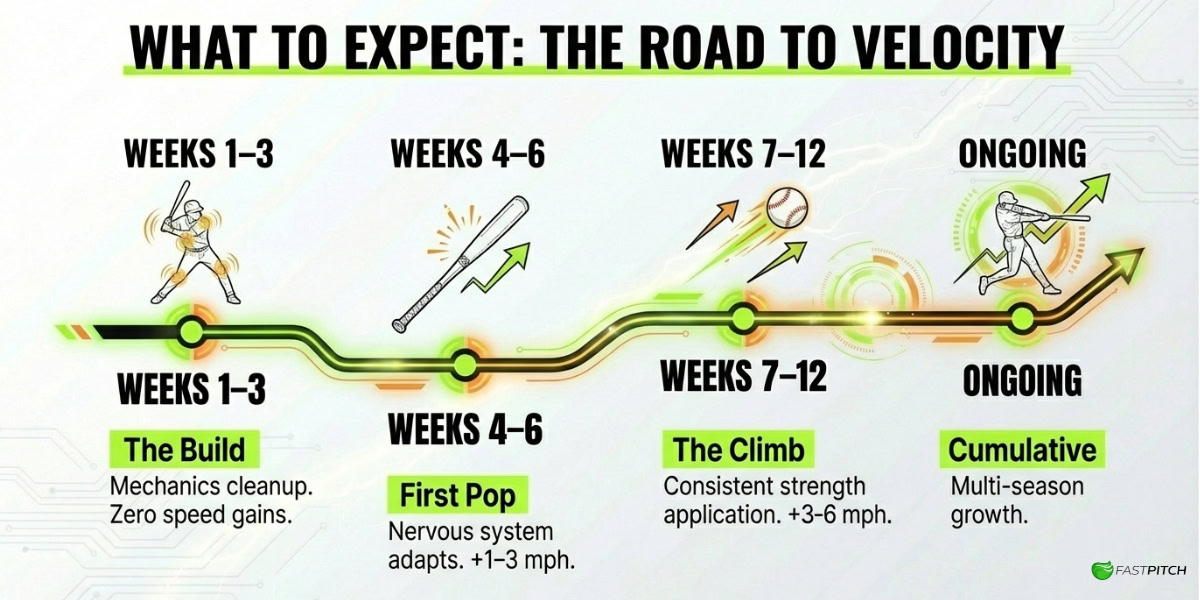
The Bat Speed Training Timeline: What to Expect
Players ask this constantly, so here’s an honest answer.
Weeks 1–3: Mechanics cleanup and drill foundation. You may not see speed gains yet. You’re building the pattern.
Weeks 4–6: First measurable gains, typically 1–3 mph, from drills plus strength work. Your swing will start to feel different — more connected, more explosive at contact.
Weeks 7–12: Consistent gains if training has been consistent. Most players in this window gain 3–6 mph over their starting baseline. Some gain more.
Ongoing: Bat speed development doesn’t plateau quickly. Players who commit to a structured off-season program for 2–3 seasons in a row see cumulative gains that fundamentally change how they perform at the plate.
Common Mistakes That Kill Bat Speed
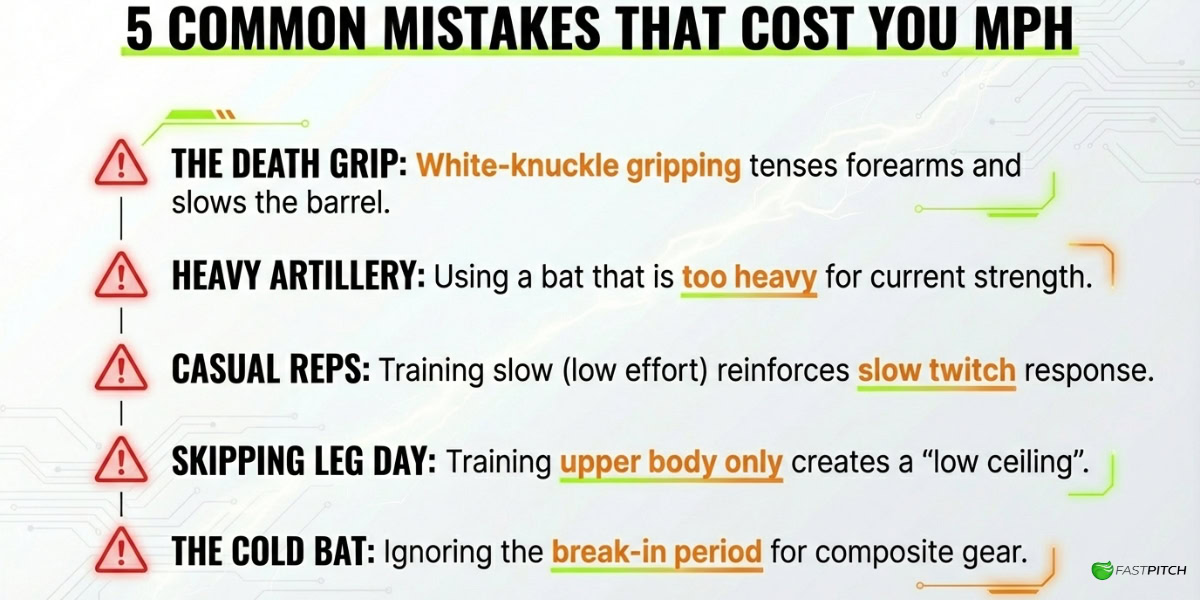
Avoid these — they’re more common than you’d think, and each one costs real mph.
- Gripping too tight: A white-knuckle grip tenses your forearms and slows the barrel. Hold the bat firmly in your fingers — not crushed in your palms. Tension is the enemy of speed.
- Using a bat that’s too heavy: If you can’t maintain mechanics through the full swing, the bat is working against you.
- Training slow: Low-effort reps in bat speed drills just reinforce slow movements. Every swing in speed-focused work should be max effort.
- Skipping lower body work: The hips generate speed. Players who only train their upper body build a ceiling they can never break through.
- Ignoring break-in: Composite bats need 150–200 proper swings before the barrel performs at its peak. Swinging a new composite bat at full power before it’s ready is a mechanical disadvantage.
Final Thoughts
Bat speed is not a gift some players are born with, and others aren’t.
It’s a skill. A trainable one. Built through consistent mechanics work, intentional drilling, targeted strength training, and smart equipment choices — done in the right sequence, over enough time.
Start with your mechanics. Build rotational strength. Add high-intent drills. Layer in overload/underload training. And make sure your bat is actually working for you, not against you.
Players who follow this process consistently — even for just one off-season — swing a measurably different bat by the time the next season starts. That’s not an exaggeration. That’s what the training produces.
Now go put in the work.