
The beloved game of softball has won the affection of numerous Americans and individuals globally since its inception. Since its establishment, the sport has evolved significantly, and it continues to expand rapidly in contemporary times.
Over the years, the sport has experienced numerous modifications in its rules and equipment. It was introduced as an Olympic event during the 1996 Atlanta Olympics, but was subsequently removed from the 2012 London Olympics and the 2016 Rio Olympics, only to make a return for the 2021 Tokyo Olympics. It was then removed again, but it will make a return for the 2026 Olympics!
Like any other sport throughout history, softball has faced its share of challenges, yet it continues to flourish worldwide, showing no signs of slowing down.
If you are interested in learning more about its fascinating history and the reasons it is now enjoyed by 40 million Americans annually, you have arrived at the right destination.
Let us explore further.
How a Boxing Glove and a Broomstick Started It All
Most sports have a planned origin story. Softball doesn’t.
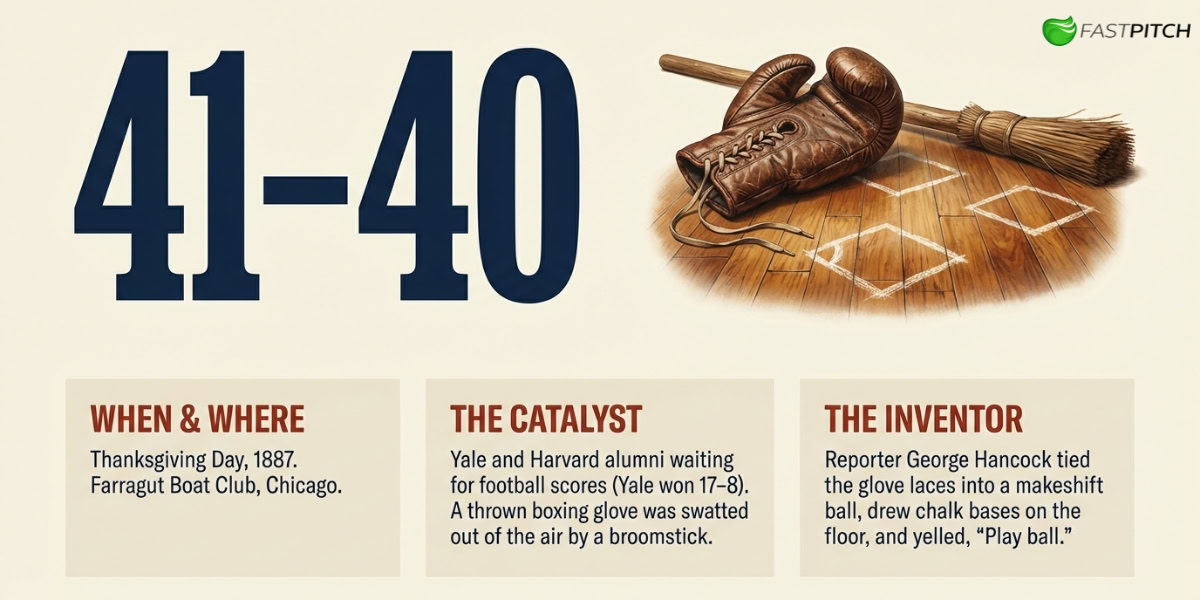
On Thanksgiving Day, 1887, a group of Yale and Harvard alumni gathered inside the Farragut Boat Club in Chicago, anxiously waiting to hear the result of the Harvard-Yale football game. When news came that Yale had won 17–8, one enthusiastic Yale supporter grabbed an old boxing glove and threw it at a nearby Harvard fan — who instinctively swatted it back with a broom handle.
George Hancock, a reporter for the Chicago Board of Trade who was watching, had an idea. He tied the laces of the boxing glove into a makeshift ball, drew bases on the floor with chalk, and called out: “Play ball.”
The first softball game in history ended with a score of 41–40. The sport that 40 million Americans now play every summer was born from a Thanksgiving celebration and a bit of athletic improvisation.
From Indoor Baseball to “Softball”: The Early Years (1887–1934)
George Hancock’s Game Grows Up
In the weeks following that first game, Hancock formalized what he had created. He designed a proper bat and ball for the new sport — originally called “indoor baseball” — which was intended to keep baseball players fit during the winter months. The following spring, Hancock took the game outdoors, adapting it for smaller fields that couldn’t accommodate a standard baseball diamond.
By 1889, the Farragut Boat Club had established the first softball league and codified a foundational set of rules.

The Farragut Boat Club In Chicago, USA (Chicagology)
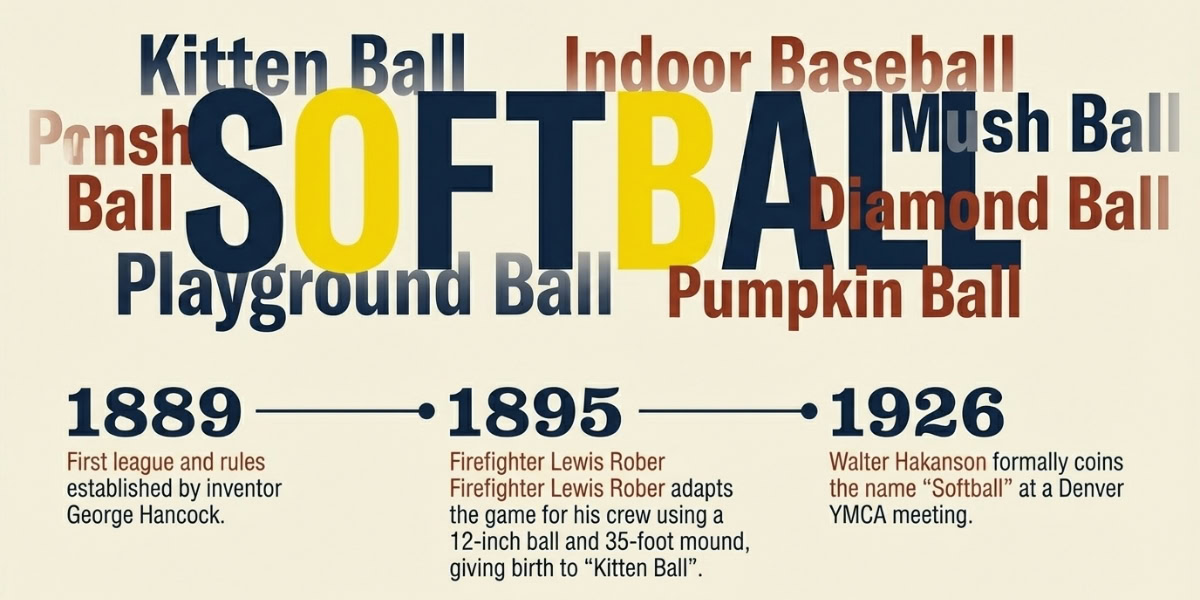
The sport spread steadily through the Midwest. In Minneapolis, a Fire Department lieutenant named Lewis Rober introduced the game to his crew as an off-duty fitness activity. Rober’s version used a 12-inch ball — smaller than Hancock’s original 16-inch sphere — and a pitcher’s mound set 35 feet from home plate. His team was called the Kittens, which led to one of the sport’s many early nicknames: Kitten Ball.
The Name Problem
For nearly four decades, the sport struggled with its own identity. Depending on where you lived, you might have called it:
- Kitten Ball
- Indoor Baseball
- Mush Ball
- Diamond Ball
- Playground Ball
- Pumpkin Ball
The name that stuck — softball — was coined in 1926 by Walter Hakanson, a YMCA official from Denver, at a meeting of the National Recreation Congress. By the early 1930s, the name had been formally adopted nationwide.
The very first softball game was played on Thanksgiving Day, 1887 — and the final score was 41–40. The entire game was organized and completed within about an hour, entirely indoors, using a rolled-up boxing glove and a broom handle.
The 1933 World’s Fair Changes Everything
The Depression Era was, paradoxically, one of softball’s best growth periods. The sport required minimal equipment — just a bat and a ball — and games could be played on small urban lots. It was accessible in a way that few sports were.
In 1933, Leo Fischer and Michael Pauley organized a national softball tournament as part of the Chicago World’s Fair. What they anticipated would be a modest event drew 70,000 spectators for the opening round alone. That tournament featured three divisions: men’s fastpitch, slow pitch, and women’s softball — confirming that the women’s game had already established its own audience.
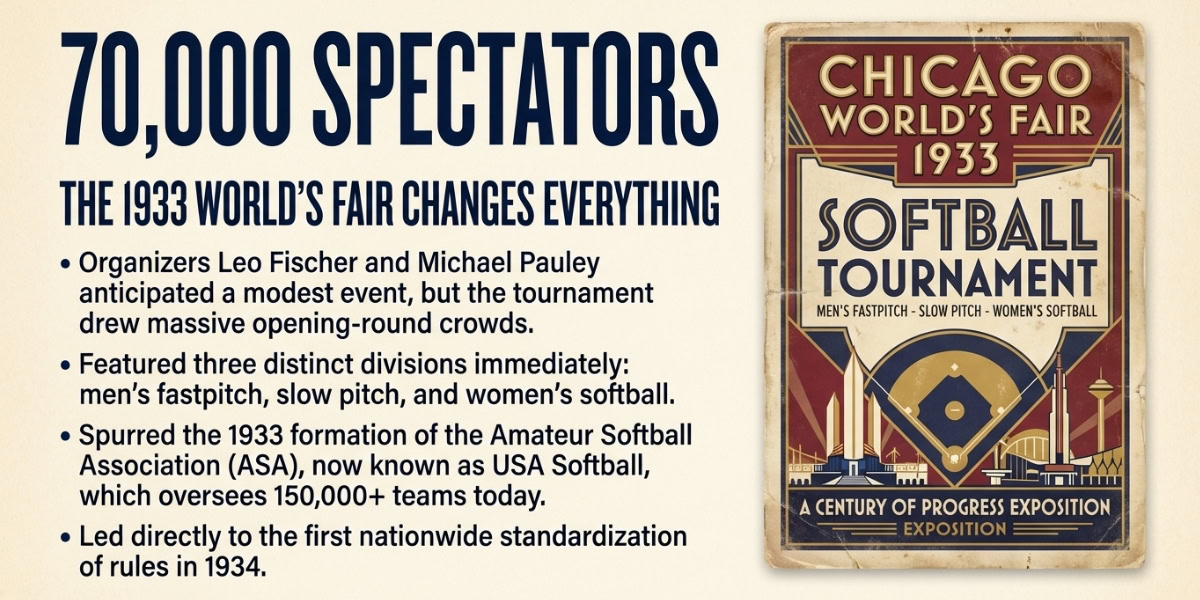
The same year, the Amateur Softball Association (ASA) was formally organized, giving the sport its first true national governing body. In 1934, the Joint Rules Committee on Softball standardized the rules for the first time, effectively ending the patchwork of regional variations that had defined the sport’s first 50 years. The ASA has since become USA Softball, now overseeing more than 150,000 amateur teams nationwide.
Softball evolved from an improvised indoor game into a nationally organized sport within 50 years. The 1933 World's Fair tournament — watched by 70,000 fans — and the founding of the ASA gave the sport the institutional foundation it needed to grow well beyond Chicago's city limits.
The Rise of Women’s Fastpitch Softball (1930s–1970s)
Why Women Claimed Fastpitch
Softball’s origins were largely male-dominated, but that shifted decisively in the 1930s and 1940s. At a time when few competitive team sports were open to women, fastpitch softball offered a genuine alternative. The national tournament established women’s divisions from the outset, and by the end of the 1930s, women’s fastpitch teams had formed in cities and towns across the country.
The sport’s Depression-era accessibility worked in women’s favor too. Games required minimal infrastructure, traveled to local parks, and drew real crowds — sometimes 2,000 to 5,000 fans for a single match. Teams like the Connecticut Raybestos Brakettes and the New Orleans Jax Maids were drawing regional followings comparable to minor league baseball.
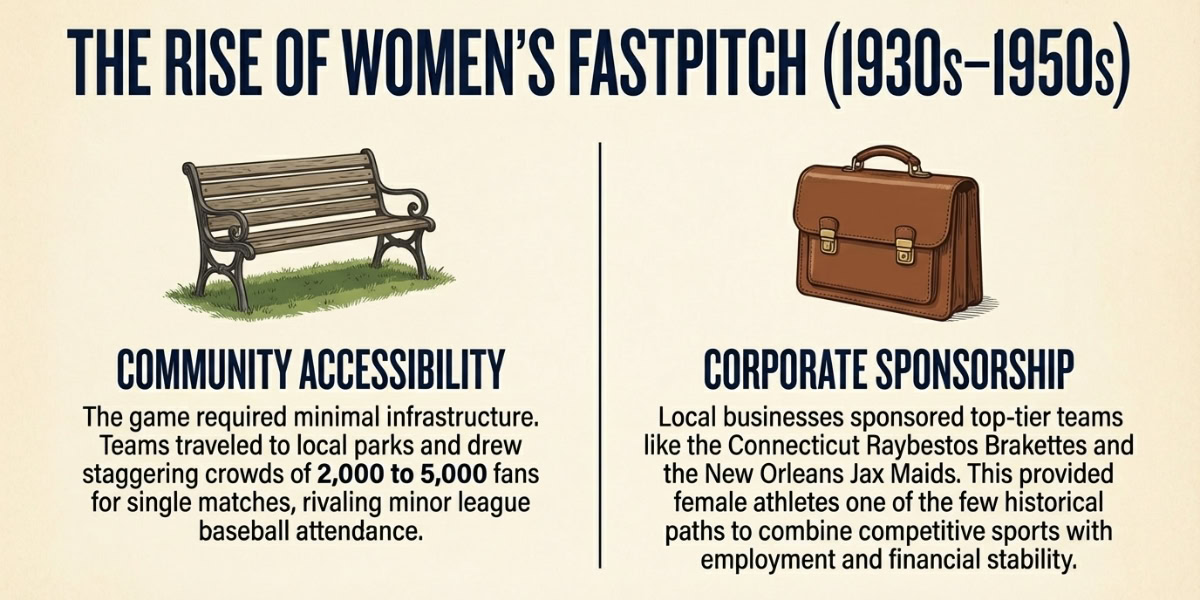
For many women, playing fastpitch softball meant more than athletic competition. Top-tier teams in the 1940s and 1950s were often sponsored by local businesses, which provided their players with employment, giving women in that era one of the few paths to combine athletic achievement with financial stability.
A fastpitch pitch at 70 mph from 43 feet gives the batter just 0.35 seconds to react — roughly equivalent to facing a 100+ mph fastball in MLB. The Guinness World Record for fastest softball pitch is 79.4 mph, set by Tennessee's Karlyn Pickens in May 2025.
The Pitching Distance Evolution
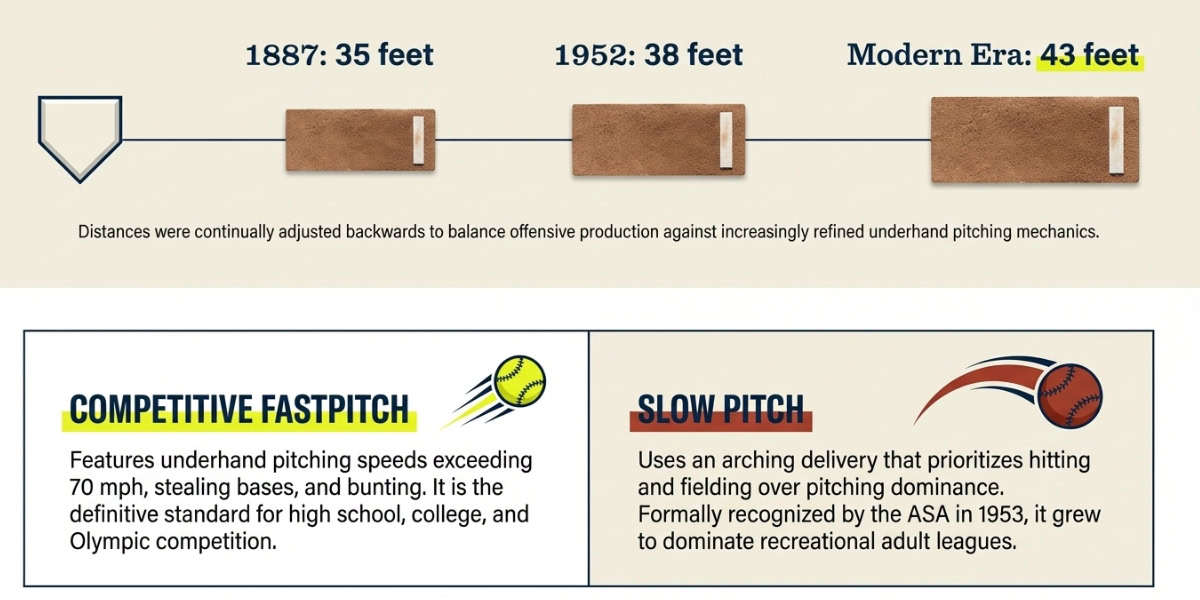
One of the clearest markers of fastpitch’s development is how the pitching distance changed as coaches and governing bodies better understood the game’s mechanics:
| Era | Distance | Context |
|---|---|---|
| 1887 | 35 feet | Original indoor game at the Farragut Boat Club |
| 1930s–40s | 38–40 feet | Early standardization under ASA rule committees |
| 1950s–60s | 40 feet | Growth of sponsored women's fastpitch leagues |
| 1970s–80s | 40–43 feet | Title IX era — college programs rapidly expanding |
| Modern | 43 feet | Current standard — NCAA, USA Softball & Olympic level |
Each adjustment was made to balance offensive production against the increasingly refined underhand pitching mechanics that define fastpitch at its competitive peak. A top collegiate pitcher today can deliver pitches exceeding 70 mph — faster, relative to reaction time, than a 95-mph MLB fastball.
Softball in the 1950s and 1960s
In 1952 the international governing body for softball was founded, the International Softball Federation (ISF) was founded. Slowpitch softball was officially recognized a year later, in 1953, when it was added in ASA (now USA Softball) softball program. The ISF now has 124 member federations and organizes world championship competitions in all versions of softball: slow pitch, fast pitch and modified pitch.

Wilson Official Rules Of Softball From 1950
1965 was an enormous year for softball; the first-ever Women’s Softball World Championship was held in Melbourne, Australia. Australia has been crowned World Champions, with the runners-up being the United States. This tournament is still being organized; the most crowned country in the history of the tournament is the United States with 15 medals, 11 gold, and 4 silver. The second most successful country is Japan with 11 medals, 3 gold, 6 silver, and 2 bronze.
The men’s version of the tournament began a year later, in 1966. New Zealand is the most crowned country with 13 medals followed by the United States with 9 medals.
Slow Pitch Gets Its Own Lane
Not every player wanted the intensity of competitive fastpitch. Slow pitch softball — which emphasizes offense and fielding over pitching dominance — was formally recognized by the ASA in 1953. Within a decade, it had surpassed fastpitch in overall participation numbers, particularly among recreational adult leagues. The two formats have coexisted ever since, serving different audiences within the broader softball community.
Title IX and the College Explosion
The 1972 passage of Title IX fundamentally reshaped women’s athletics in the United States — and softball was one of the sport’s most direct beneficiaries. With schools now legally required to provide equitable athletic opportunities for women, softball programs and scholarships grew rapidly through the 1970s.
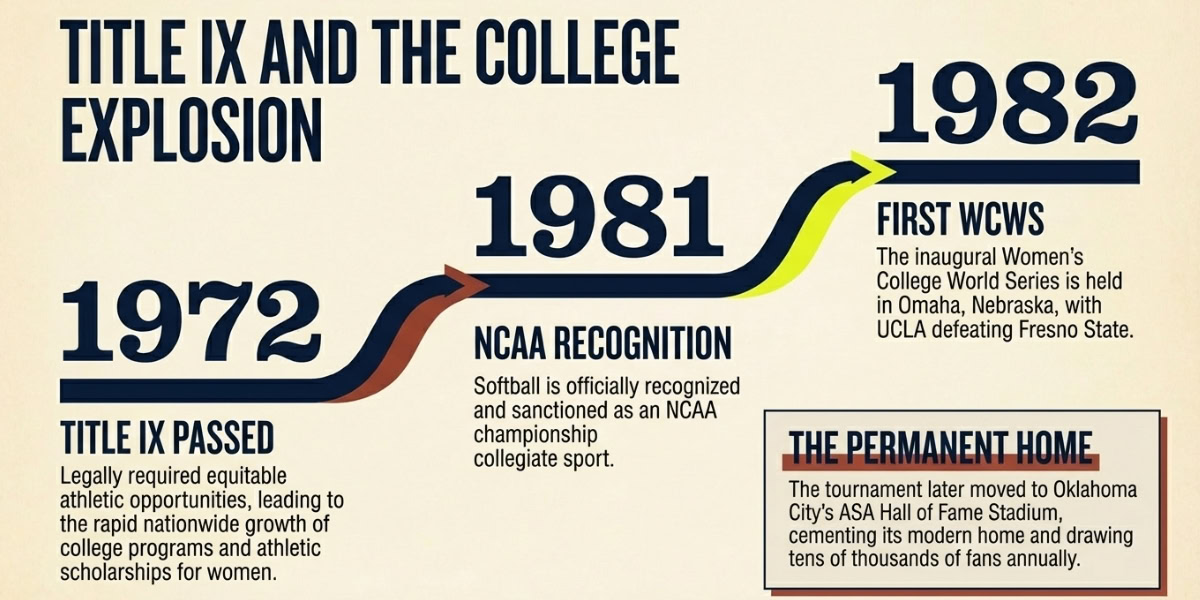
In 1981, the NCAA officially recognized softball as a championship sport. The first Women’s College World Series was held in 1982 in Omaha, Nebraska, with UCLA defeating Fresno State in the inaugural final. The tournament moved to Oklahoma City’s ASA Hall of Fame Stadium, where it has been held ever since, drawing tens of thousands of fans annually.
Women's fastpitch grew from a Depression-era community sport into a college institution through genuine athletic appeal, the structural change of Title IX, and the competitive tradition built by sponsored teams in the 1940s–60s. That foundation is what makes today's Women's College World Series one of the most-watched events in college sports.
History of Softball in the Olympics
The Long Road to Atlanta
Efforts to include softball in the Summer Olympics began in the 1940s. Progress was slow and interrupted across several decades before the sport was formally added to the 1996 Atlanta Games — its first Olympic appearance.
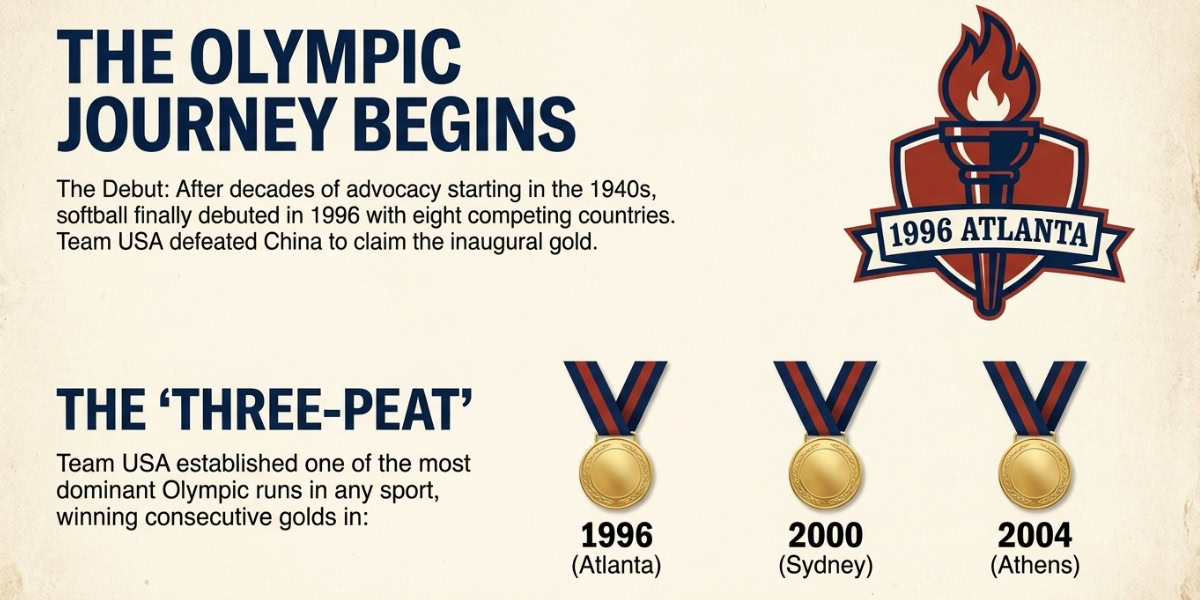
Eight countries competed in that inaugural tournament. The United States won gold, defeating China in the final. Team USA would go on to defend that gold in Sydney 2000 and Athens 2004, establishing one of the most dominant Olympic runs in any sport.

Team USA winning a Gold Medal in the 1996 Olympics (FloSoftball)
The 2028 Olympics is officially hosted by Los Angeles — but the softball games will actually be played in Oklahoma City, 1,243 miles away, at the USA Softball Hall of Fame Stadium. OKC was chosen because it already hosts the Women's College World Series every year.
Dropped, Then Returned
The IOC voted to remove softball (and baseball) from the Olympic program after the 2008 Beijing Games, where Japan ended Team USA’s gold medal streak with a 3–1 victory. The decision was controversial — softball had consistently delivered strong viewership numbers and international participation.
After a 12-year absence from the 2012 London and 2016 Rio Games, softball returned for the 2020 Tokyo Olympics (held in 2021 due to the COVID-19 pandemic). Japan won gold on home soil.
Softball will return to the Olympics at the 2028 Los Angeles Games, giving the sport another platform to build its international profile.
Olympic Softball Medal Summary
| Year & Host | 🥇 Gold | 🥈 Silver | 🥉 Bronze |
|---|---|---|---|
| 1996 — Atlanta | USA | China | Australia |
| 2000 — Sydney | USA | Japan | Australia |
| 2004 — Athens | USA | Australia | Japan |
| 2008 — Beijing | Japan | USA | Australia |
| 2020 — Tokyo | Japan | USA | Canada |
| 2028 — Los Angeles | Upcoming — softball confirmed to return | ||
Softball's Olympic history has been defined by the USA–Japan rivalry and persistent advocacy to keep the sport on the global stage. Its confirmed return for the 2028 Los Angeles Games gives the next generation of fastpitch players their most visible competitive moment yet.
History of College Softball and the Women’s College World Series
College softball has grown from a handful of scholarship programs in the early 1970s into one of the most competitive landscapes in NCAA athletics. There are now over 1,600 college softball programs nationwide, competing at the Division I, II, and III levels.
The WCWS format features 64 teams entering regional play, with eight regional champions advancing to Oklahoma City for the final double-elimination rounds. The two survivors meet in a best-of-three championship series.
Most Successful Programs in WCWS History
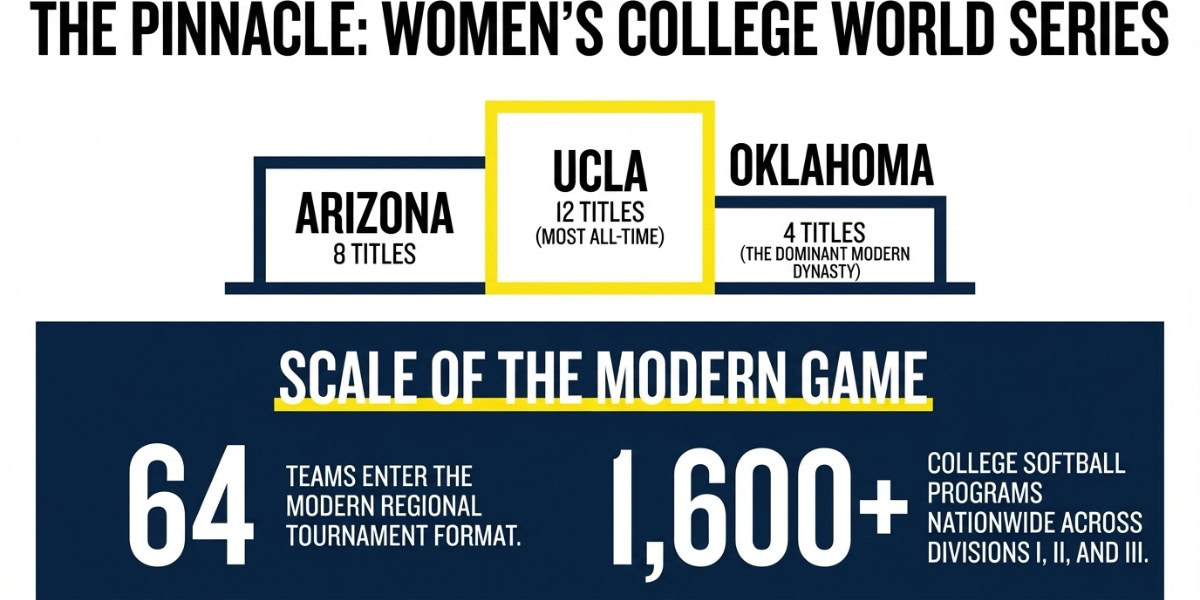
The modern era of college softball — marked by elite pitching, improved bat technology, and nationally televised games — bears almost no resemblance to the recreational origins of the sport. It is a precision-driven, athletically demanding game that produces some of the most gifted athletes in American sports.
Softball’s Global Reach
Where the Game Took Hold
As international tournaments gave the sport structure, softball spread well beyond North America. The International Softball Federation (ISF) was founded in 1952 and currently has 124 member federations. Its functions were later consolidated into the World Baseball Softball Confederation (WBSC), formed in 2013, which now governs the sport in more than 110 countries.
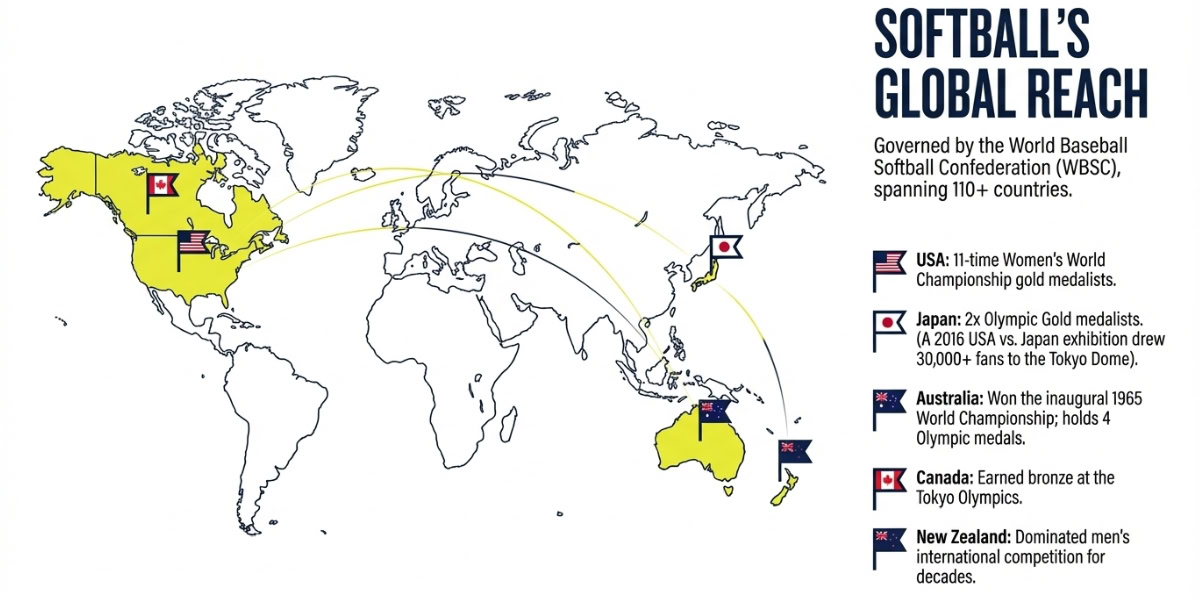
The first Women’s Softball World Championship was held in Melbourne, Australia, in 1965. Australia won the inaugural title, with the United States finishing as runners-up. The United States has since become the most decorated country in Women’s World Championship history, with 11 gold medals.
Countries where fastpitch has the deepest competitive roots:
- Japan — Olympic gold medalists in 2008 and 2020; the 2016 exhibition game between the USA and Japan in the Tokyo Dome drew over 30,000 spectators.
- Australia — Four Olympic medals; consistently among the top three international programs.
- Canada — Growing program that earned bronze at the Tokyo Olympics.
- New Zealand – Dominated men’s international competition for decades.
Frequently Asked Questions About Softball History
Softball was invented on Thanksgiving Day, November 1887, at the Farragut Boat Club in Chicago, Illinois. The game started spontaneously when a Yale alumnus threw a rolled-up boxing glove and a Harvard supporter batted it back with a broom handle. Reporter George Hancock called "Play ball!" — and the sport was born. The first game ended 41–40.
George Hancock, a reporter for the Chicago Board of Trade, is widely credited as softball's inventor. After the improvised first game, Hancock formalized the sport — designing proper equipment, writing the first rule set, and organizing the first league at the Farragut Boat Club in 1889.
The name "softball" dates from 1926, coined by Walter Hakanson at the National Recreation Congress. It refers to the original ball used in the indoor game — a larger, softer, squishier sphere designed for confined spaces. Over the decades the ball hardened significantly, but the name stuck. Today's regulation softball has a harder shell than a baseball and has had one for over 90 years.
Women's fastpitch softball was added to the Summer Olympics for the 1996 Atlanta Games — after decades of advocacy dating back to the 1940s. It appeared at four consecutive Olympics (1996, 2000, 2004, 2008) before being dropped. The sport returned for the 2020 Tokyo Olympics and is confirmed for the 2028 Los Angeles Games, where competition will be held in Oklahoma City.
Fastpitch uses a full windmill delivery at speeds up to 79 mph, allows base stealing and bunting, and is the format used at the high school, college, and Olympic levels. Slowpitch uses an arching lob delivery, bans stealing, and is primarily recreational. If you're playing competitive softball at any organized level, you're playing fastpitch.
More than 40 million Americans play softball each summer, making it the most-played team sport in the United States. Globally, the sport is governed by the World Baseball Softball Confederation (WBSC) and is played in over 110 countries. The International Softball Federation has 124 member federations.
Softball in the Modern Day: More Than 130 Years Strong
Softball has traveled a long distance from that improvised Thanksgiving game. Today, over 40 million Americans play softball in some form, and the sport connects players across age groups, skill levels, and countries.
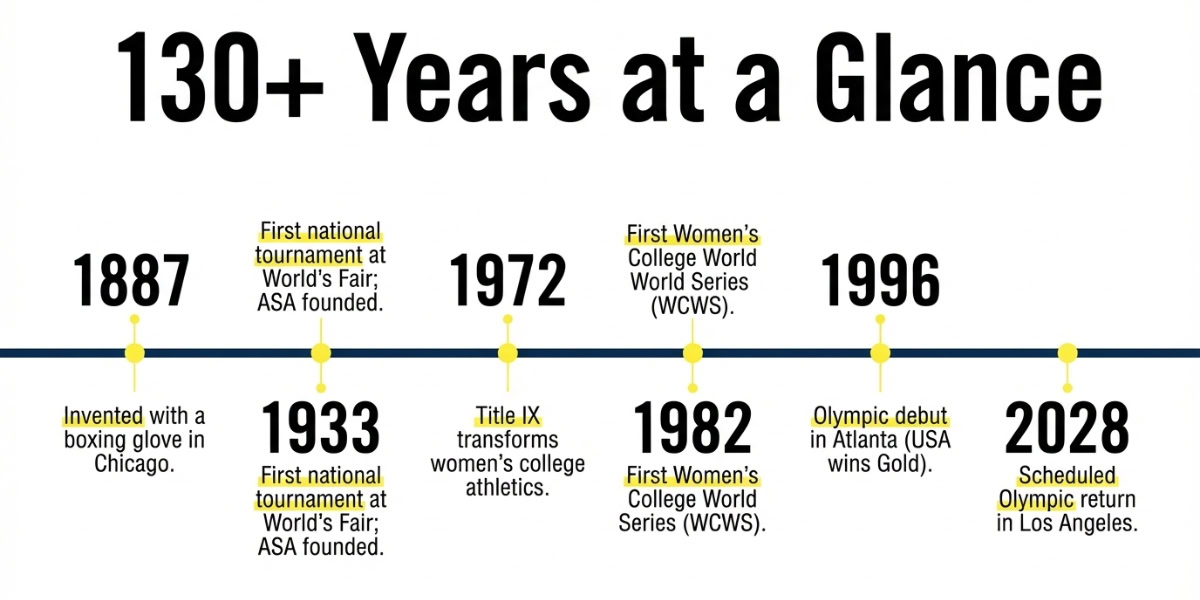
For competitive fastpitch players — the high school athletes grinding through travel ball seasons, the college-bound pitchers refining their mechanics, the coaches building lineups — the sport’s history is worth understanding. Every piece of equipment you use, every rule you play by, and every tournament format you compete in was shaped by decades of players and administrators who built this game deliberately.
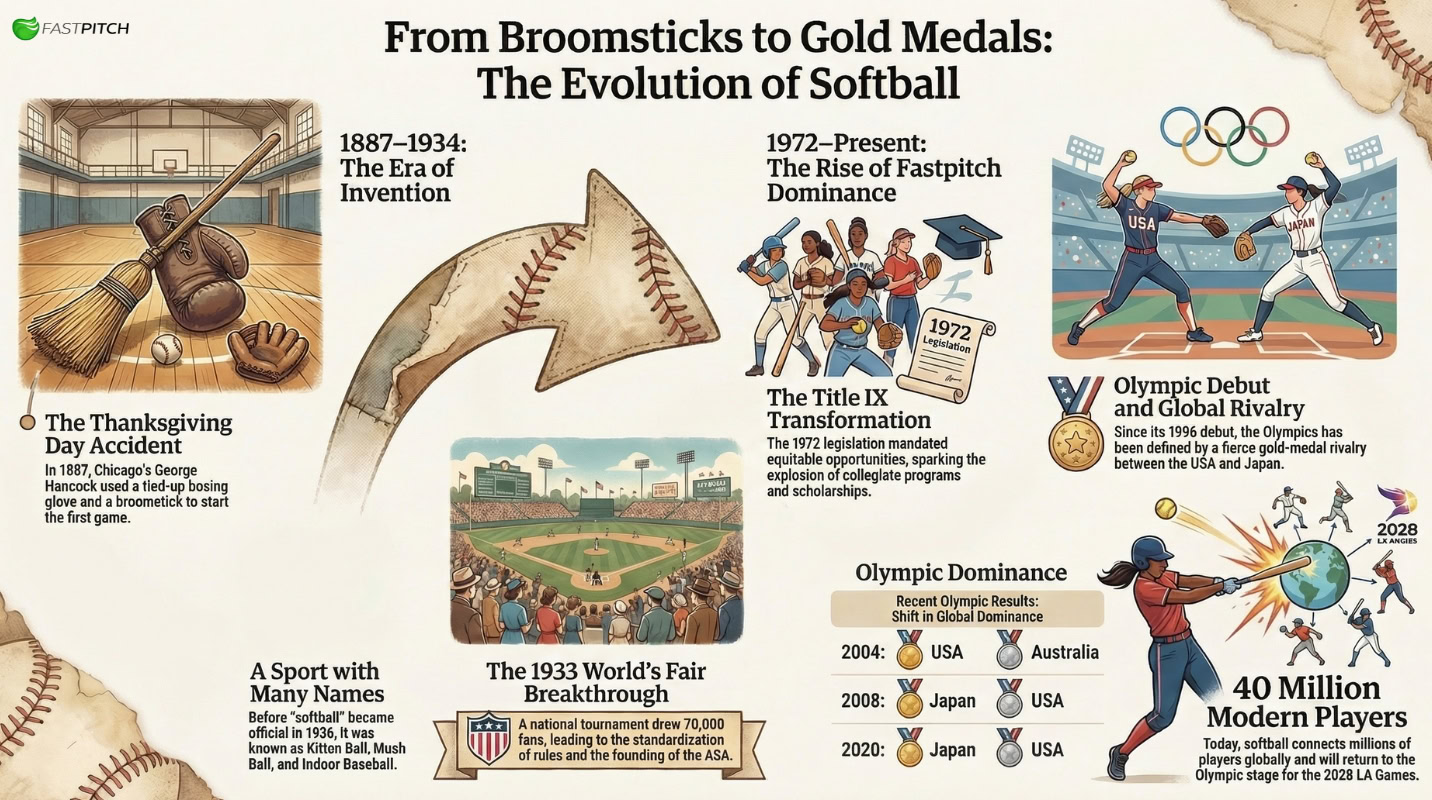
The sport is still evolving. Equipment technology, elite pitching development, and the continued push for Olympic inclusion are all part of an ongoing story that started with a boxing glove bouncing across a gym floor in 1887.
📅 Softball History Timeline at a Glance
Sources: USA Softball, Britannica, NFCA, Library of Congress, Wikipedia (Fastpitch Softball), The New Republic
Want to get the most out of today's game? Whether you're choosing your first composite bat or looking for the right catcher's gear, AllAboutFastpitch has the equipment guidance to help serious players make informed decisions.