You’ve put in the reps. You know your mechanics. Your swing feels right in practice, your footwork is dialed in, and you can make the play in drills without thinking twice.
So why does it sometimes fall apart the moment the game actually matters?
Here’s the honest answer: most players train their body consistently and leave their mind almost entirely to chance. They show up to the mental side of the game unprepared — and then wonder why pressure situations feel different from practice.
The players who perform consistently at the high school and travel ball level aren’t just physically better. They’ve put deliberate work into the mental side of their game. And the good news is that mental skills are trainable — the same way bat speed and footwork are trainable.
This post breaks down the specific mental skills that make the difference at the competitive level, and exactly how to start building them.
Why the Mental Game Is Not Optional at This Level
The Gap Between Practice Performance and Game Performance
Every serious player has felt it — the version of yourself that shows up in practice and the version that shows up when the score matters. That gap isn’t a talent problem. It’s a preparation problem.
In practice, the stakes are low. Your brain is relaxed, your mechanics run on autopilot, and you’re free to just play. The moment real pressure enters — a close game, a critical at-bat, an error in the field — that relaxed state disappears. And if you haven’t trained your mind to handle that shift, your performance will reflect it.
The players who close that gap aren’t the ones who try harder when it counts. They’re the ones who have practiced the mental side of competition with the same structure they bring to the physical side.
What Preparation Actually Builds

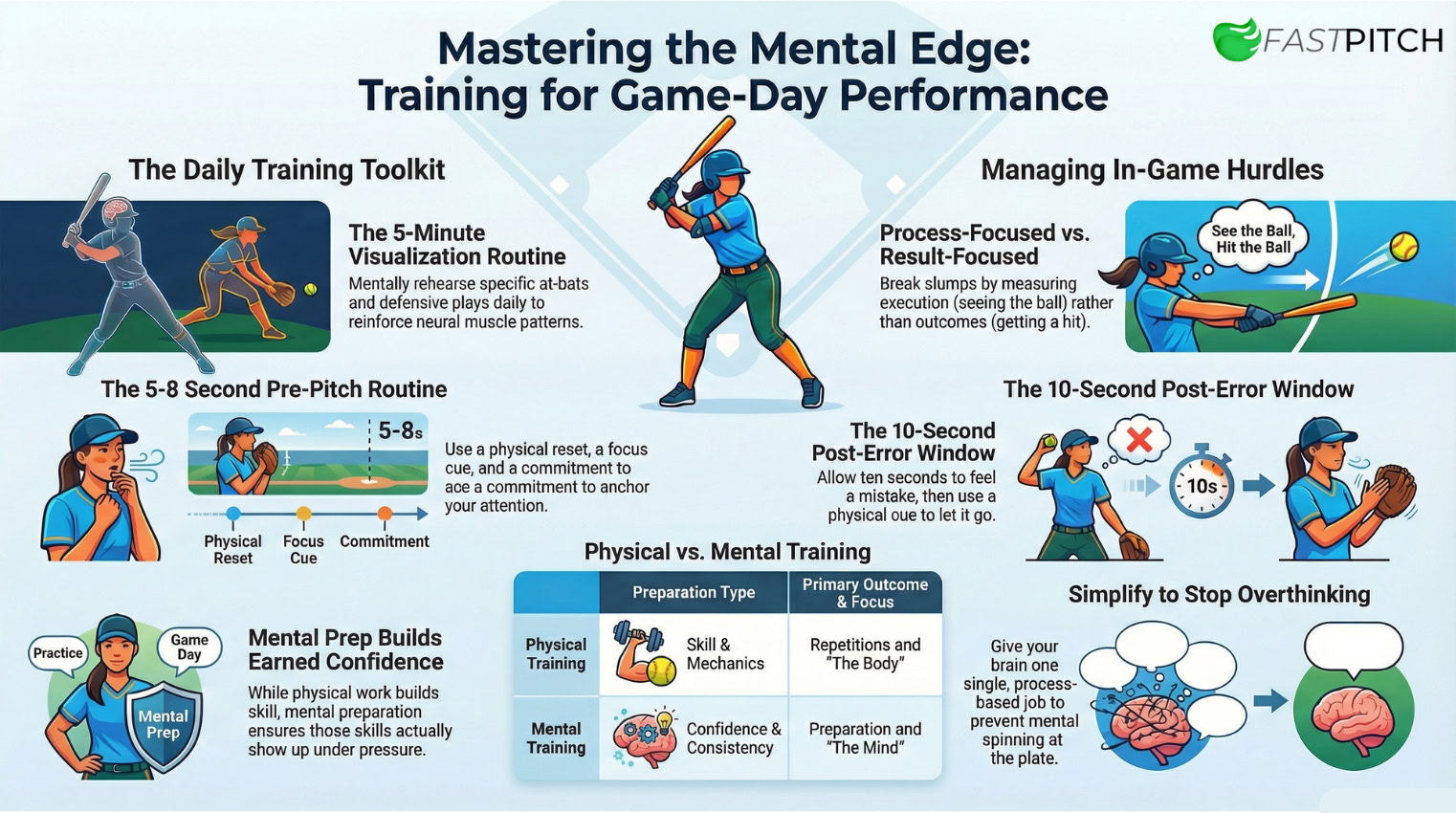
Physical preparation builds skill. Mental preparation builds confidence — and confidence is what allows your skills to actually show up under pressure.
When you’ve done the work, when you’ve prepared your mind as deliberately as your body, you stop hoping things go well and start expecting them to. That’s not arrogance. That’s what earned confidence actually feels like. It’s quiet, grounded, and remarkably durable when the game gets hard.
Visualization — What It Is and How to Actually Use It
Why It Works
Your brain processes a clearly visualized action almost the same way it processes a real one. The same neural pathways fire. The same muscle patterns are reinforced. That’s why visualization isn’t a feel-good exercise — it’s a legitimate training tool that competitive athletes across every sport use as part of their daily preparation.
The key word is clearly. A vague mental image of “doing well” accomplishes nothing. The kind of visualization that actually moves the needle is specific, detailed, and repeated consistently.
How to Build a Visualization Routine
Before games, spend five focused minutes running through your at-bats in your mind. See the pitcher’s release point. Feel your load and timing. Watch the ball make contact with the barrel. Hear the sound. Feel the follow-through.
Don’t just visualize success — visualize the process of performing well. A great swing on a tough pitch. A clean throw after fielding a tough hop. The more specific and process-focused your visualization, the more useful it becomes.
Do this before every game, not just the big ones. The players who benefit most from visualization are the ones who make it a non-negotiable part of their routine — not something they try once before a tournament.

Slumps Are Mental — Here’s How to Get Out of One
What a Slump Actually Is
A hitting slump is almost never a mechanical problem. It usually starts with one bad game or one frustrating at-bat — and then something shifts mentally. You start thinking about results instead of process. You start pressing, trying to force something that used to happen naturally. And the harder you press, the worse it gets.
The mechanics didn’t change. The mindset did.
Understanding this matters, because it changes how you respond. If a slump were mechanical, the fix would be in the cage. But if it’s mental — and it usually is — then grinding out extra swings without addressing the mindset often makes things worse, not better.
The Process-Focused Mindset That Breaks the Cycle
The way out of a slump is to stop measuring yourself by results and start measuring yourself by execution.
Instead of “I need to get a hit,” the focus becomes: “I need to see the ball early, stay back, and make a quality decision.” That’s something you can control on every single pitch — regardless of the outcome.
When you shift your focus from outcome to process, two things happen. First, the pressure drops immediately, because you’re no longer holding yourself responsible for something you can’t fully control. Second, your mechanics naturally clean up, because you’re thinking about the right things at the right time.
Set a simple, process-based goal for each at-bat. Execute it. Evaluate it. Move on.
Building a Pre-Pitch Routine That Holds Up Under Pressure
What a Pre-Pitch Routine Should Include
A pre-pitch routine is a short, consistent sequence of actions and thoughts you run through before every pitch. Its purpose is simple: it brings your focus back to the present moment and prevents your brain from wandering into outcome thinking, scoreboard awareness, or what happened two at-bats ago.
A solid routine typically includes:
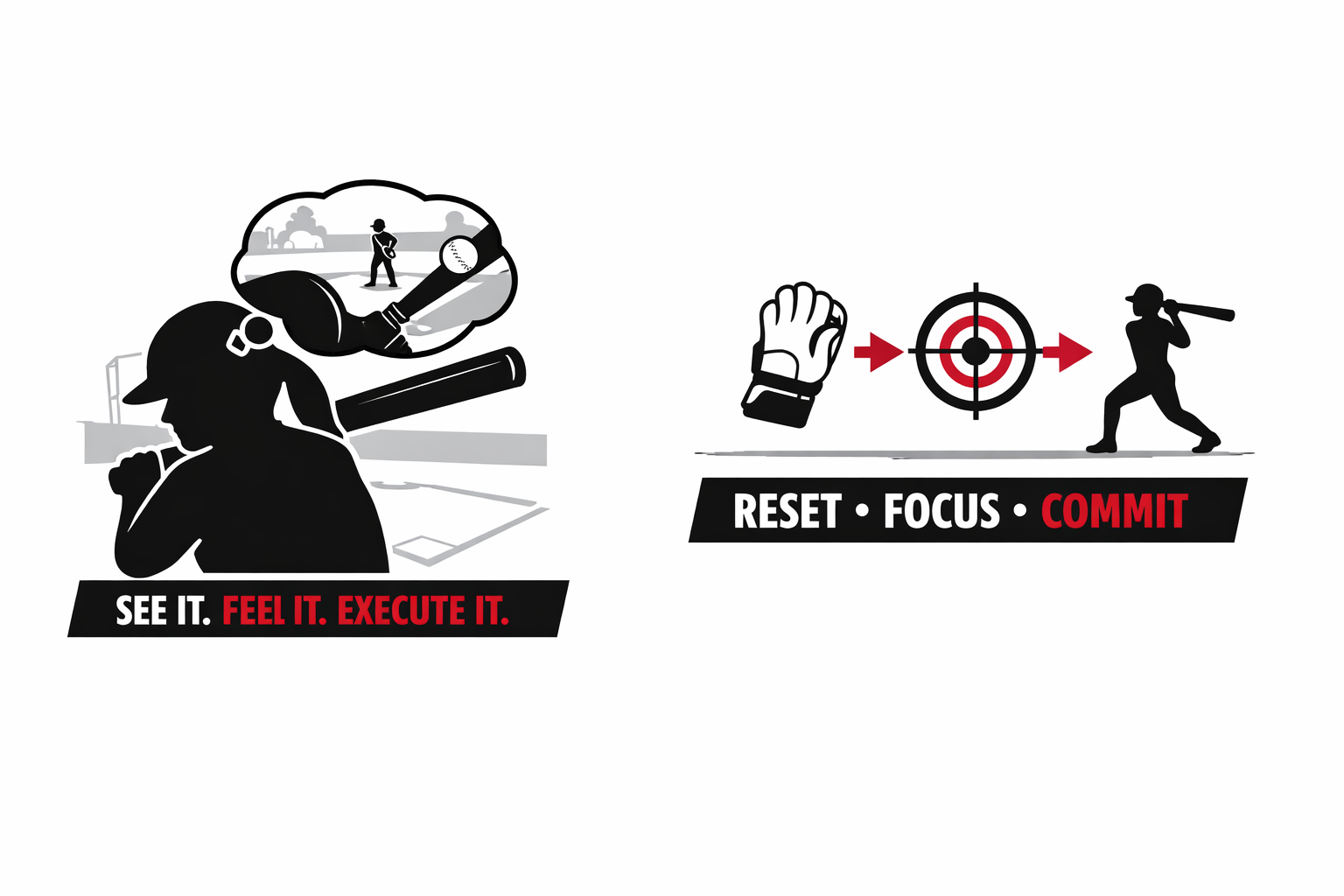
- A physical reset — stepping out of the box, adjusting your batting gloves, taking one controlled breath
- A focus cue — a single, simple phrase or thought that anchors your attention (“see it early,” “stay through the ball,” “trust your hands”)
- A commitment — stepping back in with a clear intention for the next pitch
The whole thing takes five to eight seconds. That’s enough to clear your mind and reset your competitive state between every pitch.
The Process-Focused Mindset That Breaks the Cycle
The way out of a slump is to stop measuring yourself by results and start measuring yourself by execution.
Instead of “I need to get a hit,” the focus becomes: “I need to see the ball early, stay back, and make a quality decision.” That’s something you can control on every single pitch — regardless of the outcome.
When you shift your focus from outcome to process, two things happen. First, the pressure drops immediately, because you’re no longer holding yourself responsible for something you can’t fully control. Second, your mechanics naturally clean up, because you’re thinking about the right things at the right time.
Set a simple, process-based goal for each at-bat. Execute it. Evaluate it. Move on.
Why Consistency in Your Routine Creates Freedom
This sounds counterintuitive, but a routine doesn’t restrict your performance — it frees it.
When your pre-pitch sequence is automatic, your brain doesn’t have to work to find focus before each pitch. It’s already there. You’ve created a reliable on-ramp back to your best competitive state, and you can access it in the third inning of a blowout or the bottom of the seventh with the game on the line.
The routine only works if you use it every time — not just when you feel like you need it. Build it in practice, so it’s automatic by the time the game matters.
FAQ — Common Mental Game Questions
How Do I Stop Overthinking at the Plate?
Overthinking almost always means you’re focused on too many things at once. The fix is to simplify.
Pick one process-based focus cue before you step in — just one. “Track the ball.” “Stay tall.” “Short to contact.” One clear intention is all your brain needs. When you give it a single, specific job, it stops spinning through everything else.
How Do I Stay Focused After Making an Error?
Give yourself a ten-second window to feel it — then let it go completely. Carrying an error into the next play is a choice, even if it doesn’t feel like one.
Use your between-play routine to reset: take a breath, look at the outfield fence, shake it out physically, and give yourself a specific focus cue for the next play. The players who bounce back fastest aren’t the ones who don’t care — they’re the ones who’ve practiced letting go just as deliberately as they’ve practiced their footwork.
Is the Mental Game Something I Can Train on My Own?
Absolutely. Start with two things: a daily visualization practice (five minutes before bed or before practice) and a pre-pitch routine you use on every single rep in the cage — not just in games.
The mental game is built through repetition, just like physical skills. The players who get good at it are the ones who treat it like training, not an afterthought.
Final Thoughts
The physical side of fastpitch softball gets most of the attention — and it should. Mechanics, bat speed, footwork, arm strength — those things matter enormously.
But at the high school and travel ball level, where the physical gap between players is often razor-thin, the mental game is frequently what decides who performs consistently and who doesn’t.
Visualization, process focus, pre-pitch routines, slump recovery — these aren’t abstract concepts. They’re specific skills you can build, practice, and rely on when the game gets hard.
At AllAboutFastpitch, we cover every side of what it takes to compete seriously — from the equipment you swing to the mindset you bring to the box. The players who put time into both are the ones who show up the same way whether it’s a practice Tuesday or a tournament final.